The Definitive Anorak Jacket History in 11 Photographs: From Greenland to Seoul
Anorak jacket history can be told in eleven photographs. Not described — told. The anorak is one of the few garments whose entire history is photographable — its shape changed so little that each era’s version is recognizable against every other. Each image below is a specific moment the garment stopped at on its way from a Greenlandic survival tool to a structured polyester pullover you buy in Seoul in 2026. Read the photographs in order and the anorak jacket history writes itself.
Chapter 1 — The Word and the Garment
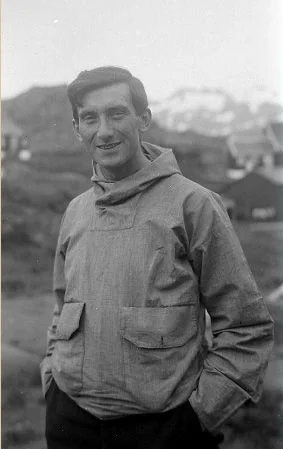
The anorak jacket history begins with a word: annoraaq, Greenlandic Kalaallisut for a hooded, pullover outer garment worn across Inuit territories from Greenland to Arctic Canada. The photograph shows what it looked like on a person, not a mannequin — a garment cut for a working body, not a museum display. No front zip. No front buttons. A sealed pullover with an integral hood, because seams leak and zips let wind in. European polar explorers — most notably Fridtjof Nansen in the 1890s — carried the word and the garment into European languages through their expedition accounts, and by the 1920s “anorak” had entered English. Everything that follows in this anorak jacket history is a variation on what you’re looking at here.
Chapter 2 — The Mountain Takes the Anorak
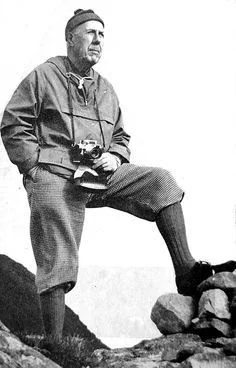
Second chapter of the anorak jacket history: the 1920s. European alpinists took the Inuit silhouette, swapped the sealskin for waxed cotton or tightly-woven gabardine, and carried it up the Eiger and the Matterhorn. The 35mm camera in this man’s hand matters — it’s the technology that made mountaineering photographable, and photographable mountaineering is what put the anorak in magazines. The knee-breeches, the wool socks, the kerchief at the neck are all period pieces. The anorak is the only garment in the frame that will survive unchanged into the 2020s.
Chapter 3 — Army Surplus, Five Dollars and Forty-Five Cents
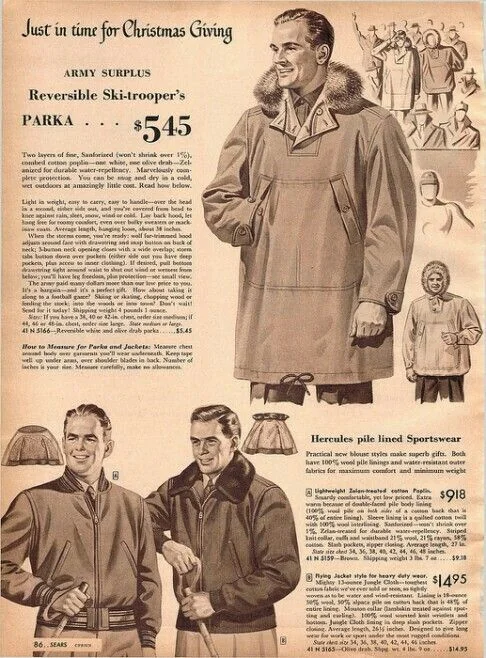
The third chapter of the anorak jacket history runs through two world wars. Both sides issued pullover smocks to alpine, paratroop, and arctic units. The British Parachute Regiment wore the Denison smock — a camouflaged pullover with a half-zip and crotch flap that shaped every paratroop jacket since. The German Gebirgsjäger carried pullover wind smocks up the Caucasus and the Italian Alps. The US 10th Mountain Division trained in Colorado in reversible parkas designed for snow warfare. When the wars ended, the surplus landed in catalogs like this one: reversible cotton poplin ski-trooper’s parka, $5.45, “light in weight, easy to carry, easy to handle.” This is the moment the anorak jumped demographic — from mountaineers and soldiers into the closets of students, anglers, and weekend drivers. An entire generation met the anorak for the first time through a hardware-store catalog page like this.
Chapter 4 — The Alpine Patches
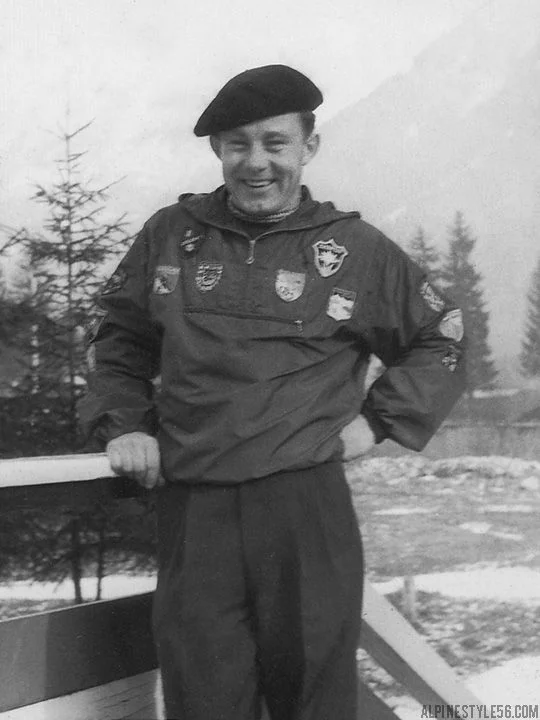
By the 1950s, the anorak had been in continuous civilian use for a generation and had started accumulating what uniforms accumulate: patches. This Alpine instructor’s chest is a résumé — each embroidered badge a resort, a guild, a season of work. The beret completes the look. What you’re seeing is the first moment in the anorak jacket history where the garment carries personal history as well as technical function. The anorak went from “cold-weather shell” to “thing you wear as a sign of who you are.” Every subsequent chapter inherits that double function.
Chapter 5 — Black-and-White Himalayan
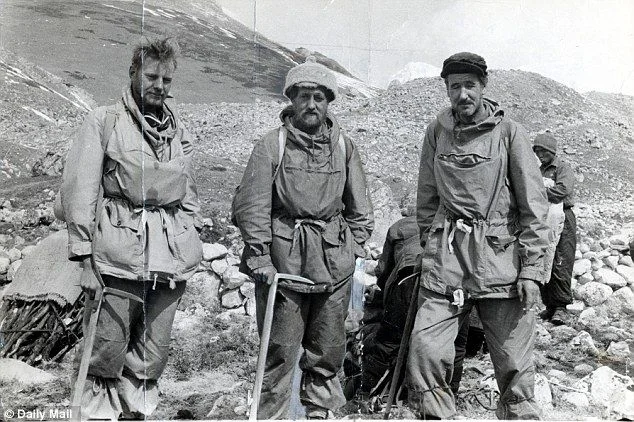
The anorak jacket history needed a high-altitude credential, and the 1950s Himalayan expeditions provided it. By the time Hillary and Tenzing summited Everest in 1953, the canvas pullover anorak was standard issue for expedition members — heavy, layered over wool, hood up against the wind. Newspapers ran photographs exactly like this one. Readers in Manchester and Brooklyn who would never climb a mountain filed away the anorak as the garment that survives the worst of what weather does. That reputation survives the garment’s subsequent drift into casualwear. It’s why you still feel serious wearing one today.
Chapter 6 — The Gentleman’s Anorak
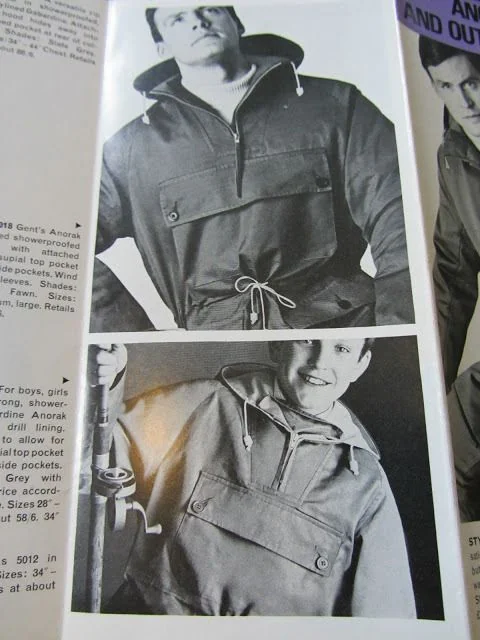
The sixth chapter of the anorak jacket history is British and bourgeois. Mail-order outfitters like Millets and the army-and-navy stores repackaged the military pullover as country wear — “showerproofed cotton drill, bellows pocket, drawstring hood, suitable for fishing and shooting.” The photograph on this catalog page shows a man and a boy, father-and-son energy, the anorak positioned as something you inherit. This is where the anorak started reading as tasteful — not mountaineer’s gear, not army surplus, but a garment a gentleman might own. It’s also where the garment began leaking into the Ivy League closet on the other side of the Atlantic.
The transatlantic transfer happened through catalog shopping and study abroad. American Ivy students brought British outdoor gear back in their luggage. Brooks Brothers and L.L. Bean started adapting the same silhouettes for the American market by the early 1960s. By the time the Japanese Take Ivy team arrived on the Princeton quad in spring 1965, the anorak was already there — a British country garment reprocessed by American Ivy habits, about to be photographed and globalized.
Chapter 7 — Princeton in the Rain
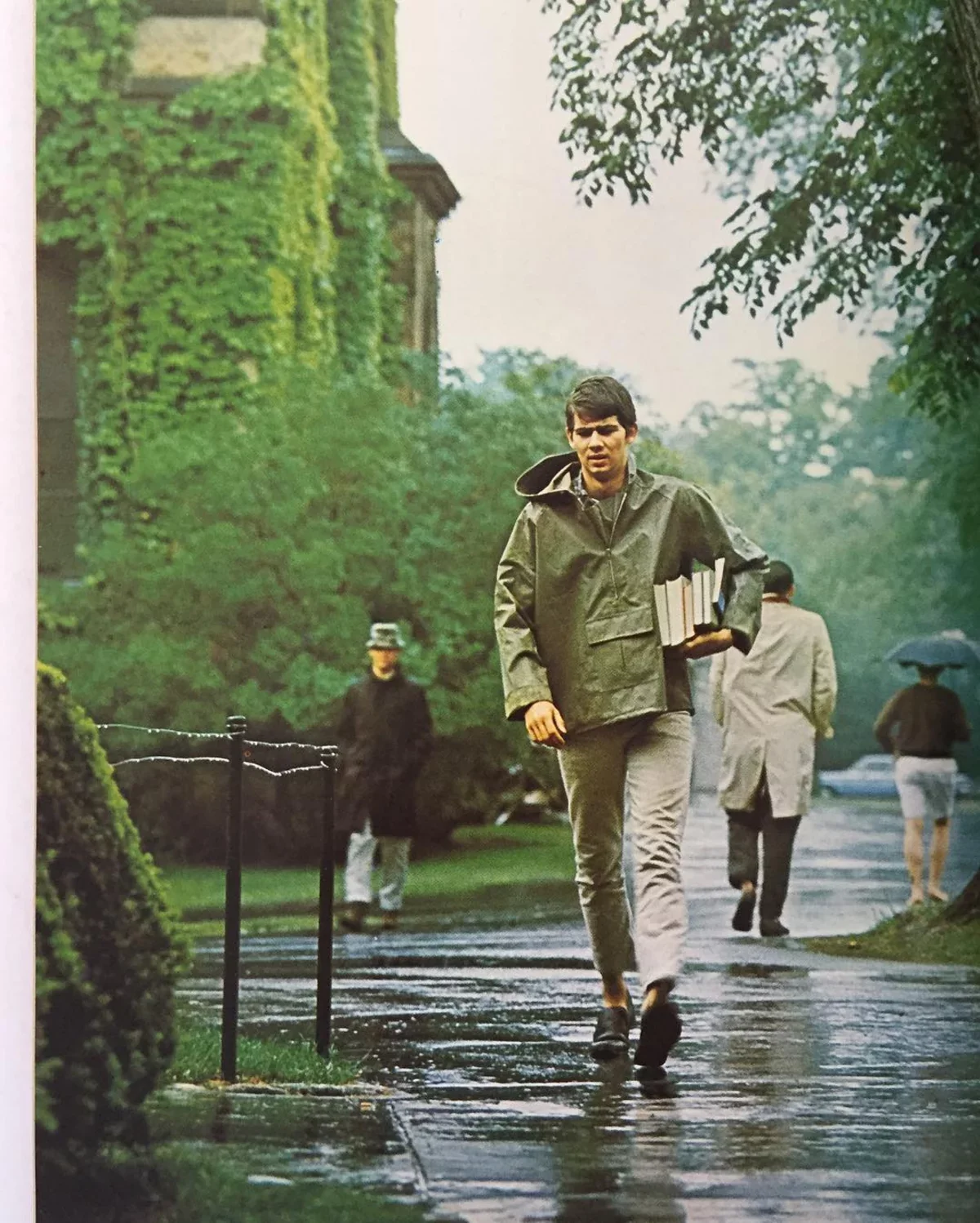
By the mid-1960s, the anorak had crossed from British country wear into the American Ivy League closet. The 1965 Take Ivy photographs — shot by the Japanese team from Men’s Club and VAN Jacket that spring, published that September — documented what the shift looked like on the ground. New England students in pullover outerwear over oxford shirts and khakis, walking across Princeton and Dartmouth quads in weather that made the hood finally useful. Take Ivy did not invent the anorak as prep. It certified it. Until Take Ivy, the anorak was a specialist garment. After Take Ivy, it was vocabulary. Every subsequent anorak — L.L. Bean’s catalog, J.Crew’s bicolor, the Renacts New Trad Anorak Pullover — descends from the wardrobe Take Ivy documented.
Chapter 8 — The Orange Seventies
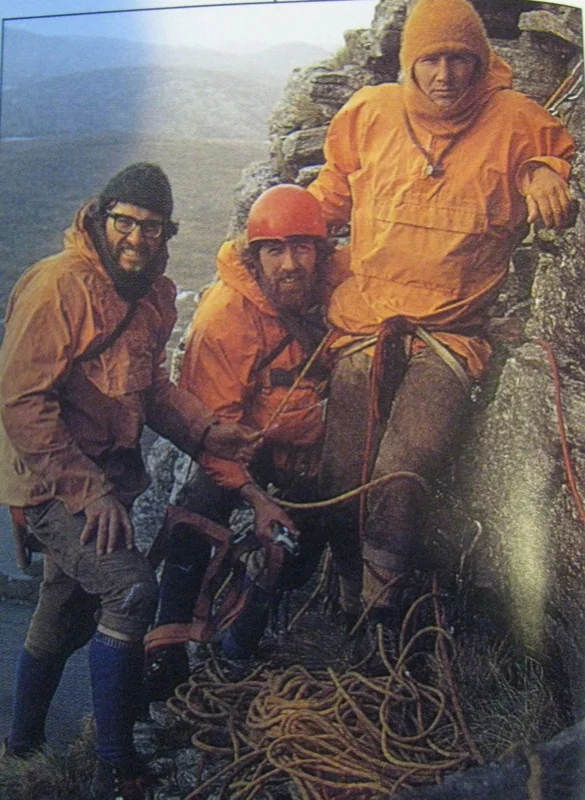
The 1970s pulled the anorak jacket history through a materials revolution. British designer Noel Bibby’s cagoule — a rollable nylon anorak invented at Peter Storm Ltd. in the early 1960s — went mainstream in the 1970s. Brands like Berghaus (founded 1966), Karrimor, and Patagonia (founded 1973) introduced nylon and polyester shells — lighter, more weather-resistant, and dyeable in bright safety colors. The photograph here shows what that looked like in the field: three climbers roped up on a Scottish outcrop, all in Day-Glo orange, hoods cinched against the wind. The silhouette is identical to the 1920s Eiger climber in Chapter 2 — pullover body, integral hood, kangaroo pocket. The fabric is entirely new. This is the chapter where the anorak becomes synthetic, and the stage is set for the commercial explosion of the 1980s and 1990s.
Chapter 9 — The American Americana (1984)
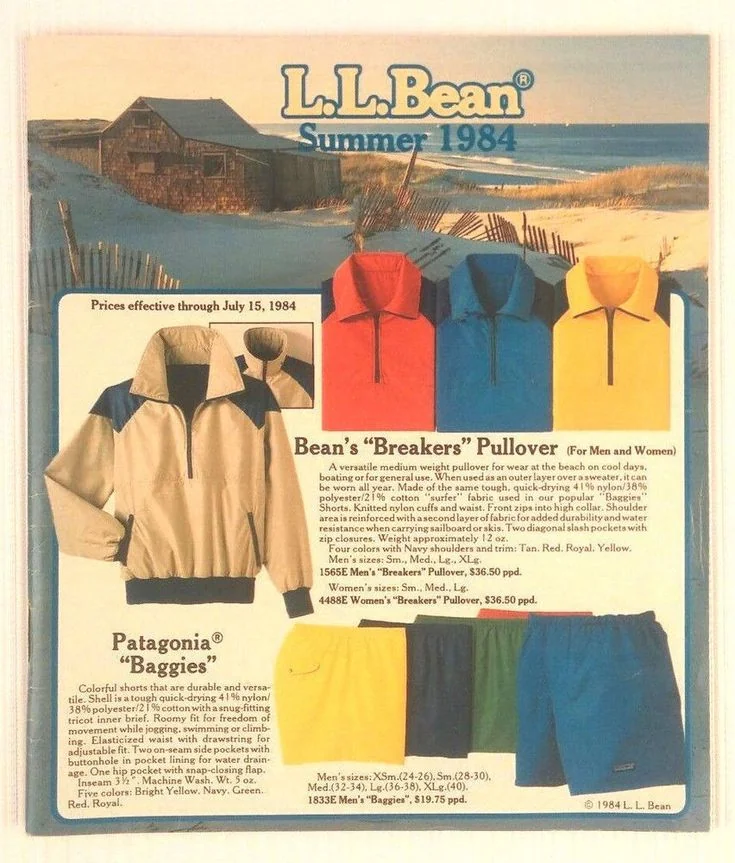
The ninth chapter of the anorak jacket history is a single line of copy buried in a 1984 L.L. Bean catalog: 41% nylon, 38% polyester, 21% cotton. By 1984, the brand most associated with American outdoor tradition had already moved its pullover anorak off pure cotton and into a synthetic blend. The “Breakers” name framed it for beach and boating use. The construction is otherwise identical to a 1965 Princeton anorak — half-zip placket, knit cuffs, color-block chest. But the shell material says the next decade out loud. This page is the quiet pivot point between the cotton poplin era and the full synthetic era.
Chapter 10 — The Technical Peak (late 1980s–1990s)
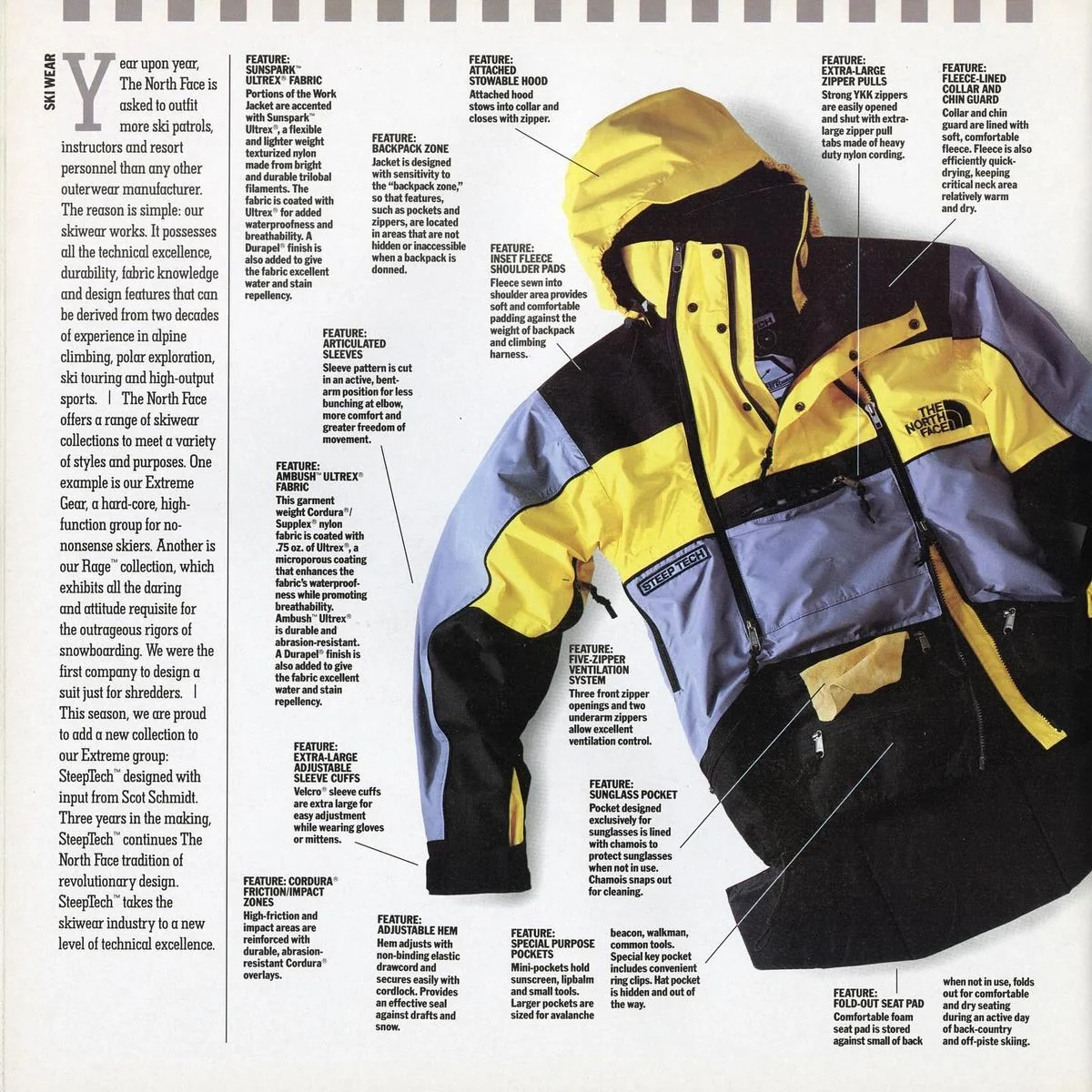
The anorak jacket history briefly splits in two during the late 1980s and 1990s. One branch goes hyper-technical. The North Face Steep Tech, designed with ski-mountaineer Scot Schmidt, kept the pullover-with-hood silhouette and stacked it with engineered features: Cordura friction patches, Velcro-adjustable articulated cuffs, multiple internal vents, a fold-out seat pad. Every detail was photographed and labeled in the catalog — the era’s way of saying this is a piece of equipment, not a garment. But look past the callouts and the silhouette is the same pullover cut you saw in Chapter 2.
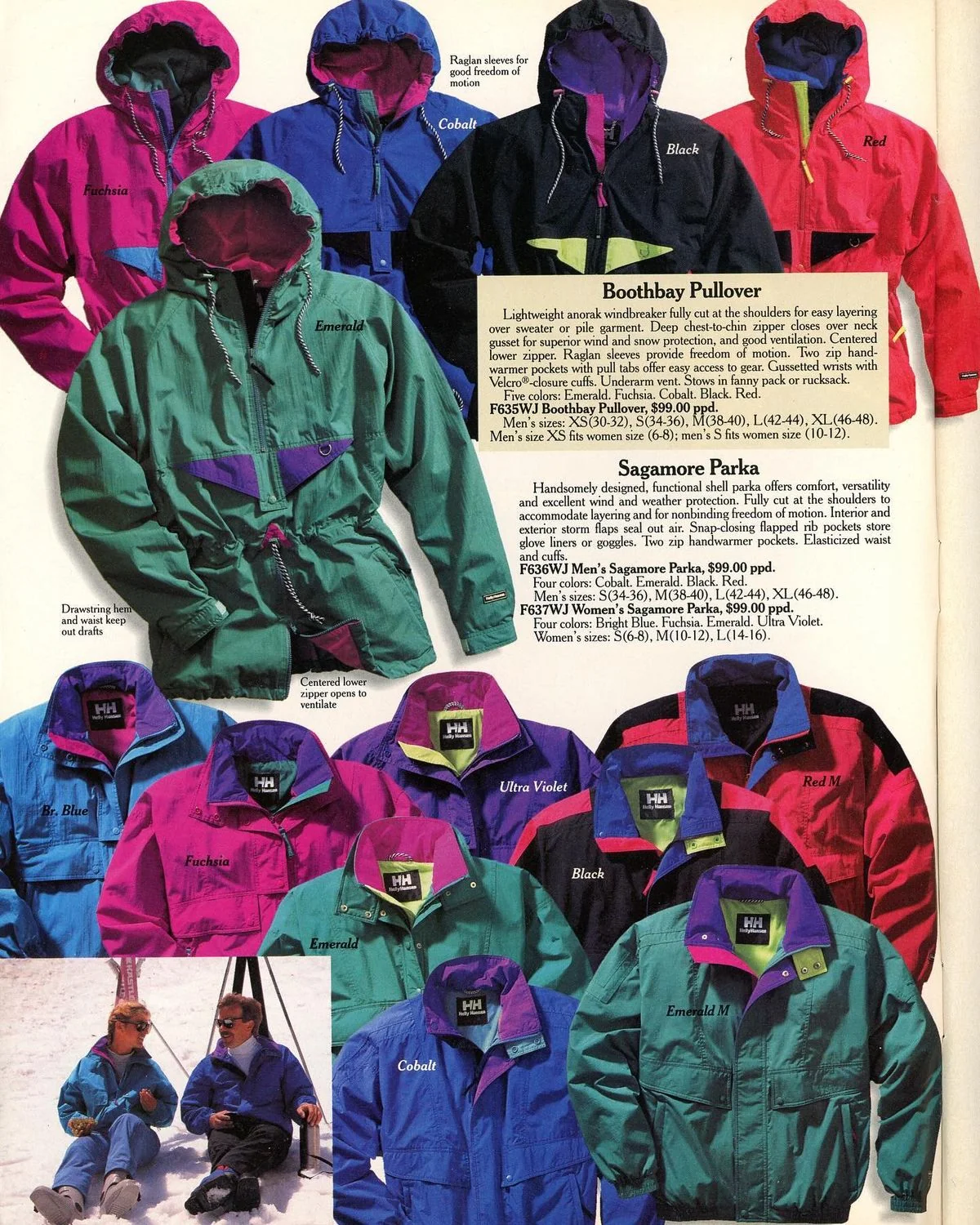
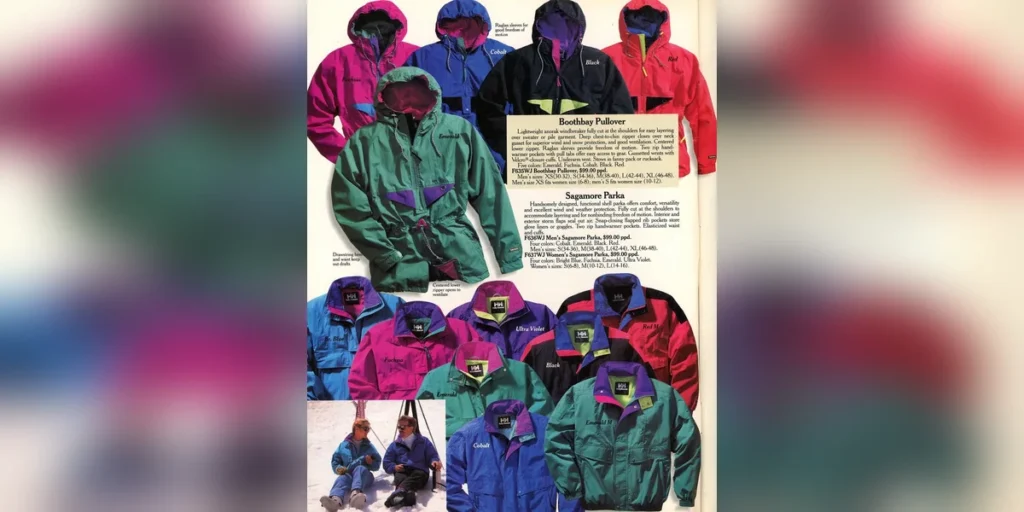
The second branch of the 1990s anorak jacket history ran through catalogs like the Boothbay/Sagemore spread above — lighter nylon shells, brighter commercial color palettes, Gore-Tex as a selling point. Same body, same hood, same kangaroo pocket as the 1970s cagoule three chapters back. By the mid-1990s, a shopper could order a pullover anorak in pink or ultraviolet from a mainstream catalog and wear it to a college campus. The garment had finished its transition from specialist gear to commodity outerwear — without changing its shape.
Chapter 11 — Bicolor, Cotton Poplin
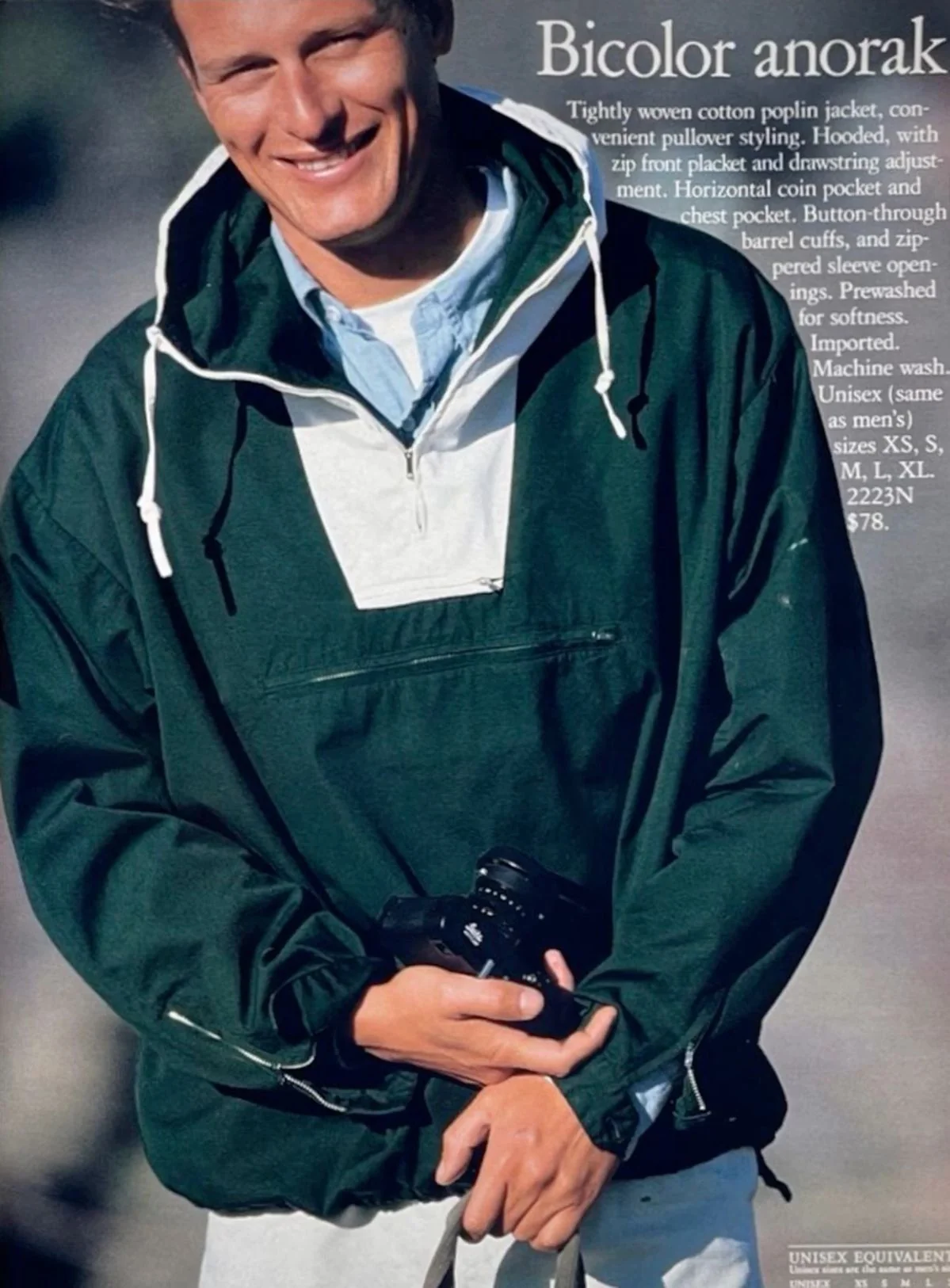
The eleventh and final historical chapter is the 1990s anorak that returned to cotton. While L.L. Bean was pushing synthetic blends and Boothbay was shipping ultraviolet nylon, a preppy-adjacent American outfitter in the 1990s offered a “Bicolor Anorak” — tightly-woven cotton poplin, zip front placket with drawstring hood, horizontal coin pocket, chest pocket, barrel cuffs. Green with a white chest panel. Unisex. Read the caption copy carefully: “convenient pullover styling.” That phrase had to be sold to 1990s American shoppers as a feature. Two decades later it would be the default for an entire Seoul menswear aesthetic. This catalog page is the direct visual ancestor of what Renacts builds now.
The Twelfth Photograph — Seoul, 2026
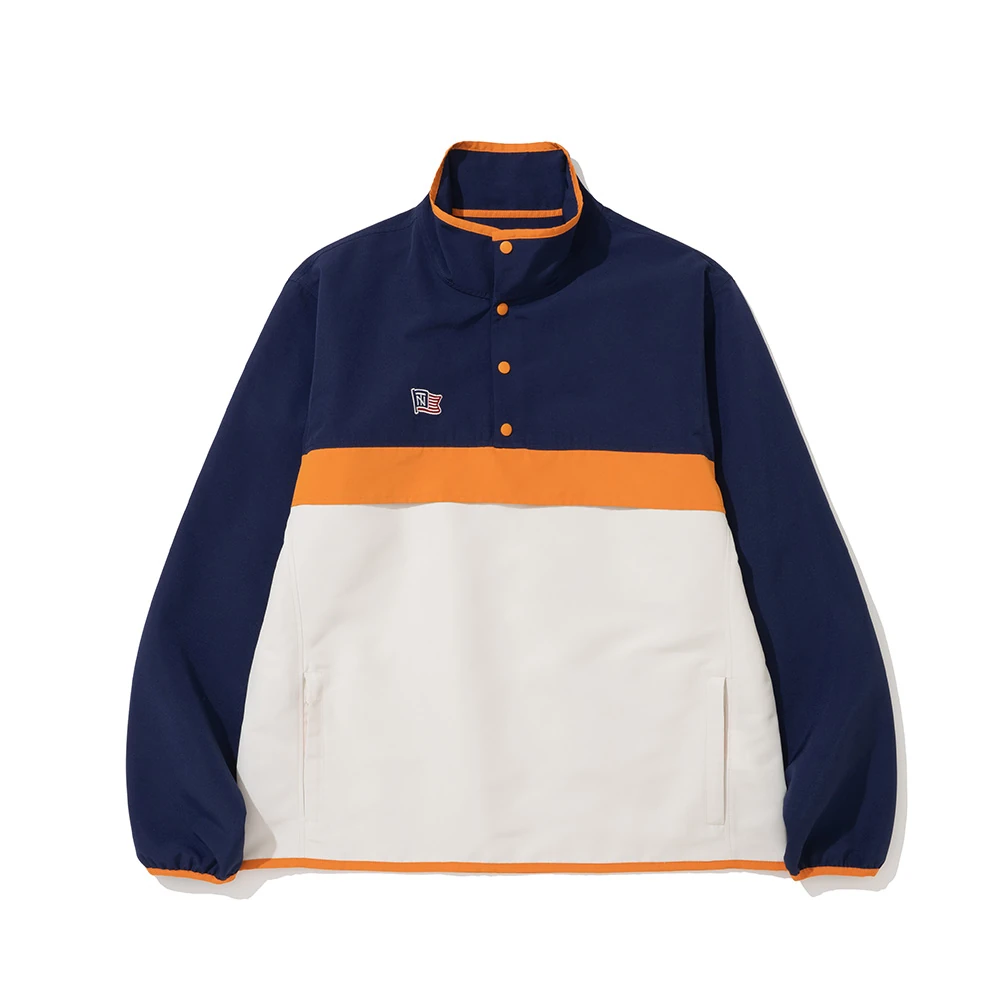
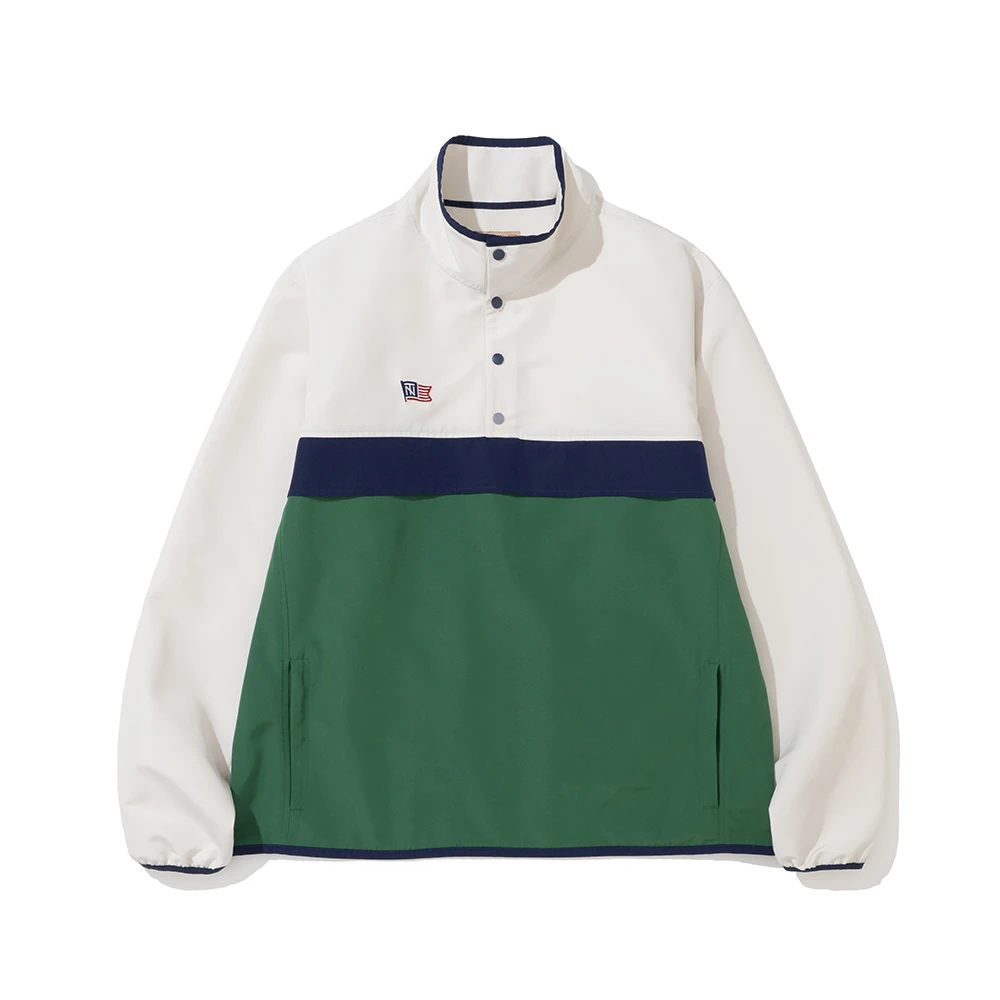
If the anorak jacket history was a book, this would be the epilogue. Seoul, 2026. Between the 1990s American bicolor and the garment in this photograph lies an unphotographed chapter: 1970s and 80s Japan, where illustrator Yasuhiko Kobayashi read the L.L. Bean catalog cover-to-cover and codified “Heavy Duty Ivy” in Men’s Club magazine after a 1972 visit to Freeport. Without that Japanese re-reading, the Renacts New Trad Anorak Pullover would not exist (the full account is in our L.L. Bean history). The Renacts New Trad Anorak Pullover carries the Inuit pullover silhouette, the 1920s climbing hood (now detached), the 1940s surplus color-block, the 1960s British showerproof drawcord, the 1965 Princeton-rain proportions, the 1970s synthetic-shell material choice, and the 1990s American bicolor design language. One garment, over a century of evidence, and a shell fabric — 100% polyester — that updates the 1990s cotton poplin for Seoul’s humid spring.

Why Renacts uses 100% polyester instead of the 1990s cotton poplin is itself a footnote in the anorak jacket history: Seoul springs are wetter and more humid than New England springs, and the polyester shell holds shape and dries faster. A 1990s cotton anorak in Seoul’s April would be damp by lunchtime. The polyester version handles four kinds of weather before dinner. Same silhouette; upgraded material — exactly the kind of incremental translation the anorak has accepted at every previous step of its history.
Reading the Full Anorak Jacket History Backwards
Look at the eleven photographs again in reverse. The 2026 Renacts anorak is almost indistinguishable in silhouette from the 1990s Bicolor, which coexisted with the 1990s Boothbay commercial catalog and the late-80s North Face Steep Tech, which inherited the 1984 L.L. Bean Breakers synthetic-blend shell, which descends from the 1970s Day-Glo cagoule, which copies the 1965 Princeton pullover, which borrows from the 1960s British Gent’s Anorak, which repackages the 1940s surplus, which standardizes the 1950s Alpine and Everest pullovers, which adapt the 1920s climbing anorak, which modernizes the Greenlandic annoraaq. Run the sequence forward and you see continuous evolution. Run it backward and you see a single garment concept that refused to be replaced for more than a century — and, with its Inuit antecedents, for centuries before that.
One final photograph closes the loop.

Why the Anorak Jacket History Still Matters
The anorak jacket history is not a nostalgia tour. It’s a case study in two kinds of survival. First, a silhouette that absorbed new materials — sealskin to waxed cotton to nylon to polyester — without changing shape. Second, a garment that learned to carry personal history — the 1950s Alpine patches, the 1965 Princeton student, the 2026 Seoul editorial — without losing technical function. Every decade on this page ran a small experiment on the anorak, and the garment absorbed the improvements without losing either its shape or that double function. That’s why you can wear the 2026 Renacts anorak with chinos in Seoul and look continuous with a 1965 Princeton student, a 1950s Alpine ski instructor, and a 19th-century Greenlandic hunter. The eleven photographs above are the receipt.
Our own entry in that line is the New Trad Anorak Pullover, cut in navy and in green — a pullover made to go over a shirt rather than under a shell, which is where the garment ended up once the mountain was done with it.