L.L. Bean History: From Maine Hunting Shoe to Heavy Duty Ivy Canon
L.L. Bean history starts in 1912 with a single product — a waterproof hunting boot — and ends up as the template for every American outdoor brand that matters. This is how a one-man mail-order operation in Freeport, Maine became the workwear-meets-prep canon that still shapes how men dress in Seoul a century later.
1912, Freeport, Maine: A Businessman, Not a Cobbler
Leon Leonwood Bean was born in 1872 in Greenwood, Maine. He left school after eighth grade, took commercial courses at Kent’s Hill and Hebron Academy, and spent most of his adult life as a hunter, fisherman, and small-town retailer. Crucially for the L.L. Bean history that follows: he was not a cobbler, a tailor, or any kind of maker. He could not have sewn a boot himself if his life depended on it.
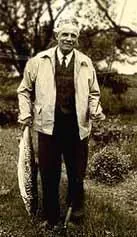
In 1911, tired of coming home with cold, wet feet, he designed a waterproof boot — leather uppers attached to rubber bottoms — and paid a local cobbler to make the first pairs. The boots themselves were sewn by a seamstress named Gertrude Goldrup, whose sewing machine is still on display in the Freeport flagship. This is the first thing to understand about the L.L. Bean history: the founder was an entrepreneur and a product designer, not an artisan. The making was always done by other hands.
In 1912 he bought a list of non-resident Maine hunting license holders, printed a four-page mail-order circular, and set up shop in his brother’s basement in Freeport. With his brother as the town postmaster and the introduction of parcel post that same year, Bean could mail boots anywhere in the country cheaply from a one-man operation. A product, a mailing list, and a postal shortcut — that is the entire L.L. Bean history origin story in one paragraph.
The 90% Refund and a Trip to Boston
The first production run had a catastrophic defect. Ninety percent of the boots came back: the rubber bottoms couldn’t hold the stitching that attached them to the leather uppers. Bean could have folded right there. Instead he did three things in sequence. He honored every refund. He borrowed money. And he went to Boston.
In Boston, Bean worked with the United States Rubber Company to solve the bonding problem between rubber and leather — a manufacturing chemistry issue that required expertise he didn’t possess and infrastructure he couldn’t build. He came back with a version of the Maine Hunting Shoe that would actually survive a hunting trip. That boot, slightly refined, is the Bean Boot still sold in Freeport today.
The pattern set in 1912 defines everything the L.L. Bean history becomes. Ship a product, let customers test it, refund ruthlessly when it fails, partner with someone who knows more than you do to fix the underlying problem. The famous L.L. Bean money-back guarantee — no questions, no time limit — wasn’t marketing. It was the only way a one-man mail-order operation could survive the first batch of its own product.
1917: The Main Street Flagship Over the Post Office
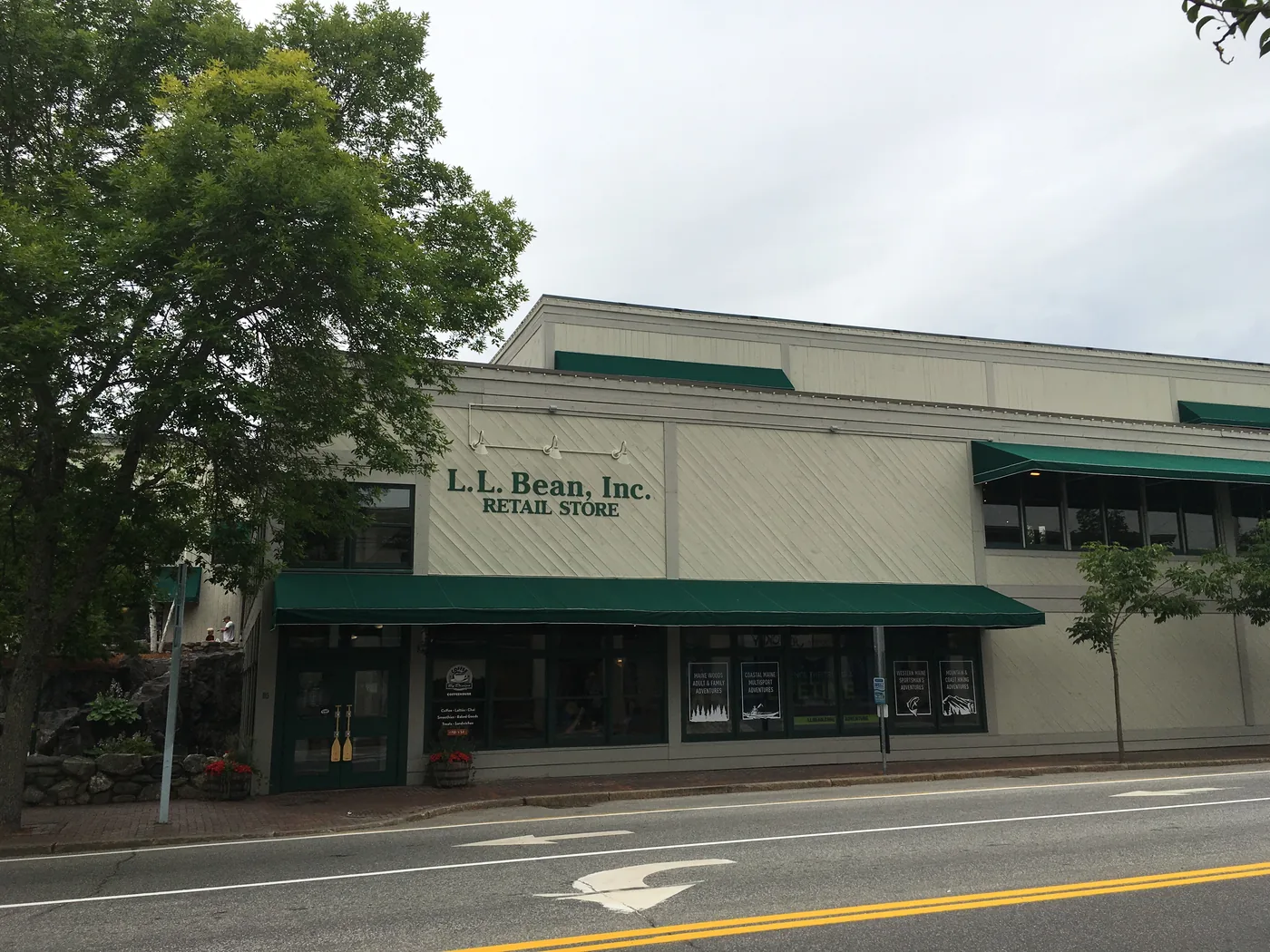
By 1917 — just five years after founding — the Maine Hunting Shoe was selling well enough that Bean built a proper factory and storefront on Main Street in Freeport, constructed directly over the town’s post office. That building is the L.L. Bean flagship today. The geography of the company has not meaningfully changed in over a century.
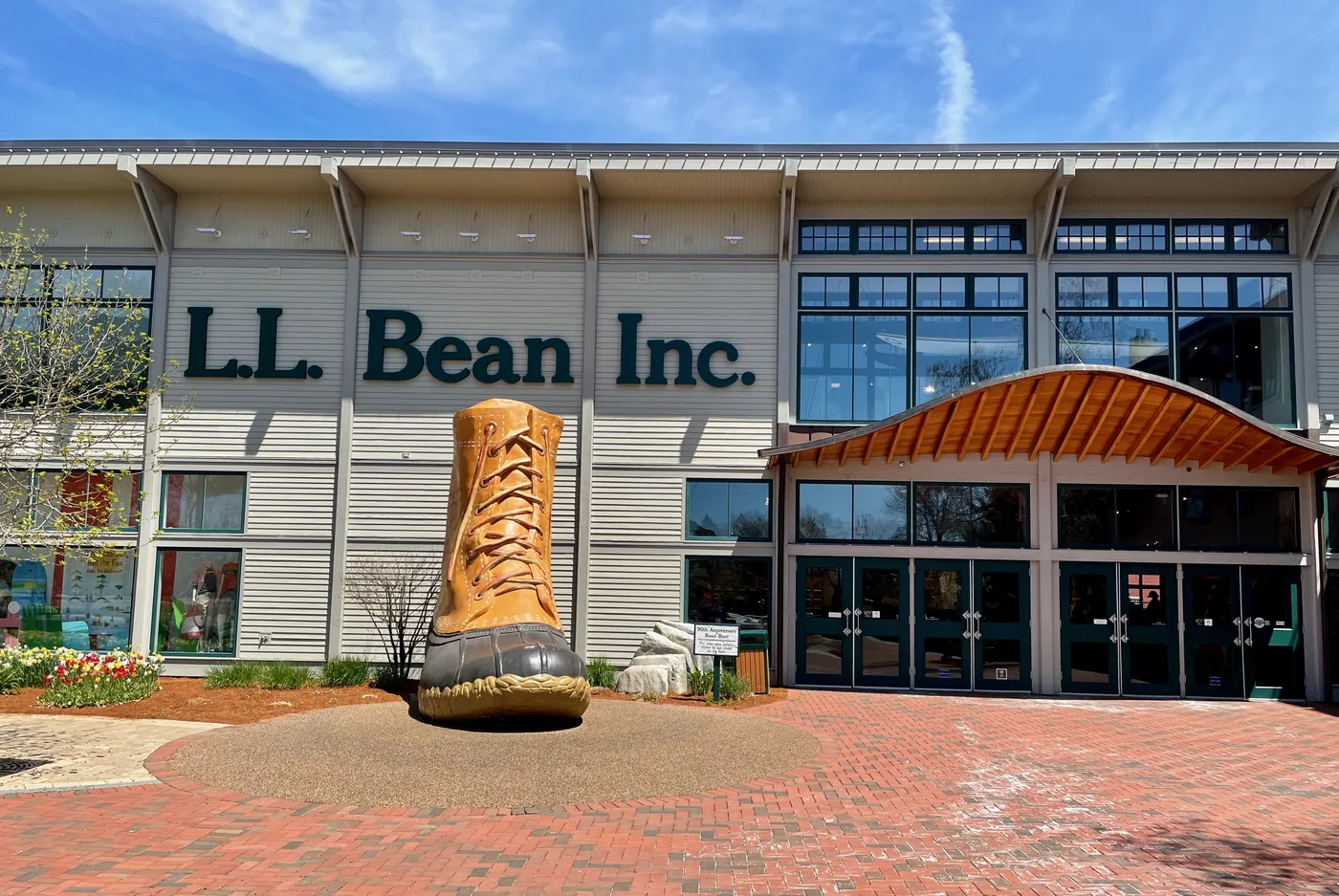
That consistency matters. In the broader arc of American menswear, almost no iconic garment survives unchanged for a hundred years. Brooks Brothers redesigned the OCBD. Levi’s reworked the 501 in the 1970s. L.L. Bean kept the Bean Boot essentially identical. It is the closest thing American outdoor clothing has to a constant — a garment whose design was effectively finished by 1920 and never revisited.
Three Products That Defined the L.L. Bean History
If you reduce the L.L. Bean history to its three most influential products, the whole company snaps into focus. Each of these pieces is still in the catalog today, essentially unchanged from the decade it debuted.
1912 — The Maine Hunting Shoe (Bean Boot). Rubber bottom, leather upper, chain-tread sole, visible double stitching. The product that started the company and remains its clearest signature.
1924 — The Maine Duck Hunting Coat (Field Coat). A tin-cloth hunting jacket designed to be worn with the Bean Boot. Waxed-cotton body, bellows pockets, corduroy collar, action back. The Field Coat is the direct ancestor of every modern hunting-inspired jacket, including the Barbour Bedale, the Filson Tin Cloth, and every reproduction waxed-cotton field coat currently being made in Japan or Korea.
1944 — The Boat and Tote Bag. Designed originally as an ice carrier — 24-ounce cotton canvas, reinforced bottom, cotton webbing handles (leather handle options were introduced in later years). By the 1970s, the Boat and Tote had been repurposed by the prep community as a university bag, a beach bag, and a grocery bag. It is now the most visible prep object in American culture after the OCBD itself.
1921, The Arctic: MacMillan Sends a Letter
Nine years after founding, the L.L. Bean history got the kind of external validation most brands never earn. Admiral Donald MacMillan, one of the most respected polar explorers of the early 20th century, wrote Bean a letter after his 1921 Arctic Expedition: “My men are very enthusiastic over their experience with your foot equipment on our last Arctic Expedition.”
Consider what this means. In 1921, Bean had been in business less than a decade. His first production run had failed spectacularly. His second run was, in the eyes of the customers who received it, still a boot from a small Maine retailer. Nine years in, an Arctic explorer who had lived and died by the quality of his gear formally endorsed the product. That endorsement wasn’t solicited. MacMillan simply wrote the letter.
The MacMillan endorsement did for Bean Boots in the 1920s what the 1960s Ivy adoption would later do for L.L. Bean as a brand. It confirmed, with the authority of an outsider who had nothing to gain, that the boot worked at the edges of what the boot was designed to do. Every subsequent L.L. Bean catalog drafted a version of the same argument: real people in real conditions tested this and it held up.
The Freeport Flagship That Almost Never Closes
In 1951, L.L. Bean made an operational decision that became cultural legend. The Freeport flagship would stop locking its doors. The reasoning was pragmatic — hunters and fishermen heading into the Maine woods before dawn needed gear at 4 AM, and fishermen coming off the water at midnight needed a replacement rod. The store operated 24 hours a day, 365 days a year, from 1951 through today, with a handful of exceptions.
It briefly closed for two Sundays in 1962 when Maine’s blue laws interrupted the policy. It closed to honor the deaths of President Kennedy in 1963, founder L.L. Bean in 1967, and Leon Gorman (the grandson who led the company from 1967 until his death) in 2015. And it closed for several months during the COVID-19 pandemic in 2020 — the first time the flagship had ever closed for more than 24 hours since the policy began.
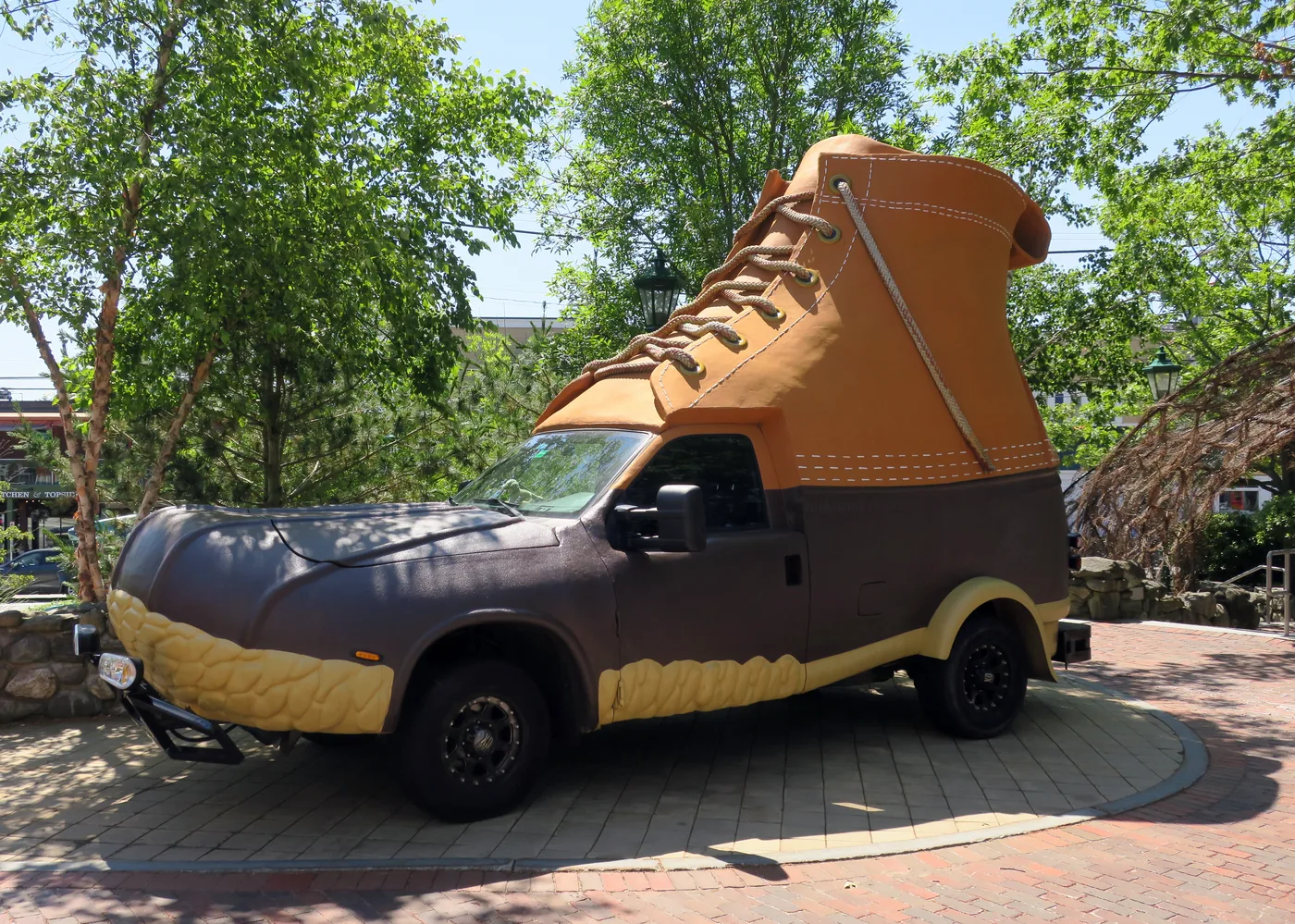
A 24-hour flagship in a town of 8,000 people doesn’t make retail sense. It makes brand sense. For seventy years, the claim that L.L. Bean was there when you needed it — at any hour, returnable at any time — was more valuable than any ad campaign. Freeport became a destination. The entire town’s identity reorganized around the store.
From Hunting Catalog to Ivy Staple
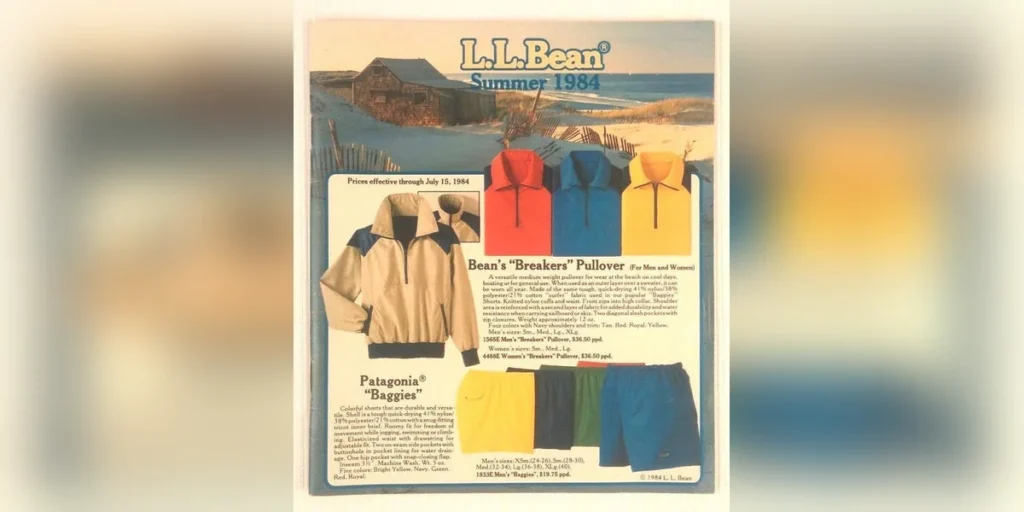
The next chapter of the L.L. Bean history is the one that matters for anyone reading this site. In the 1960s and 1970s, a cohort of Ivy League students discovered the catalog. They weren’t hunting or fishing. They wore Bean Boots with khakis. They bought the Norwegian sweater because it layered well under a blazer. They threw on the pullover cotton anorak — the same silhouette covered in our anorak jacket history — over an OCBD on Saturday mornings in Cambridge and New Haven.
This wasn’t a marketing pivot on L.L. Bean’s part. The company kept selling the same hunting and fishing gear. The customers changed — or more precisely, the customer base widened. The canonical L.L. Bean Ivy kit is easy to describe: Bean Boots or Blucher Mocs, chinos, OCBD, Norwegian sweater or chamois shirt, pullover anorak, Boat and Tote slung over the shoulder. It’s the uniform that shows up in every Take Ivy outtake and in any Ivy League yearbook page from the late 1960s through the mid-1970s.
1972–1976: Kobayashi Goes to Freeport
The Japanese chapter of the L.L. Bean history is where the story turns specific enough to matter for Seoul. In 1972 or 1973, the Japanese illustrator Yasuhiko Kobayashi — who had been documenting Ivy style for Men’s Club magazine for over a decade — traveled to Freeport in person. He spent two full days at L.L. Bean headquarters. He examined every item in the catalog. He took notes on construction, materials, pricing.
In September 1976, Kobayashi published an article in Men’s Club that coined a term: Heavy Duty Ivy. It was a parody concept at first — the idea that a mountain parka, Levi’s 501s, and climbing boots could be combined with an OCBD and call itself Ivy style. The joke landed because it was true. His 1977 Heavy Duty Book formalized the category. L.L. Bean was no longer just an outdoor brand in Japanese eyes; it was the other half of the Ivy paradigm, the durable-function wing that complemented the Brooks Brothers–J.Press tailoring wing.
Kobayashi’s Heavy Duty Ivy didn’t just revive interest in L.L. Bean — it re-classified the brand. The most complete English-language account of how this happened is W. David Marx’s Ametora: How Japan Saved American Style (2015), which traces the line from Kensuke Ishizu’s VAN Jacket in the 1950s through Kobayashi’s Heavy Duty in the 1970s and into the contemporary Japanese menswear industry. If you want to understand why a Seoul Traditional brand in 2026 carries the L.L. Bean DNA at all, that book is the single best primer.
2018: The First Time L.L. Bean Broke Its Own Promise
In February 2018, L.L. Bean did something that the first 106 years of L.L. Bean history would have said was impossible. The company limited its return policy. The old policy — unlimited time, no receipt required, no questions — became one year from purchase, receipt required.
The reason was straightforward and slightly sad. People had started buying L.L. Bean products at yard sales, wearing them for years, and returning them to Freeport for full credit. Others were returning twenty-year-old boots because the soles had finally worn through. The policy that had defined L.L. Bean history since 1912 was being exploited at a scale the original guarantee was never designed to absorb.
The 2018 change matters because it’s the only meaningful break in the L.L. Bean history’s pattern of refusal. For a century, L.L. Bean had refused to redesign the Bean Boot, refused to close the Freeport store, refused to narrow the return guarantee. When something finally gave, it was the piece that had the most direct financial cost. The change was defensible. It was also a signal that the L.L. Bean of 2018 was not the L.L. Bean of 1912, no matter how identical the boot still looked.
The Monument and the Myth
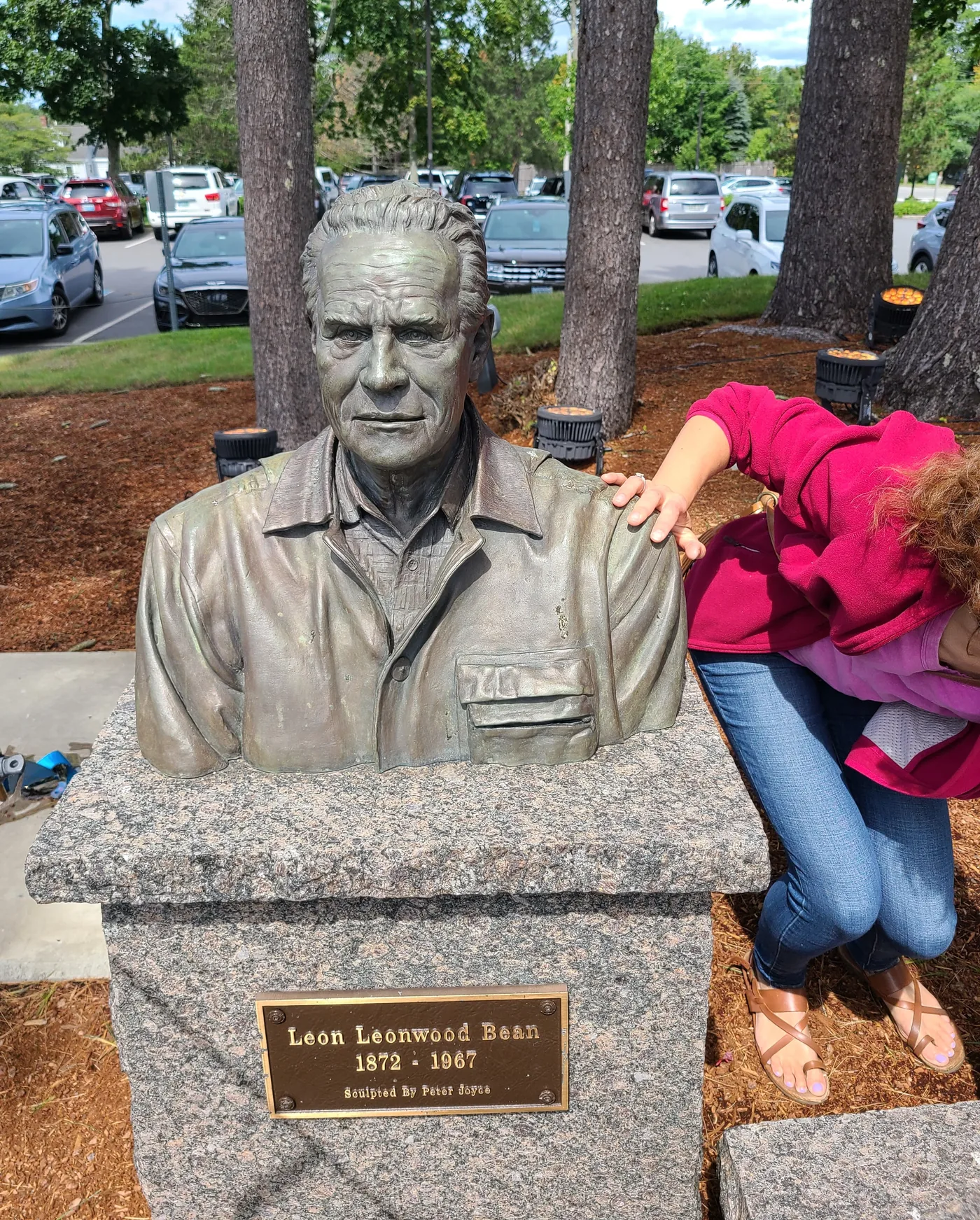
Leon Leonwood Bean died on February 5, 1967 at the age of 94. His grandson, Leon Gorman, took over as president in 1967 and led the company for over three decades before moving to the Chairman role in 2001. The Gorman era is what most people mean when they refer to L.L. Bean’s “classic” period — expanded catalog, preserved quality, conservative growth. Gorman died in 2015, and the Freeport flagship closed for a day to honor him.
In Freeport today, the L.L. Bean history is everywhere. The giant boot at the flagship entrance. The Bootmobile parked nearby. The bust of the founder. The 24-hour store (mostly). The sewing machine that made the first Maine Hunting Shoe in 1912, displayed in a case inside the flagship, bearing Gertrude Goldrup’s name. These objects aren’t ironic — they’re literal. This company was built on a boot, made by a woman on a machine that is still in the building, and it continues to admit every piece of that.
In Seoul: The L.L. Bean Lineage Continues Through the Anorak
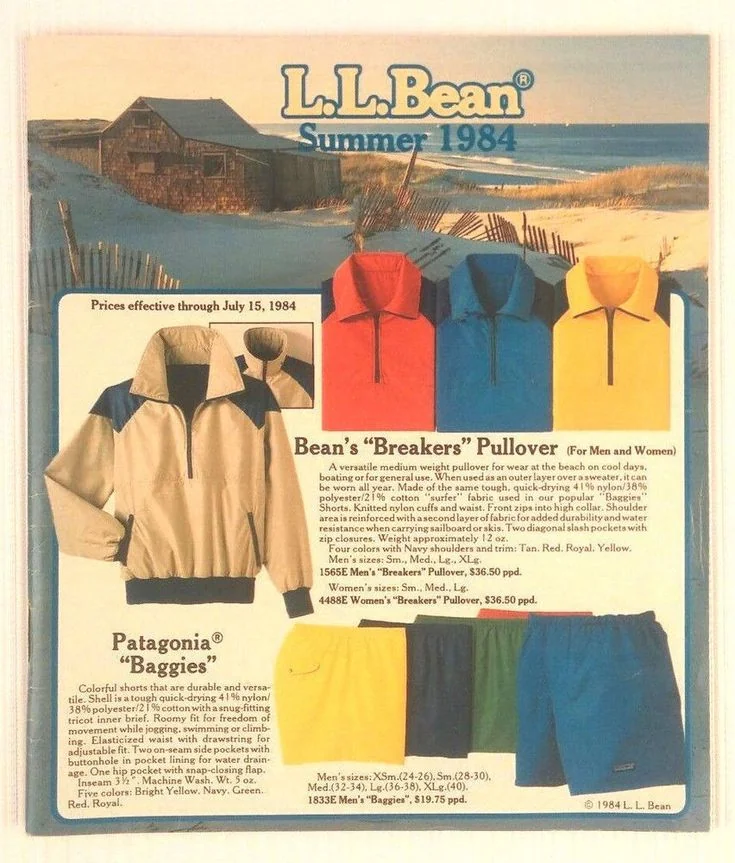
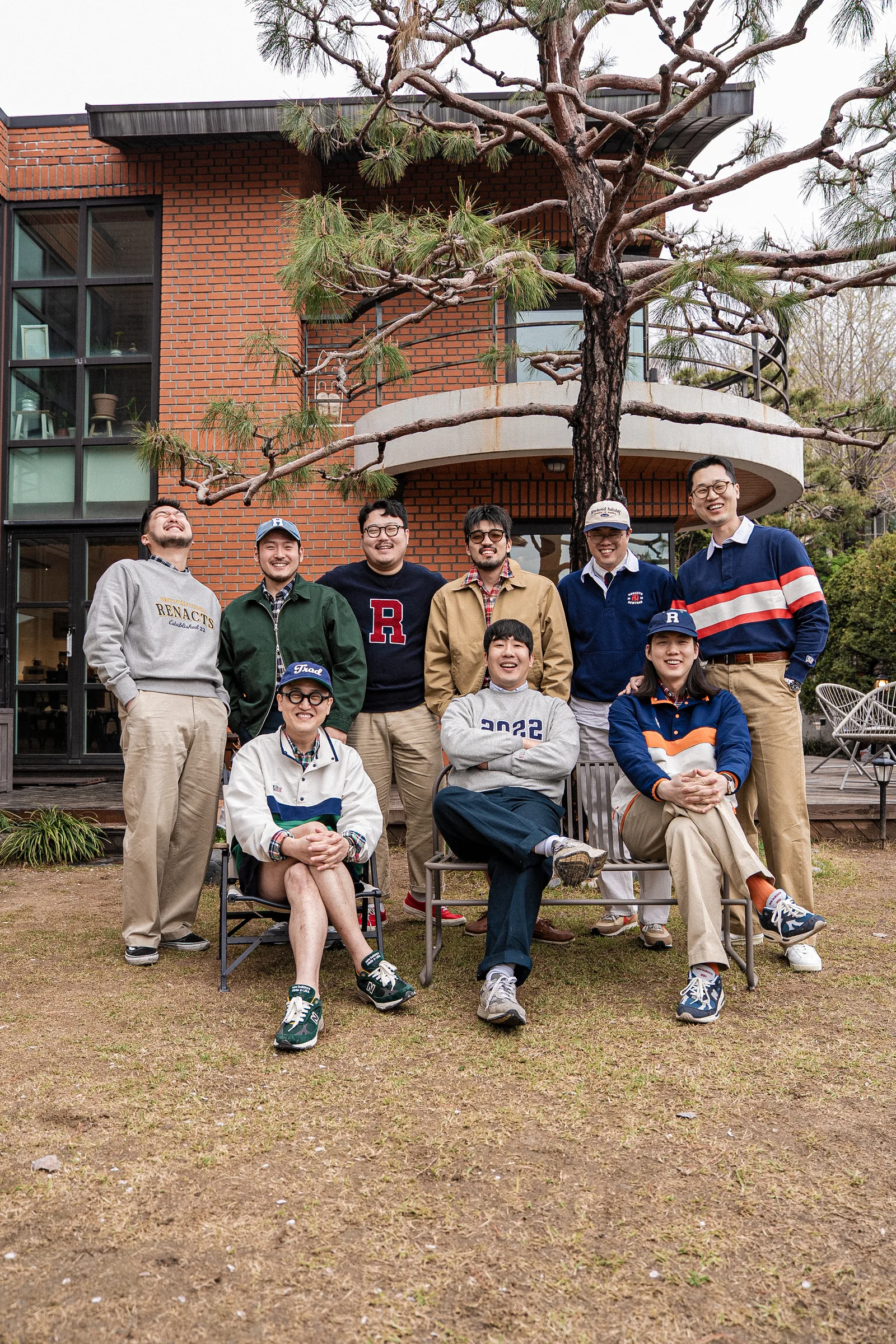
There is no L.L. Bean flagship in Seoul. The brand sells in Korea mostly through department-store accounts and online. But the specific pieces that made L.L. Bean Ivy-relevant — the pullover anorak, the chamois shirt, the Norwegian sweater, the Field Coat — are precisely the garments that Seoul Traditional brands have chosen to carry forward. The Heavy Duty Ivy look covered elsewhere on this site is an L.L. Bean outfit in everything but the label.

The Renacts New Trad Anorak Pullover is the clearest example. A heavyweight polyester anorak with a half-zip placket and chest color-block panels — the exact formula L.L. Bean was selling to Maine hunters in the 1960s, now in a technical shell re-proportioned for Seoul’s spring weather and with a V-zone that allows a collared shirt underneath. Kobayashi went to Freeport in 1972 and returned to Tokyo with a new way to read American clothing. The path from his reading to what’s being made in Seoul today runs straight through that visit.
The L.L. Bean history, in other words, doesn’t continue in Freeport alone. It continues wherever the specific garment language — cotton pullover, integral hood, utility pocket, chain-tread sole, rubber-bottom boot, waxed-cotton field coat — gets re-made seriously. Japan did that work from 1972 through the 1990s. Seoul is doing a version of it now, with brands that understand why the original products were built the way they were.
Why L.L. Bean History Still Matters in 2026
That’s the full L.L. Bean history in compressed form: one boot designed in 1911 and made by a seamstress named Gertrude, a 90% refund that led to a Boston rubber partnership, a flagship built over a post office in 1917, three origin products (1912, 1924, 1944), an Arctic endorsement in 1921, a 24-hour store since 1951, an Ivy adoption in the 1960s, Kobayashi in Freeport in 1972, Heavy Duty Ivy in 1976, a return-policy concession in 2018, and in 2026, a Seoul brand making the same anorak silhouette Leon Bean was selling to hunters.
The through-line is refusal — refusal to redesign what works, refusal to close, refusal to treat the origin story as a marketing asset separable from the product. The 2018 return-policy change is the exception that proves the rule. Clothes can be made correctly once and then kept correct for a hundred years. A hunting boot can become an Ivy staple without the boot changing. A one-man mail-order operation can become a canon-defining American brand without losing the original product. Whether you shop L.L. Bean directly or pick up the lineage through a Seoul Traditional maker, the lesson is the same: build one thing well, stand behind it, don’t move.