
The Rep Weave: Silk Ribbing That Became Ivy’s Signature Tie
A Weave, Not a Pattern
Most people think the diagonal stripes make a repp tie what it is. They’re wrong. The repp silk history begins not with a pattern but with a texture — a specific ribbed weave structure where the weft threads are thicker than the warp. The diagonal ribs are the surface tell. The stripes are what most of us remember. But strip the stripes away and you still have a repp — quietly textured, lightly substantial, ribbed enough to catch light differently than a smooth twill silk. That ribbed surface is the through-line every chapter of repp silk history returns to.

Repp Silk History Starts in the Regiments
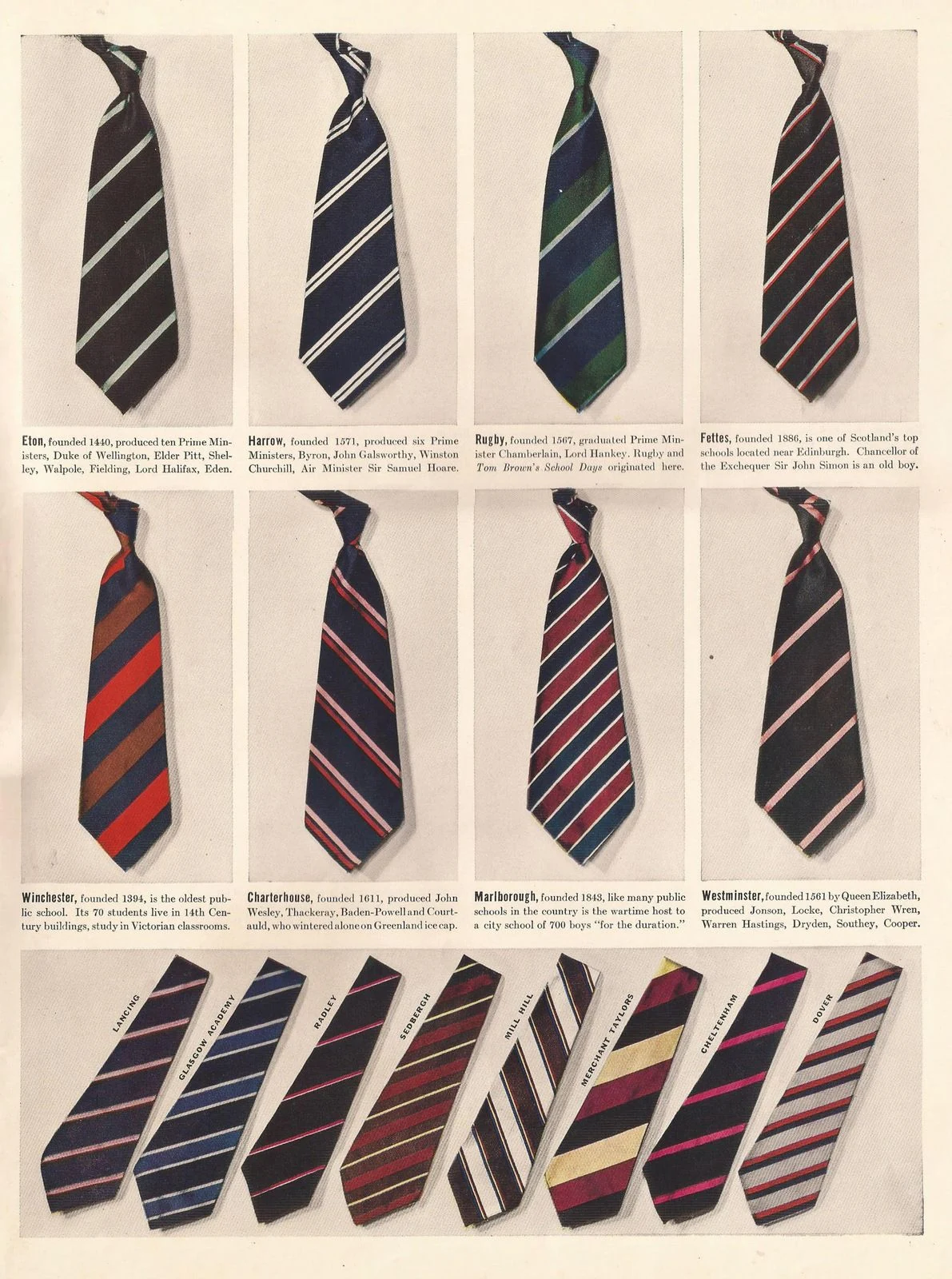
The word “repp” — sometimes spelled “rep” — comes from the French reps, a 19th-century textile term for ribbed fabrics. The construction predates its association with neckwear. By the late 1800s British silk weavers were producing repp neckties for regimental use — military units adopted ties in fixed stripe combinations as informal uniforms off the parade ground. The stripes denoted the regiment, the school, the club. The weave gave the tie its weight and drape.
British regimental ties run with the stripes descending from the wearer’s left shoulder to the right hip. This direction is the original, the source code. Everything that follows in repp silk history is, in one way or another, a response to this 19th-century British convention.
Brooks Brothers Flips the Stripe
In 1920, Brooks Brothers introduced its own version of the regimental tie. A member of the Brooks family had returned from England with a collection of British regimental ties and an idea — sell similar striped ties in America, but reverse the stripe direction.
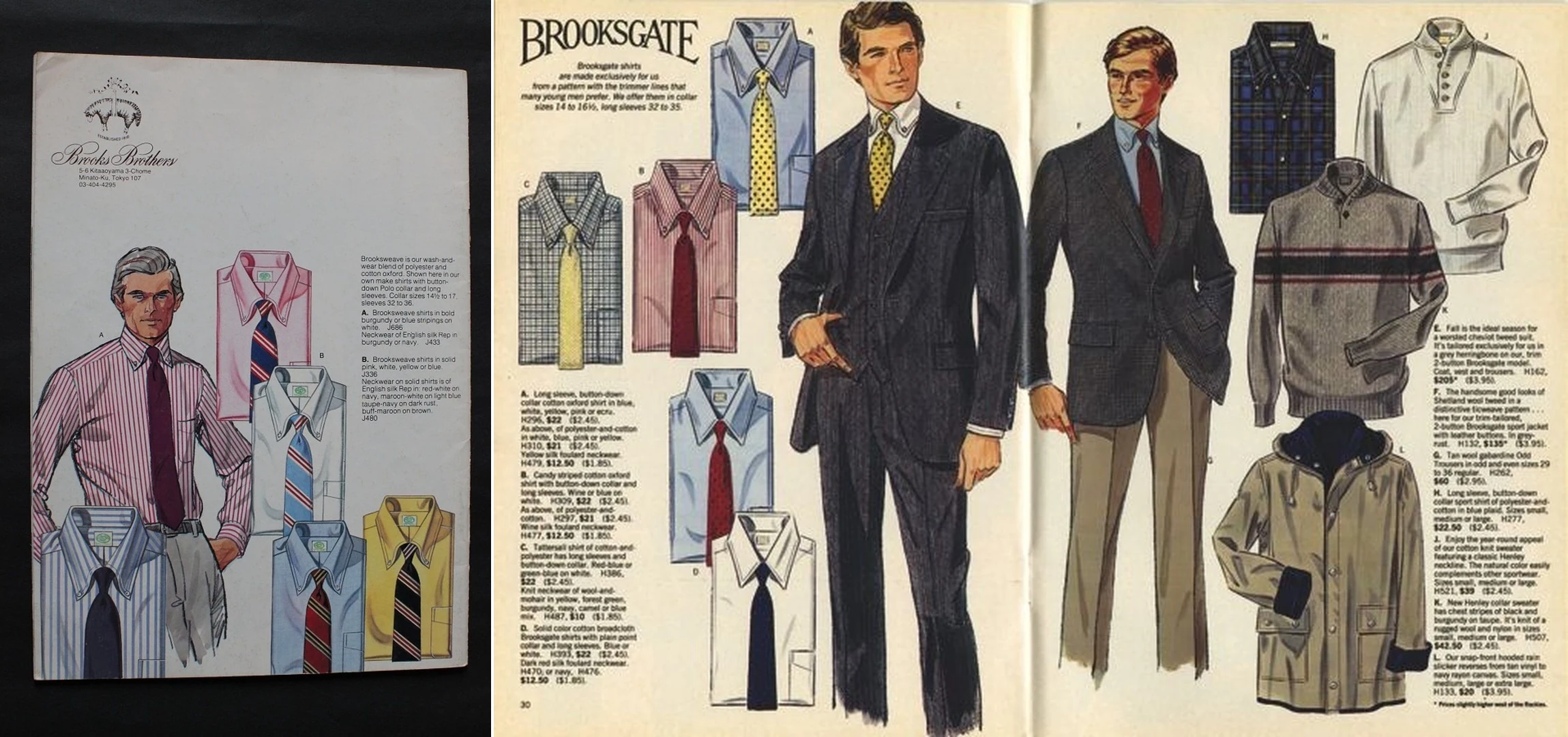
American repp ties run from the right shoulder down to the left hip. The mirror image. Why? The standard explanation is diplomatic — Brooks didn’t want Americans accidentally claiming membership in British regiments they’d never served in. That’s probably true. But there’s a practical benefit too. The reversal created a distinctly American product. You could spot the difference across a room. British tie, American tie. Two traditions, one weave.
Brooks Brothers called them “repp ties” and sold them in color combinations that had no military meaning whatsoever. Navy and gold. Red and navy. Green and gold. The stripes were purely decorative — freed from the burden of signifying anything beyond good taste. This is where repp silk history pivots from British formality to American ease.
The wide-tie tradition that runs through this story has had three resurgences. British public schools and regiments wore wide repp ties through the 1920s and 30s — the chart above (Eton, Harrow, Rugby, Winchester, Charterhouse, Marlborough, Westminster, Fettes) is from exactly that era. Brooks Brothers carried the wide-tie form across the Atlantic in 1920, reversing the stripe direction along the way.
Forty-seven years later, in 1967, Ralph Lauren’s Polo necktie line through Beau Brummell Cravat Company revived the 4-inch wide silk tie when the American market norm had narrowed to roughly 2 inches — the move that built Polo into a brand on the back of a single accessory. The repp weave has carried the tie through every one of these widening moments — three resurgences over a hundred years of repp silk history, all on the same construction logic.
Why Ivy Adopted the Repp Over Everything Else
By the 1950s the repp tie had become one of the default neckwear options at Harvard, Yale, Princeton, and their satellites — often the daily standard for students. Three reasons explain why the repp owned the campus while plain silks, knit ties, and printed ties all coexisted alongside it.
First, the weave was forgiving. A repp’s ribbed surface hides minor stains, creases, and the daily wear of a tie that gets dressed and undressed in dorm rooms rather than dressing rooms. A printed silk shows everything. A repp shows almost nothing.
Second, the stripes were modular. Three or four color combinations covered every social register a student needed — navy and red for daily wear, navy and gold for occasions, green and navy for the country-club weekend. You didn’t need a closet of ties. You needed three.
Third — and this is where repp silk history intersects with Ivy specifically — the repp tie’s reversed-from-British stripe direction made it an unconscious American identifier. Wearing a repp at Yale wasn’t just wearing a tie. It was wearing an Anglo-American hybrid in the right direction for your continent. The cue was almost invisible. That’s the whole point.
The Weave Itself: What Makes Repp Different
Step back from the stripes and look at the weave. In a standard silk tie, warp and weft threads are roughly the same thickness — the surface reads smooth, even glossy. In a repp, the weft threads (running across the tie) are notably thicker than the warp threads (running along the length). The thicker weft creates a ribbed surface that runs perpendicular to the tie’s long axis.
Look at it under angled light and you’ll see fine ridges, almost like corduroy at much smaller scale. Run your thumb across the surface and the texture is faintly tactile. Hold it at a 45-degree angle and the diagonal ribs catch light differently than the recessed valleys between them — which is exactly the optical effect that gives a repp tie its specific visual weight.
The diagonal stripes of a regimental repp run with the rib direction, which is part of why the stripes read as confidently as they do. The pattern and the weave reinforce each other. On a smooth silk, painted-on diagonals can look graphic and flat. On a repp, the same diagonals look structural. This optical effect is why the repp silk history of the past century reads, visually, as a single continuous tradition.
Repp vs. Mogador vs. Regimental: Clearing Up the Confusion
Three terms get used interchangeably and they shouldn’t be.
Repp refers to the weave structure — the ribbed surface created by thick weft over thin warp. Any tie woven this way is a repp, regardless of pattern.
Regimental refers to the British tradition of stripe combinations denoting military or club membership, and by extension to the diagonal-stripe pattern itself. Most regimental ties are woven as repps, which is why the two terms overlap. But a tie can be regimental in pattern without being repp in weave, and a repp can be solid (no stripes at all).
Mogador is a heavier, more textured variation of rep weave — usually with silk and cotton blended in the weft for additional body. Named after the Moroccan port city of Essaouira (formerly Mogador), where the silk-cotton trade ran for centuries. A mogador tie is a repp’s burlier cousin — same construction logic, more weight, more rustic surface.
For our purposes — and for the Renacts neckwear lineup — the relevant category is repp. Specifically, three-color or two-color regimental stripe patterns woven as repps in 100% silk.
The Repp Tie in Seoul: Heavier Than You Think
Seoul Traditional isn’t about replicating 1960s Princeton. It’s about asking what the same values — dress with care, live with intention — look like in a different city and a different century.
In the original Ivy context, a repp tie meant understated belonging. In Seoul today, it means something slightly different. Neckties aren’t default office wear here the way they were in mid-century America. Wearing one is a more deliberate choice. A repp tie in Seoul doesn’t whisper conformity — it signals that you care about this stuff. That you’ve read the repp silk history and chosen to participate in a tradition that spans continents.
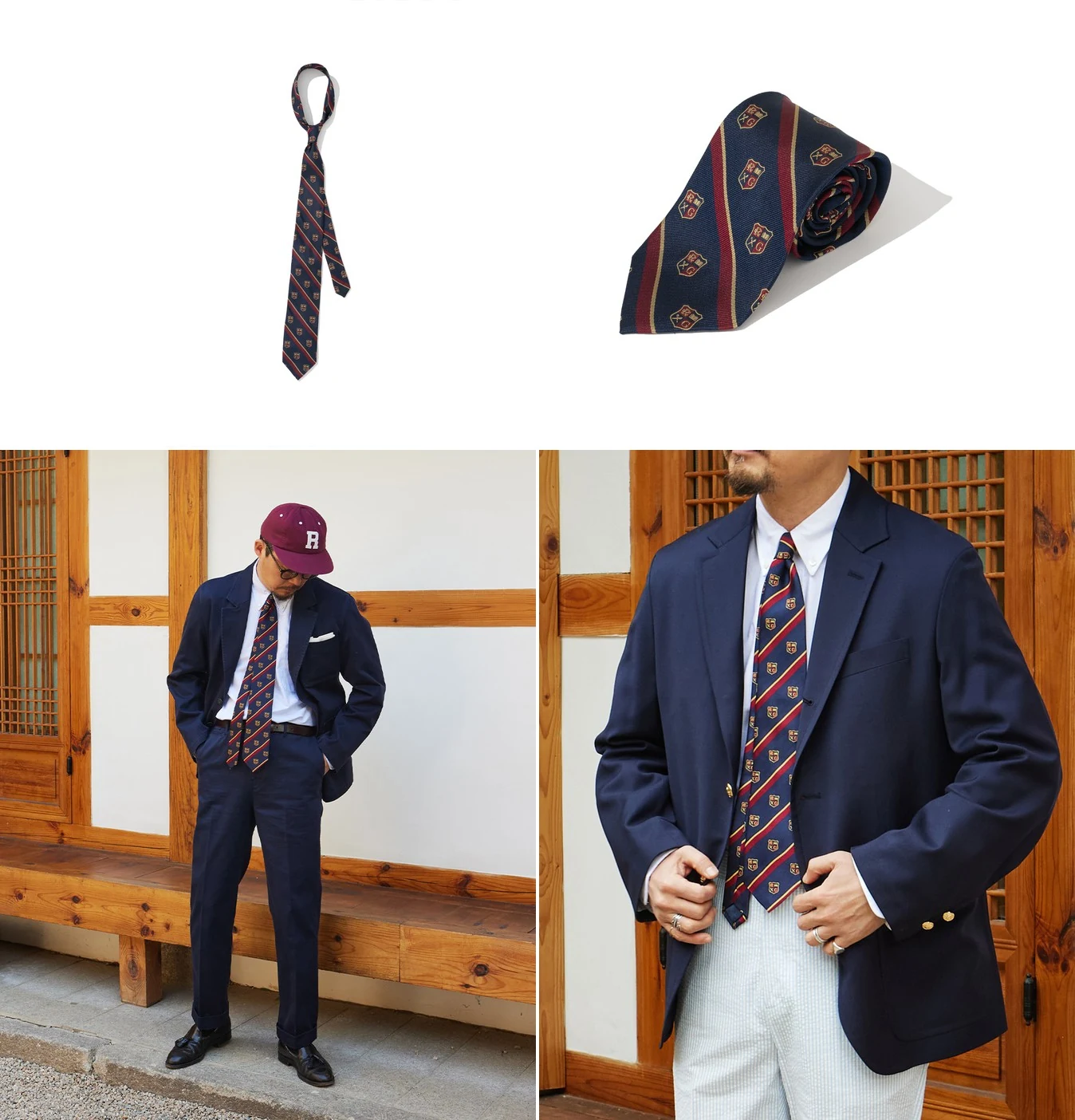
Renacts includes repp stripe ties — all woven in 100% silk — in their neckwear lineup, and they work particularly well with the brand’s slightly wider collar rolls. A navy-and-gold repp against a white oxford cloth shirt, under a navy blazer, walking through Seongsu-dong — that’s Seoul Traditional in one outfit. No costume. No irony. Just a man who’s thought about what he’s wearing.
There’s a quieter detail in how Renacts approached the repp from the start. The brand’s early production runs of regimental ties used the British stripe direction — left shoulder down to the right hip. Part of it was practical: the American flip adds construction cost, which would have pushed retail prices up. Part of it was narrative. As a Seoul brand reinterpreting American Trad through Korean construction, the British root of the regimental tradition felt honest to acknowledge — complete replication wasn’t the goal, meaningful translation was.
That logic has since shifted. New production runs the American direction now, and as legacy inventory sells through, reorders are switching over. The British-direction pieces are a closing chapter — a quiet record of an early decision that found its own kind of meaning.
The Gentlemens Club members wear them to football matches, to volunteer events, to weekend seminars. The tie becomes a uniform of sorts — not mandated, but chosen. Which is the whole point of carrying repp silk history forward in a city that doesn’t owe it anything.
How to Read a Repp Tie’s Quality
Four checks separate a good repp from a forgettable one.
Weight. Pick the tie up by the small blade. A well-made repp has perceptible weight — not heavy, but substantial. A flimsy silk will hang lifelessly. The Renacts repp construction in 100% silk falls into the mid-weight range, heavier than a printed silk, lighter than a mogador or grenadine.
Hand. Squeeze the blade gently. The fabric should compress slightly and recover instantly. A repp that compresses and stays flat is under-constructed. A repp that resists compression entirely is over-interfaced — too stiff, the knot will look architectural rather than soft.
Knot recovery. Tie a four-in-hand, wear it for a day, untie it, and hang it overnight. By morning the dimple should be gone and the blade should have its original drape. A well-woven repp recovers cleanly; a poor weave keeps a faint memory of every knot.
Tipping and bar tack. Flip the tie to the back side. Look at the tipping (the lining at the tip) and the bar tack (the horizontal stitch that holds the tie’s seam together). Hand-rolled tipping is the mark of a serious tie. A clean, even bar tack is the mark of a careful one. Both should be present. These four checks are the practical residue of a century of repp silk history compressed into a one-minute inspection.
The Collection: Three Patterns × Three Colors
If you’re building a repp tie wardrobe from scratch, color priority is settled before pattern. The build order is: Red Navy first (the workhorse), Yellow Navy second (the assertive), Green Navy third (the dark horse). Once you’ve decided on color, the pattern question opens — three patterns sit on the same three-color base, each with a different conversational register.
Across the Renacts collection, the same logic plays out at nine positions: three patterns (Regimental, Regimental Crest, Two-Tone Regimental) crossed with three colors (Red Navy, Yellow Navy, Green Navy). Same repp construction. Same 100% silk. Different register. Nine positions, each one a distinct dialect of the same repp silk history.
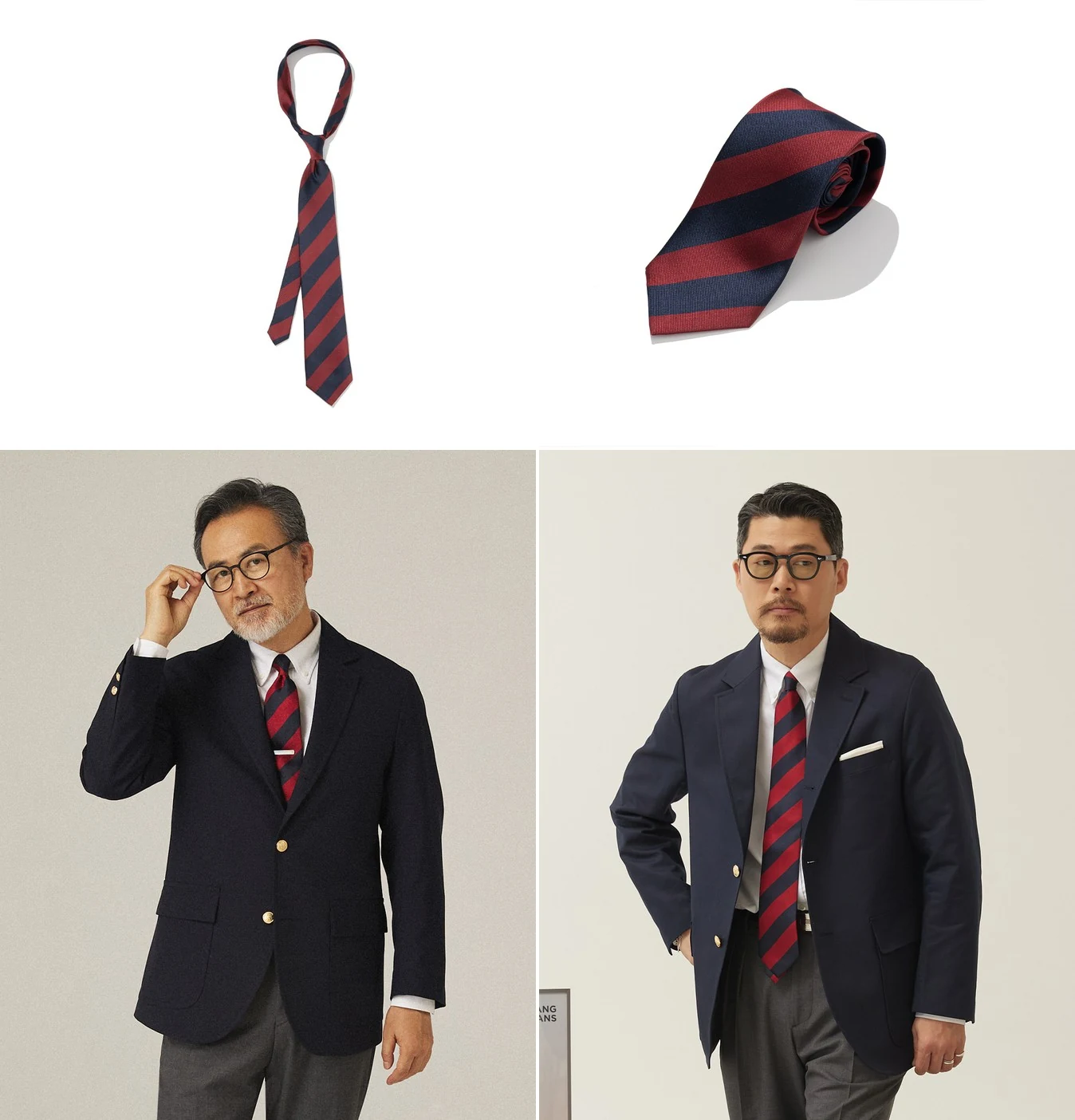
Red Navy — The Workhorse
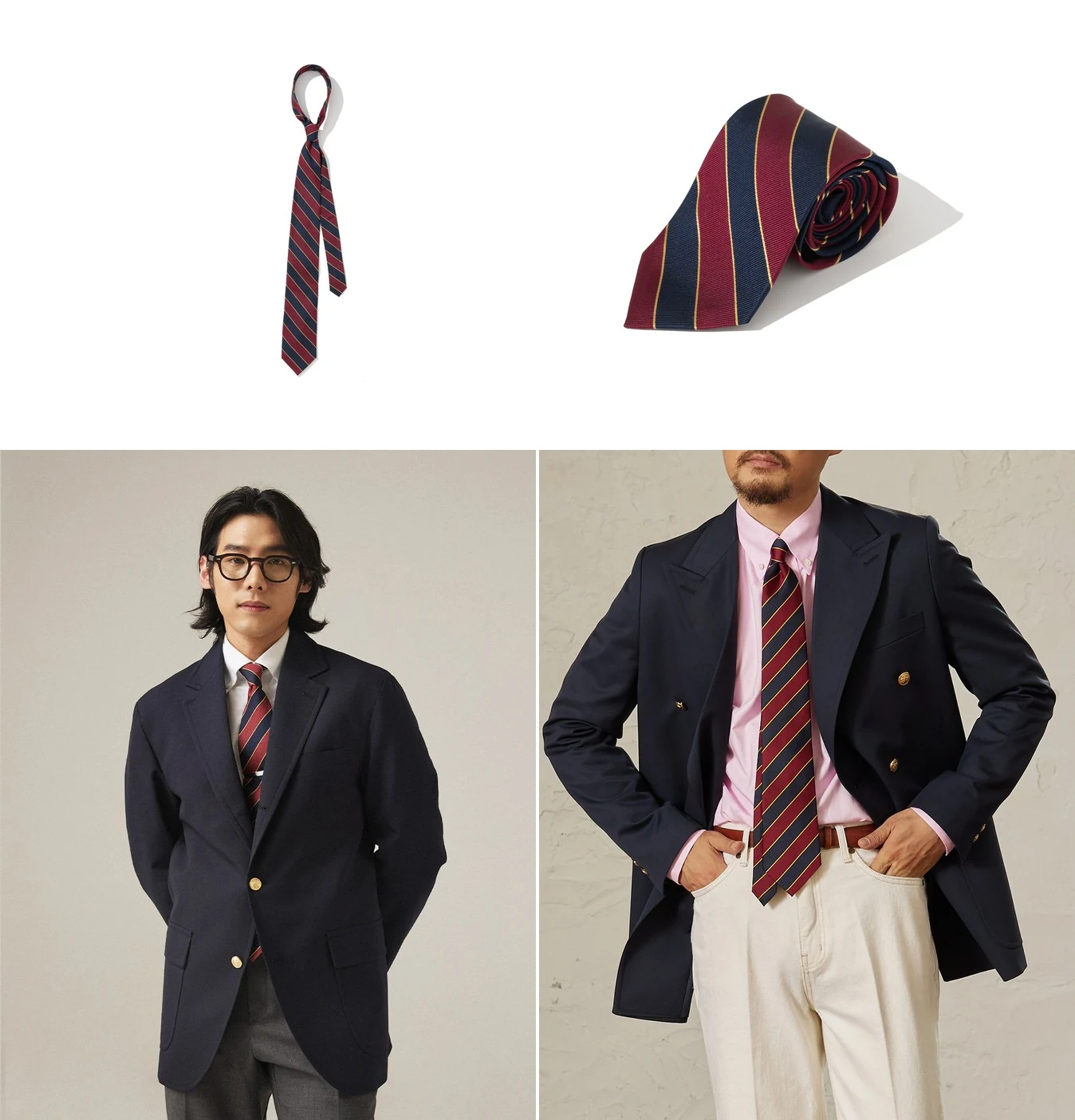
The first tie you should own. Red-and-navy works under any blazer color (navy, charcoal, herringbone, glen check, tweed) and under any shirt color (white, blue, pink, university-stripe). It’s the tie that signals nothing in particular — which is exactly why it can go anywhere. Buy this color first.
Yellow Navy — The Assertive
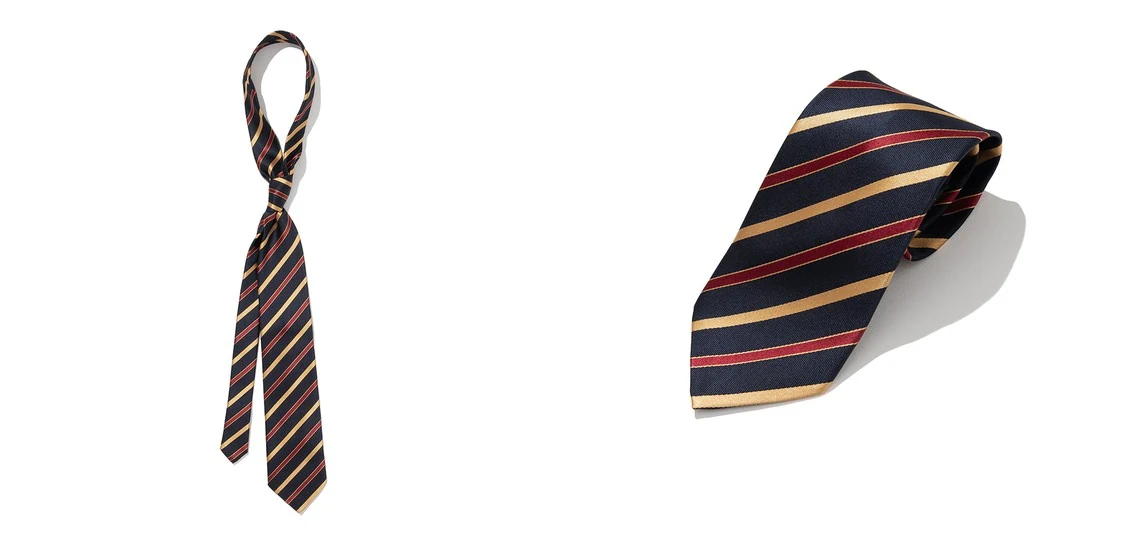
More forward than red. Navy-and-gold (yellow against navy) projects from across the room — it pairs best with a quiet shirt (white, light blue) and a tonal blazer (navy, charcoal). When the rest of the outfit is conservative, the gold makes the tie the center of the visual register. Wear it when you want the tie to be the statement.


Green Navy — The Dark Horse
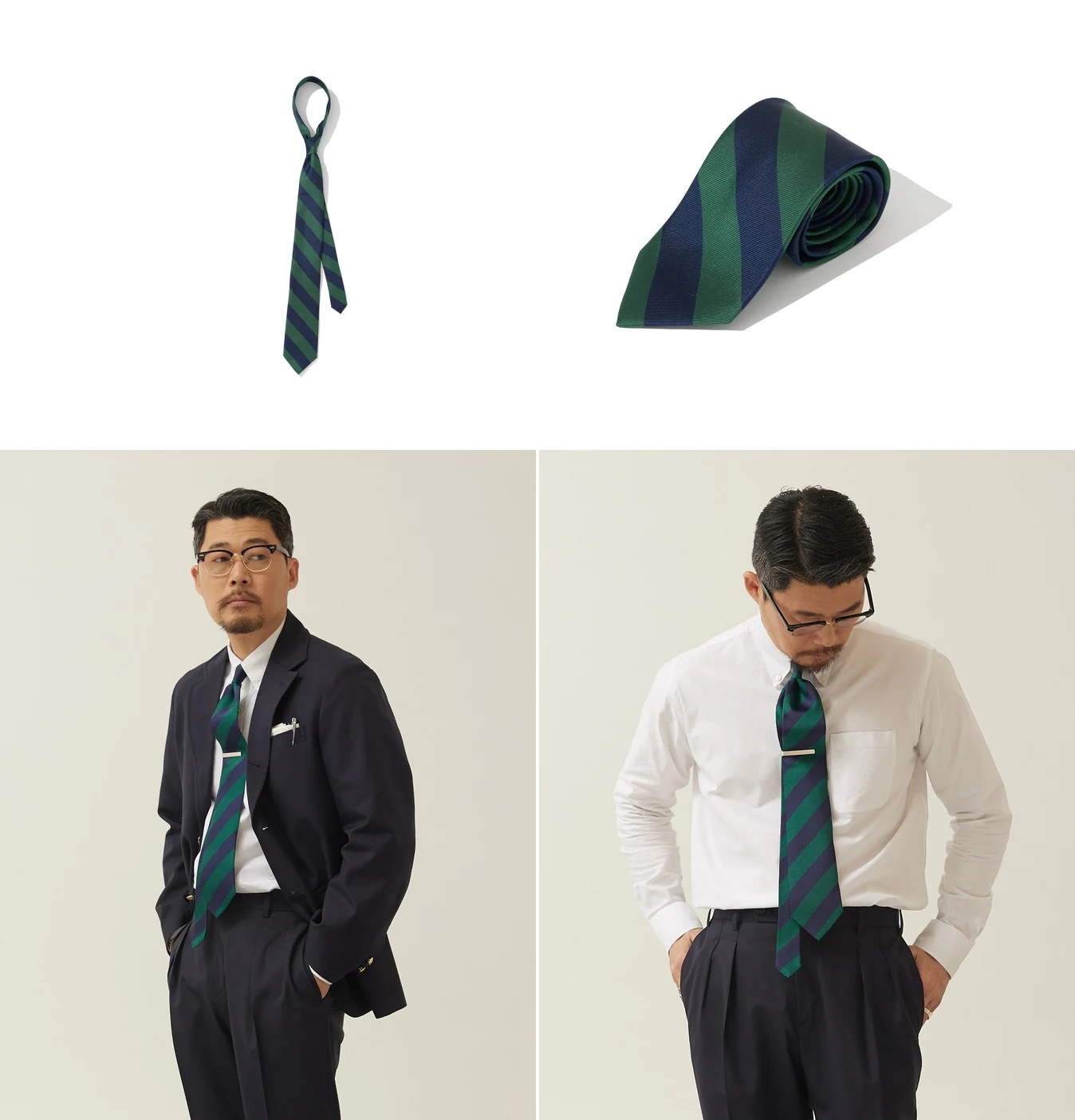
Buy this one last and you won’t regret it. Forest green and navy is the autumn-into-winter tie, the country-tweed companion, the choice for occasions that call for color without volume. Pairs particularly well with tweed sport coats (Glen Check, Gun Club, herringbone) and grey flannel trousers — the country-tweed register where green earth tones recede into the cloth rather than fight it.


The Repp Tie’s Quiet Endurance
A repp tie has been doing the same job, in roughly the same form, for over a century. British regiments wore them in the 1880s. Brooks Brothers Americanized them in 1920. Yale wore them in 1950. Renacts weaves them in 2026. The construction has barely changed because it doesn’t need to. The repp weave gives the tie its weight; the stripe gives it its language; the silk gives it its hand. Everything else is style.
In Seoul, where trends cycle faster than almost anywhere else on earth, that kind of staying power means something. Choosing a repp stripe tie is choosing to opt out of the cycle. Not because you’re against fashion, but because you’ve found something that doesn’t need replacing. And that — the choice to stop chasing and start building — is what Seoul Traditional is really about.