Cricket Sweater: The 1870s English Uniform That Became an Ivy Essential
The cricket sweater is the single piece of Ivy knitwear that actually started on a sports field — not in a boardroom, not on a campus, not in a designer’s studio. A cable-knit V-neck in cream cotton, trimmed at the neck, cuffs, and hem with two stripes in club colours. For the same English-origin Ivy knit canon, see our Fair Isle knit history — the 1921 Prince of Wales moment that made multi-color Shetland patterns part of every Ivy wardrobe. Cricket teams wore them to stay warm between innings in the damp English summer. Then Oxford and Cambridge students took them off the pitch and into quads. Then the Ivy League took them across the Atlantic. And a century later, they ended up in Seoul.
1840s-1890s: The Cricket Sweater Starts in Cricket
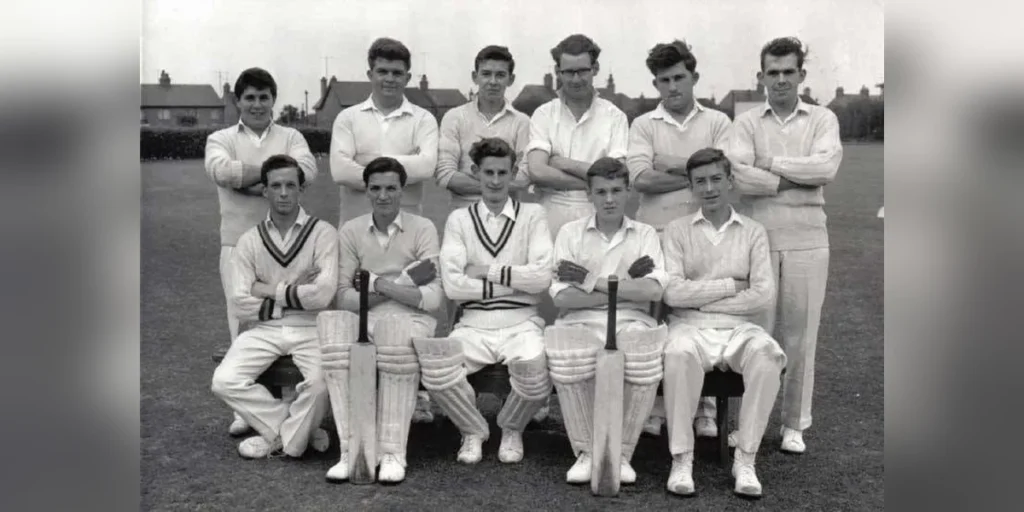
Foster & Co. of London was already selling wool sweaters to cricket teams in the 1840s. By the 1880s, English cricketers routinely wore heavy pullovers — sometimes buttoned, sometimes V-neck, sometimes with collars — in club-specific colours. The sweater was genuine sportswear: cricket in England is played into September, the air is cold, and batsmen waiting to go in need to keep their shoulders warm.
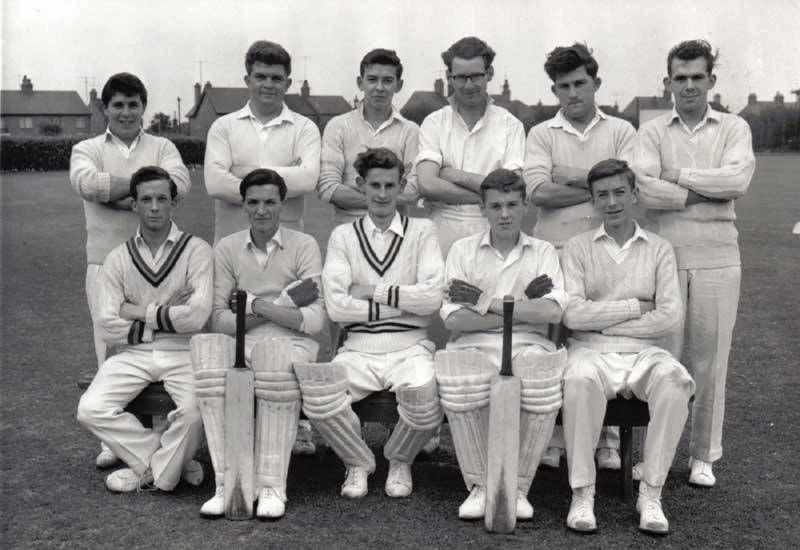
What the 1880s cricket sweater often lacked was the definitive cable-stitch V-neck we think of today. Early cricket knitwear varied — some plain stockinette, some simple rib, some early cable experiments. The stripes were already there, encoding club identity (Marylebone Cricket Club’s red and gold, Oxford’s dark blue, Cambridge’s light blue). The standardised cable-knit V-neck with club-colour tipping arrived later.
1907 – 1920s: Paines of Godalming Defines the Cable Knit
William Paine founded Paines of Godalming (later renamed Alan Paine after his son of the same name) in Surrey in 1907. From the start, Paine’s knitting mill made cable-knit sweaters — arguably among the first cable-knit pullovers ever produced commercially. The client list was broad: cricket, rowing, tennis, and golf clubs across England, plus nearby private schools, most famously Charterhouse in Godalming itself.
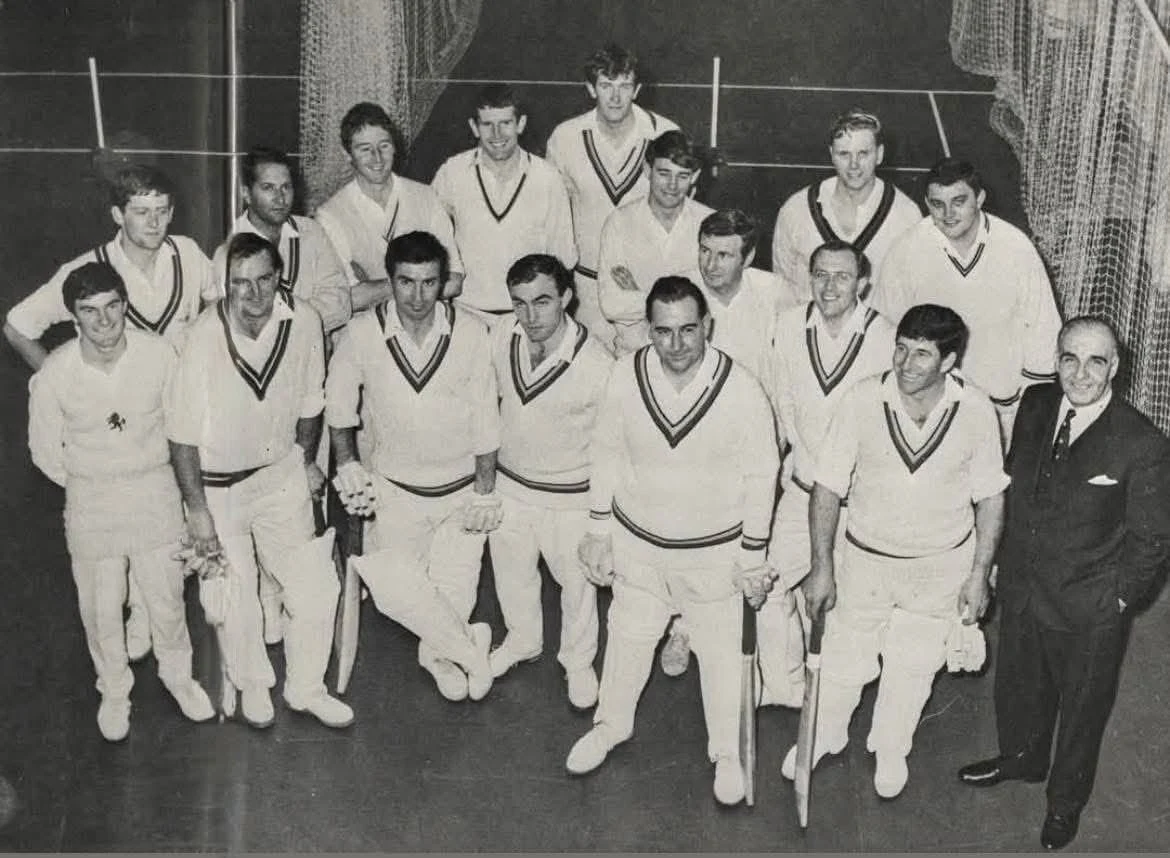
The step that turned a plain cable sweater into the “cricket sweater” came around 1920. Paine’s mill started adding what its own heritage record calls the “Club Colour Trim” — two or three coloured stripes at the V-neck, the cuffs, and the hem, rendered in club-specific palettes. This was the detail that made the sweater legible at a distance: you could tell a Lord’s sweater from an Oxford sweater from a Charterhouse sweater at thirty paces.
By the mid-1920s, the cable-knit V-neck with club-colour tipping was standard issue for English county cricket and Oxbridge sides. Wimbledon tennis players wore the same design on change-overs. The Prince of Wales — who would briefly become Edward VIII before abdicating in 1936 — commissioned Paine’s sweaters in custom regimental colours, which locked in the design’s aristocratic cachet. To this day, serious menswear nerds argue whether to call it a “cricket sweater” or a “tennis sweater”. Both are correct. The garment is the same.
Wearing the Classic Ivory: The Canonical Fit
There is exactly one way to wear a cream cricket sweater without overthinking it:
- White or light blue oxford button-down underneath
- Knit tie or silk grenadine — muted colour (navy, burgundy, forest)
- Cream, khaki, or grey wool trousers — flat-front, slight break
- Penny loafers or derby shoes — suede works better than calf with this sweater
- White socks are fine; ribbed cotton is better
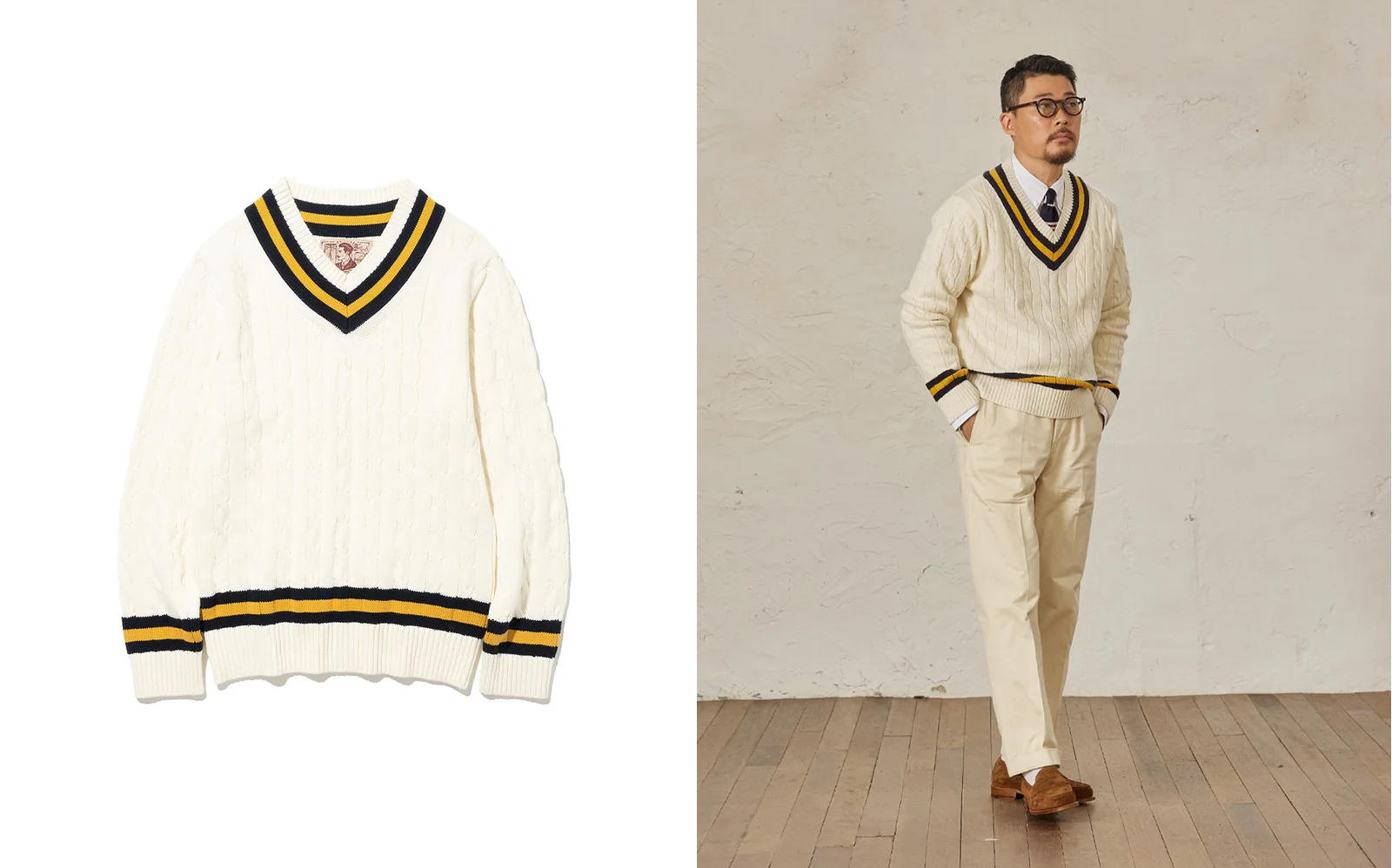
The V should sit at the second shirt button. Too high and it looks like a school uniform. Too low and the tie escapes into the V and ruins the geometry. Length: the hem should end at the top of the hip, not covering the belt.
The Navy Variant: Less Obvious, Still Cricket
The ivory cricket sweater is the classical cut, but the navy version is the more practical piece for Seoul. Harder to stain, less seasonal, and sits better over a white OCBD in spring and autumn. The tipping at the neck — navy, gold, navy — is inverted from the classical cream pattern, which keeps the V-neck visually strong.
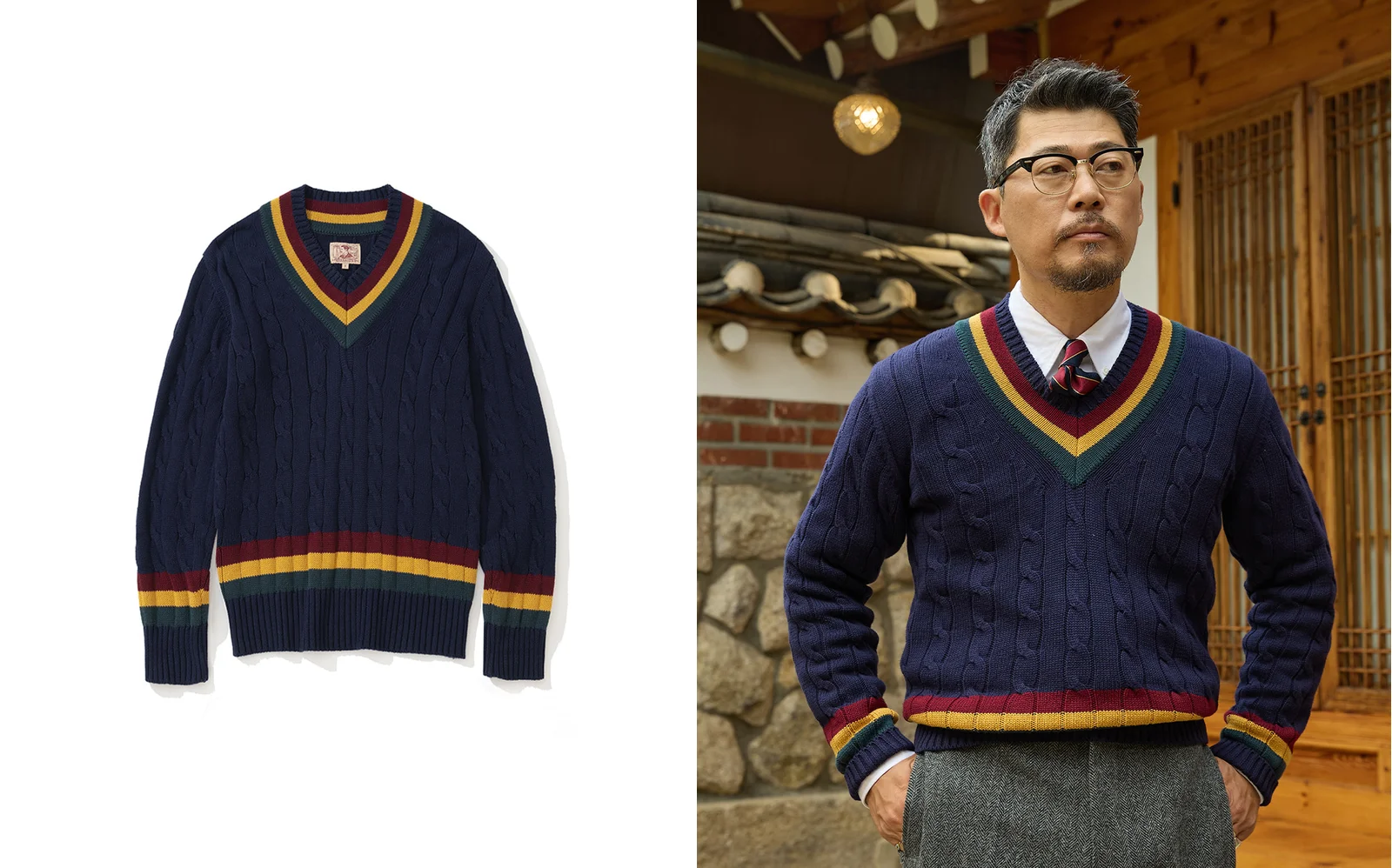
Wear it with the same trouser options (cream, khaki, grey). Avoid navy trousers with a navy sweater — too monochrome. The sweater is supposed to be an object of contrast, not a color match.
The Cricket Vest: Same Logic, No Sleeves
A cricket vest (sleeveless cricket sweater) sits in a specific gap in the Seoul menswear year. Late April through early June, and again mid-September through early November — when you need a layer over a shirt but a full sweater is too much. The V-neck vest solves this cleanly.
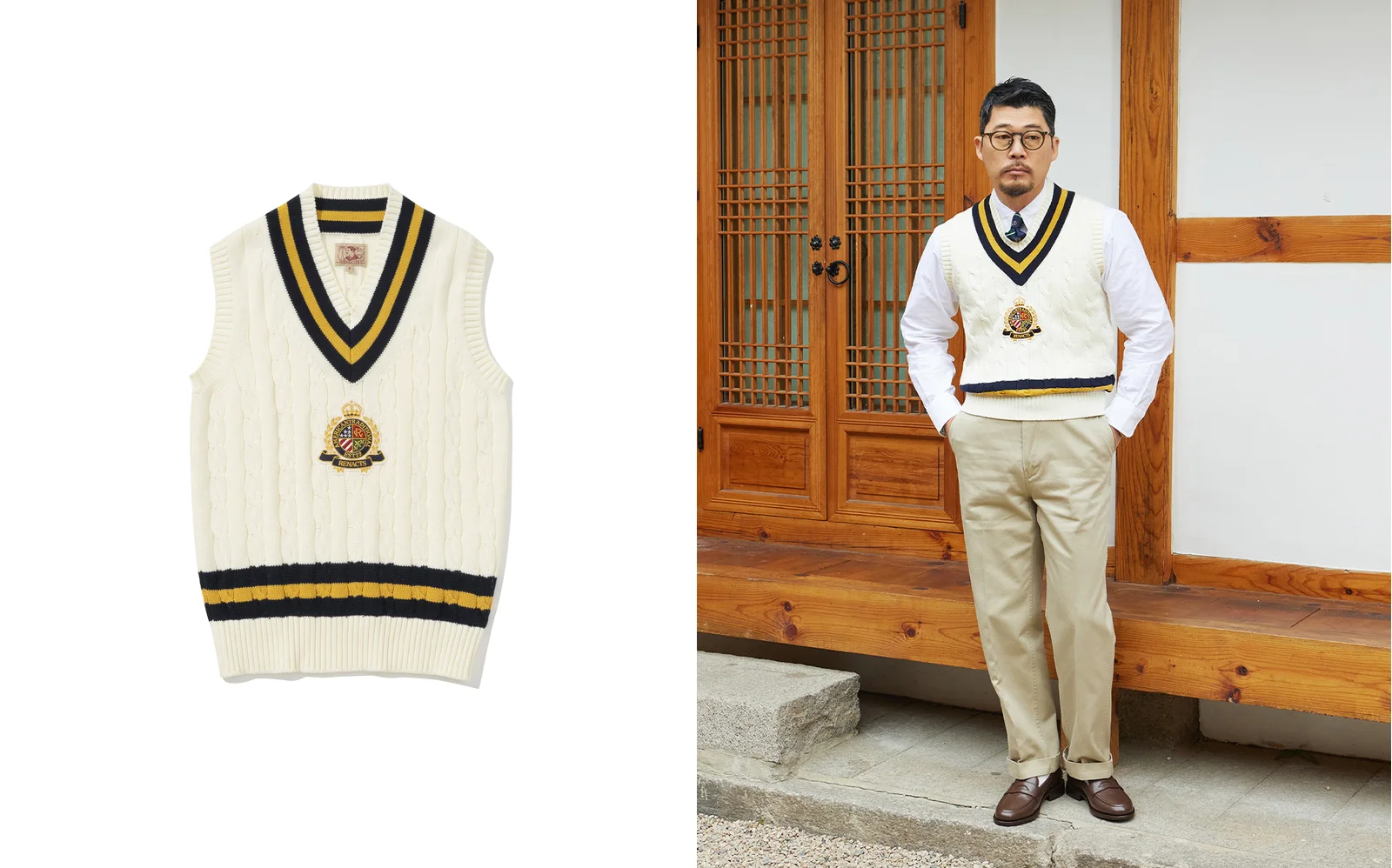
The ivory version is the summer-leaning option. Over a blue OCBD with khaki chinos and loafers, it reads as thoughtful without trying. A crest at the chest — which Renacts’s vest carries — is traditional; unadorned is also correct.
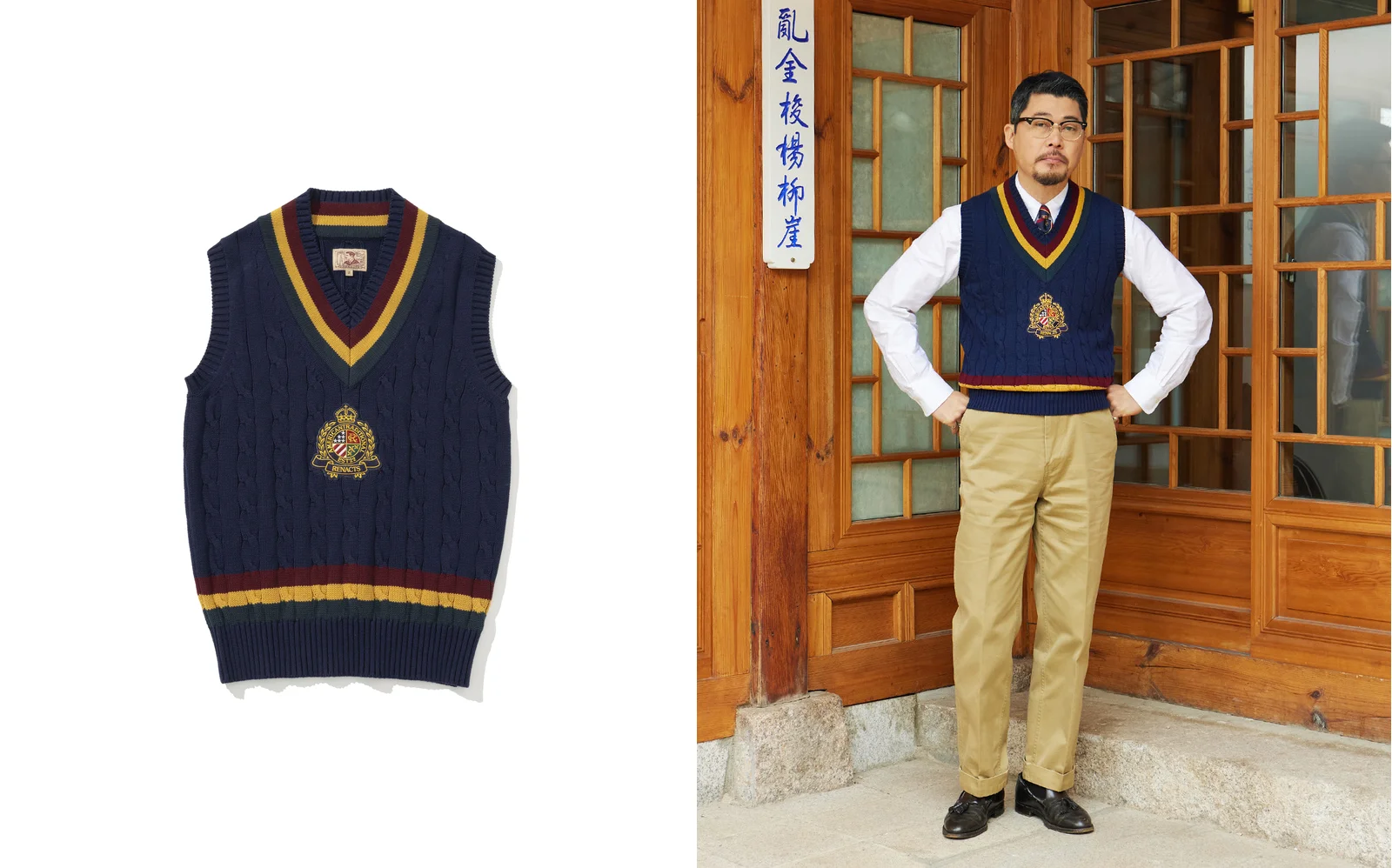
The navy vest with its multi-stripe V (green, gold, burgundy) leans into club-heraldry territory. Over a white OCBD with a repp tie in muted colours, it holds its own at an art gallery opening, an office day in September, or a weekend coffee in Yeonhui-dong. No specific cricket club affiliation required — just the willingness to wear a piece of clothing that takes itself slightly seriously.
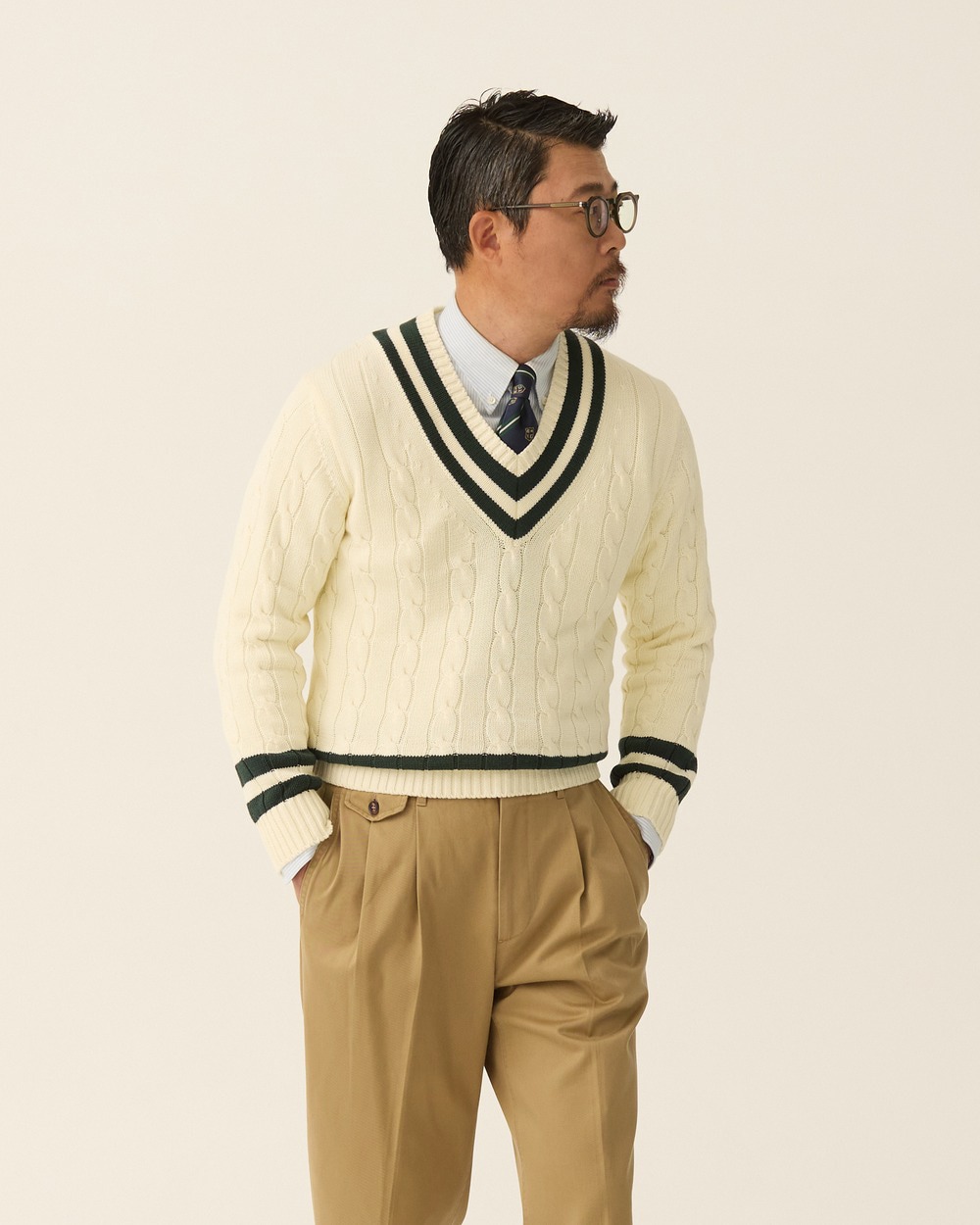
The 2026 Colours: Green and Red
Here’s the thing about a cricket sweater’s colour name. It isn’t the body. The body stays ivory — what changes is the band at the neck, the cuffs and the hem.
That band is the club colour. On a real club sweater it told you which side a man played for, and it’s still the only loud thing about the garment.
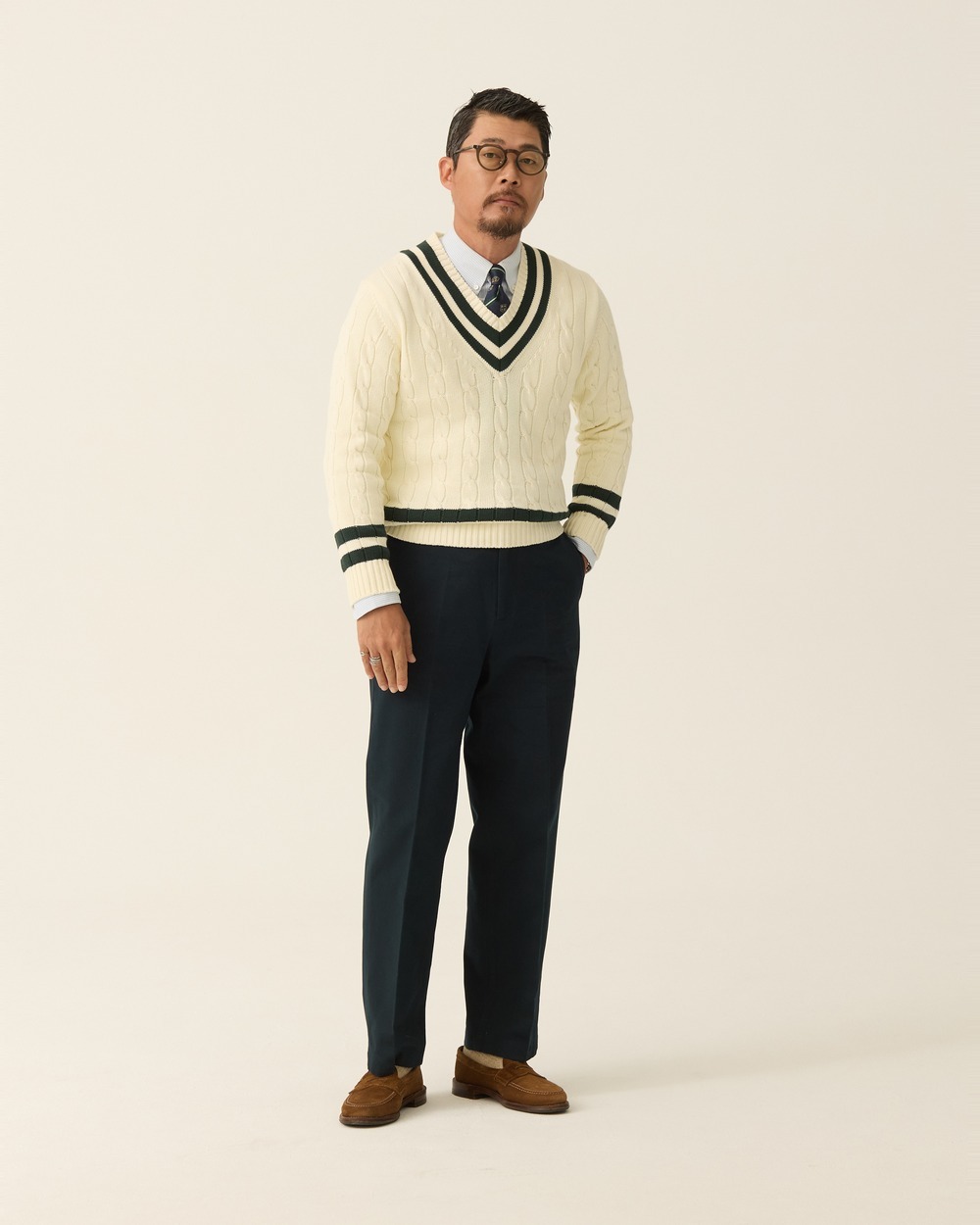
Green reads quieter than you’d expect. Against navy trousers it behaves almost like a neutral, and it’s the easier of the two new colours to wear with a tie.
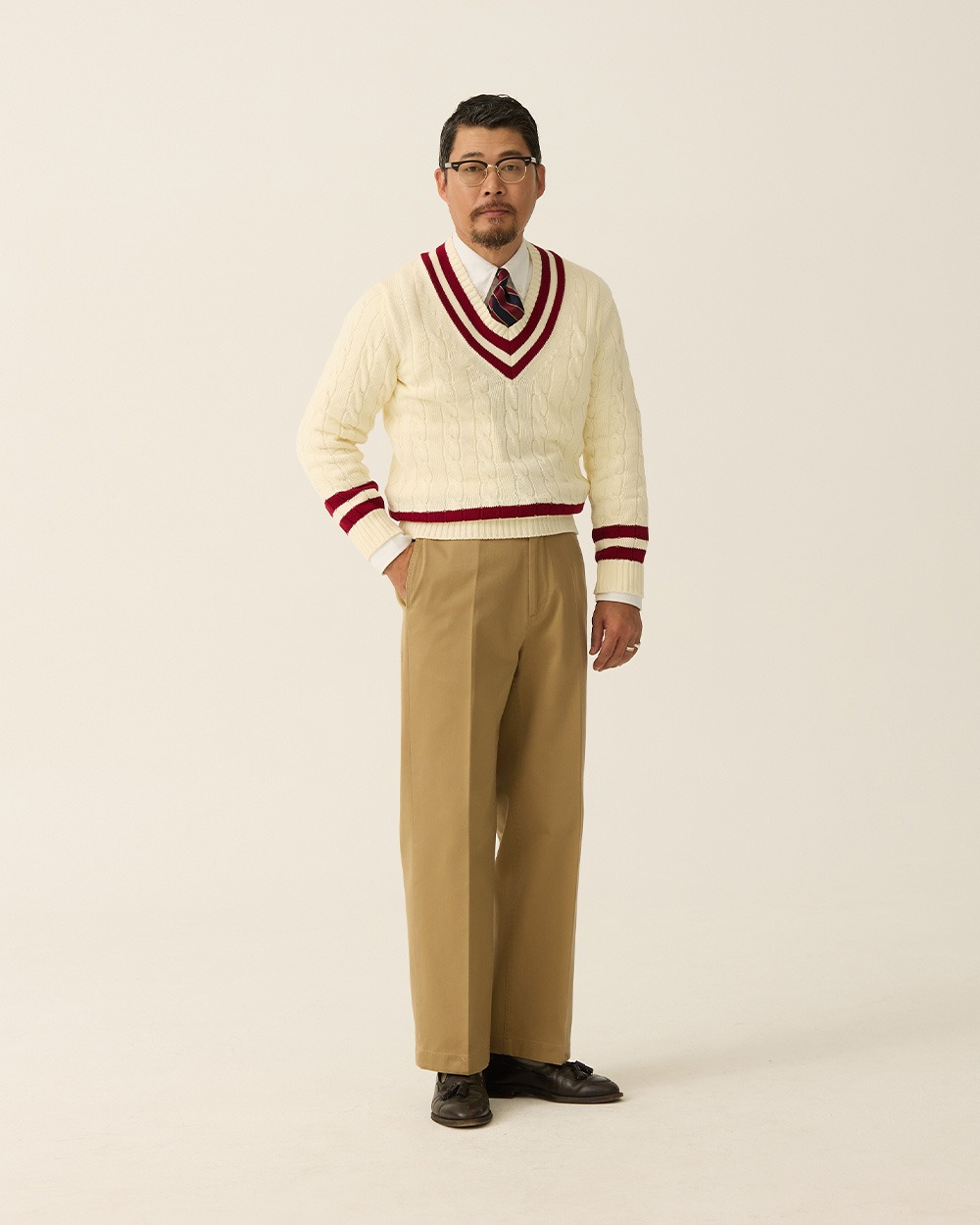
Red is the one people notice from across a room. Keep everything else plain — khaki chinos, a white shirt, dark shoes — and it looks deliberate rather than festive.
If this is your first one, buy ivory or navy. The red and green versions are second sweaters, not first ones.
Four Ways to Wear a Cricket Sweater
The cricket sweater has one real problem: the deep V leaves a lot of shirt showing. That space decides the outfit.
1. Over an oxford shirt and a tie
This is the default, and it’s what the V was cut for. A white or blue oxford button-down and a knit tie or repp tie fill the opening.
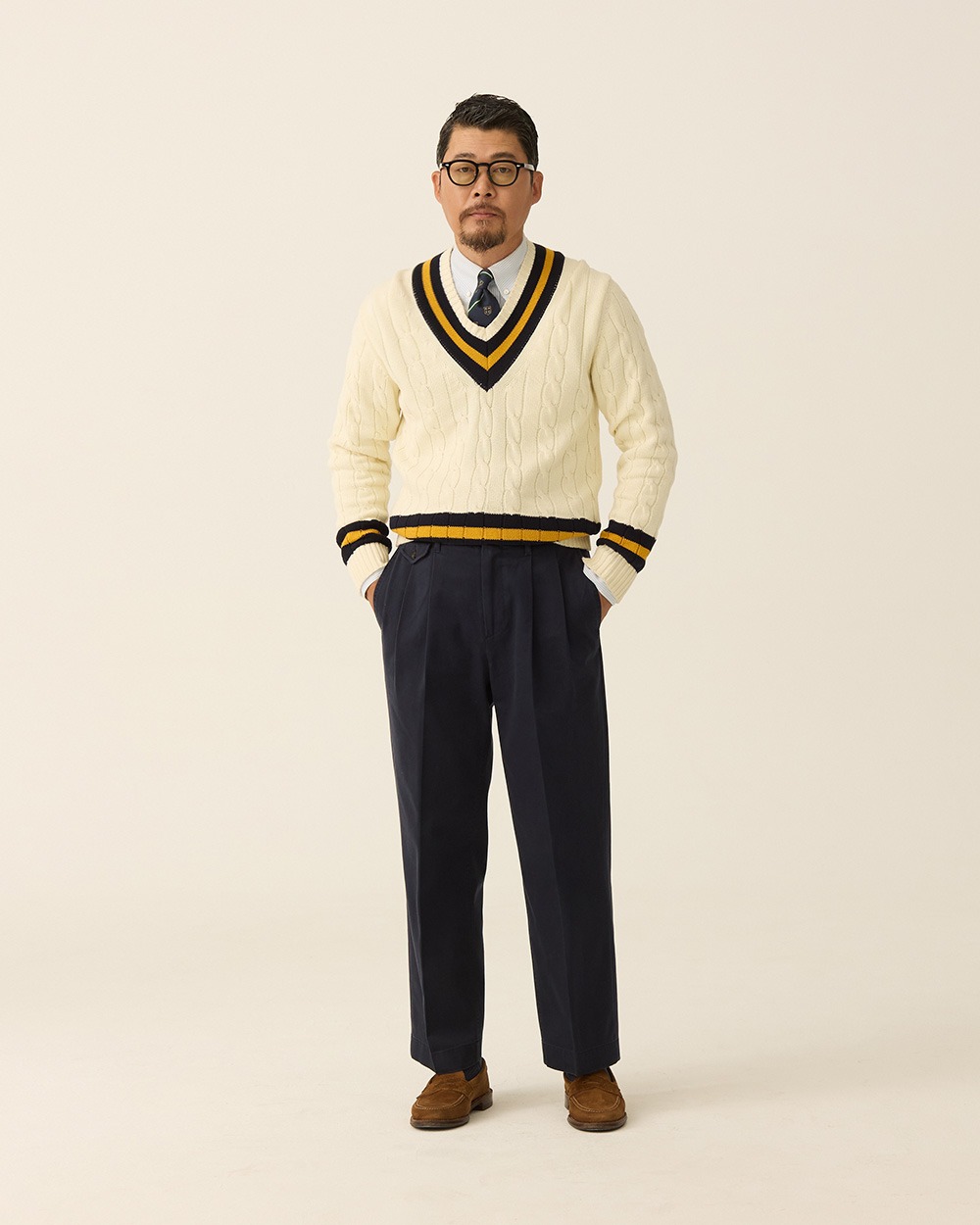
Tuck the shirt. An untucked hem under a cropped knit ruins the line the ribbing is trying to hold.
2. Under a jacket
A cricket sweater under a sport coat is warmer than a waistcoat and reads less formal. The trim shows at the V and nowhere else.
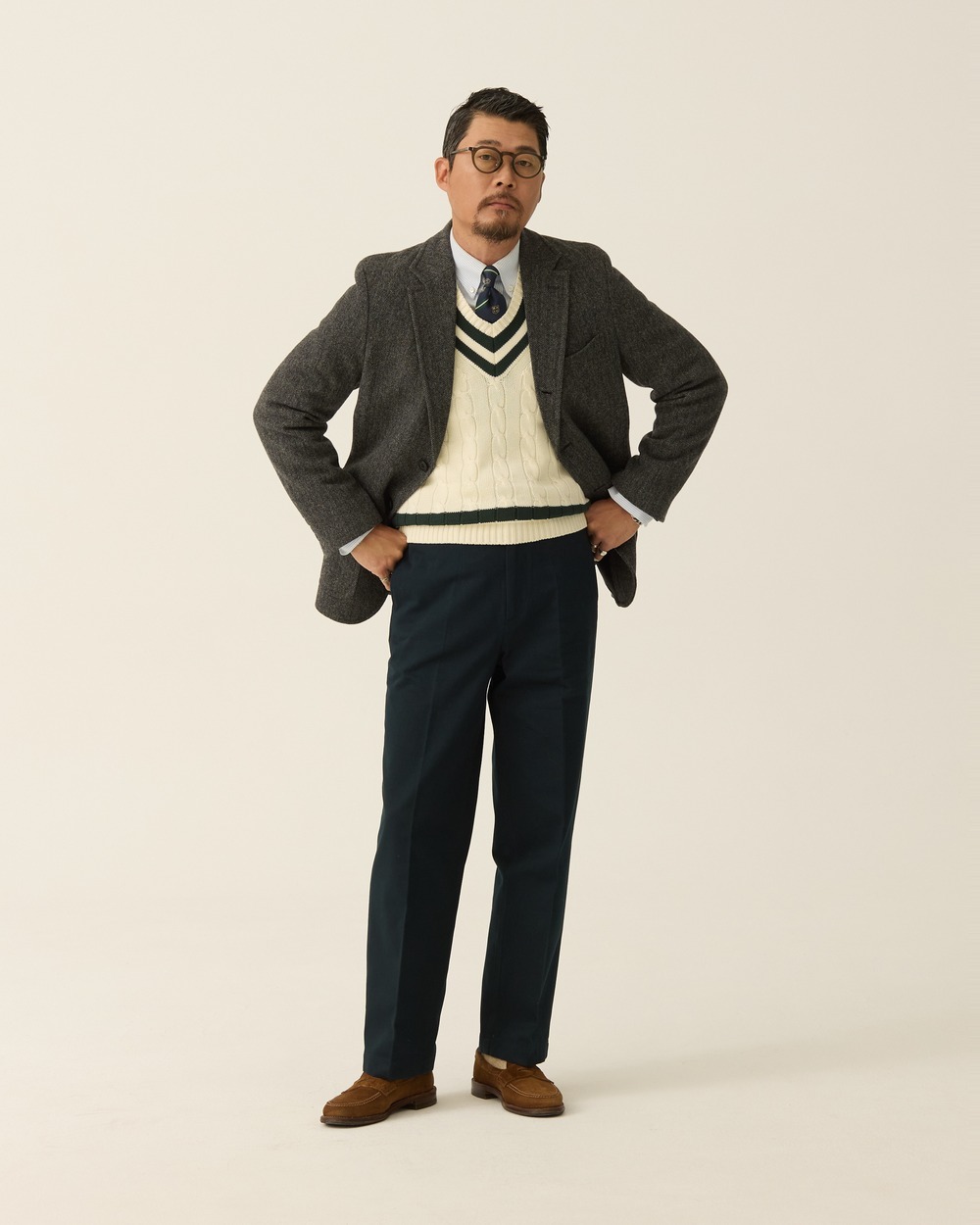
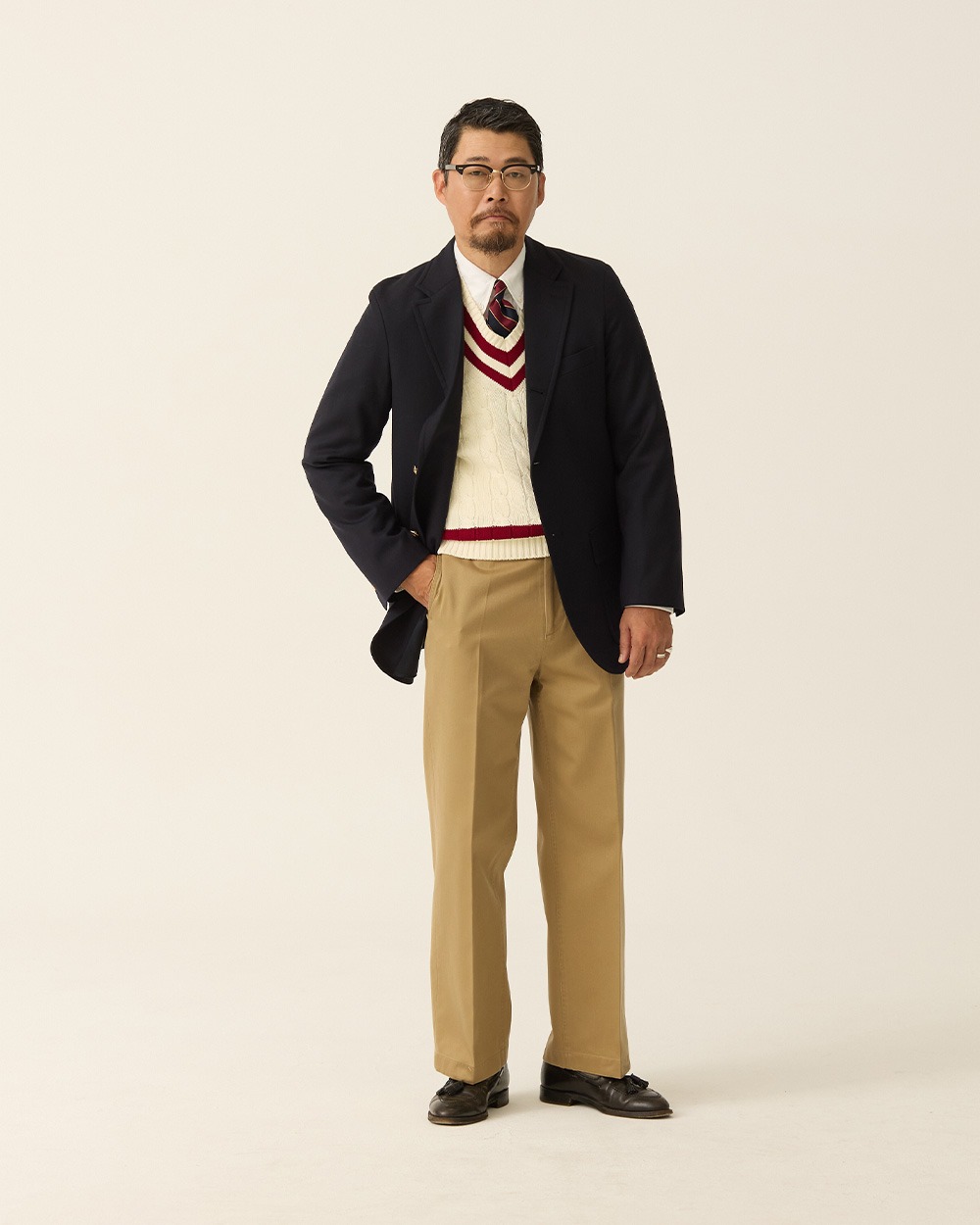
Colour order matters here. A dark jacket over an ivory sweater works every time; a navy sweater under a navy jacket needs the trim to separate them.

3. With the right trousers
The trousers set the register. Khaki chinos make it a weekend sweater. Grey wool makes it something you can wear to an office that doesn’t require a tie.

Our wool trousers guide covers that switch in detail. Jeans work too, as long as they’re dark and straight.
4. The vest, for the in-between weeks
The vest is for the fortnight when a sweater is too much and a shirt alone is too little. Seoul gets about three of those weeks in October.
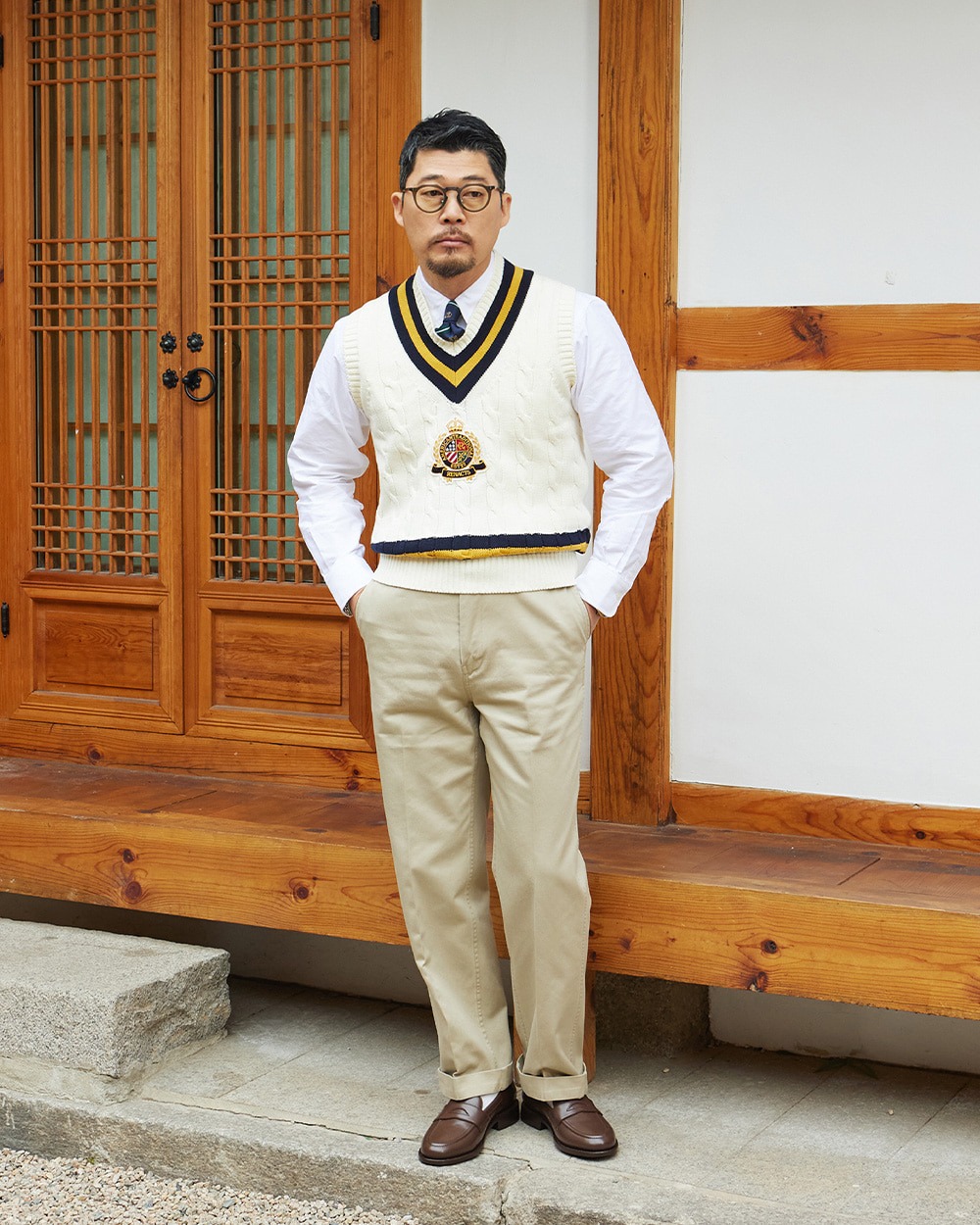
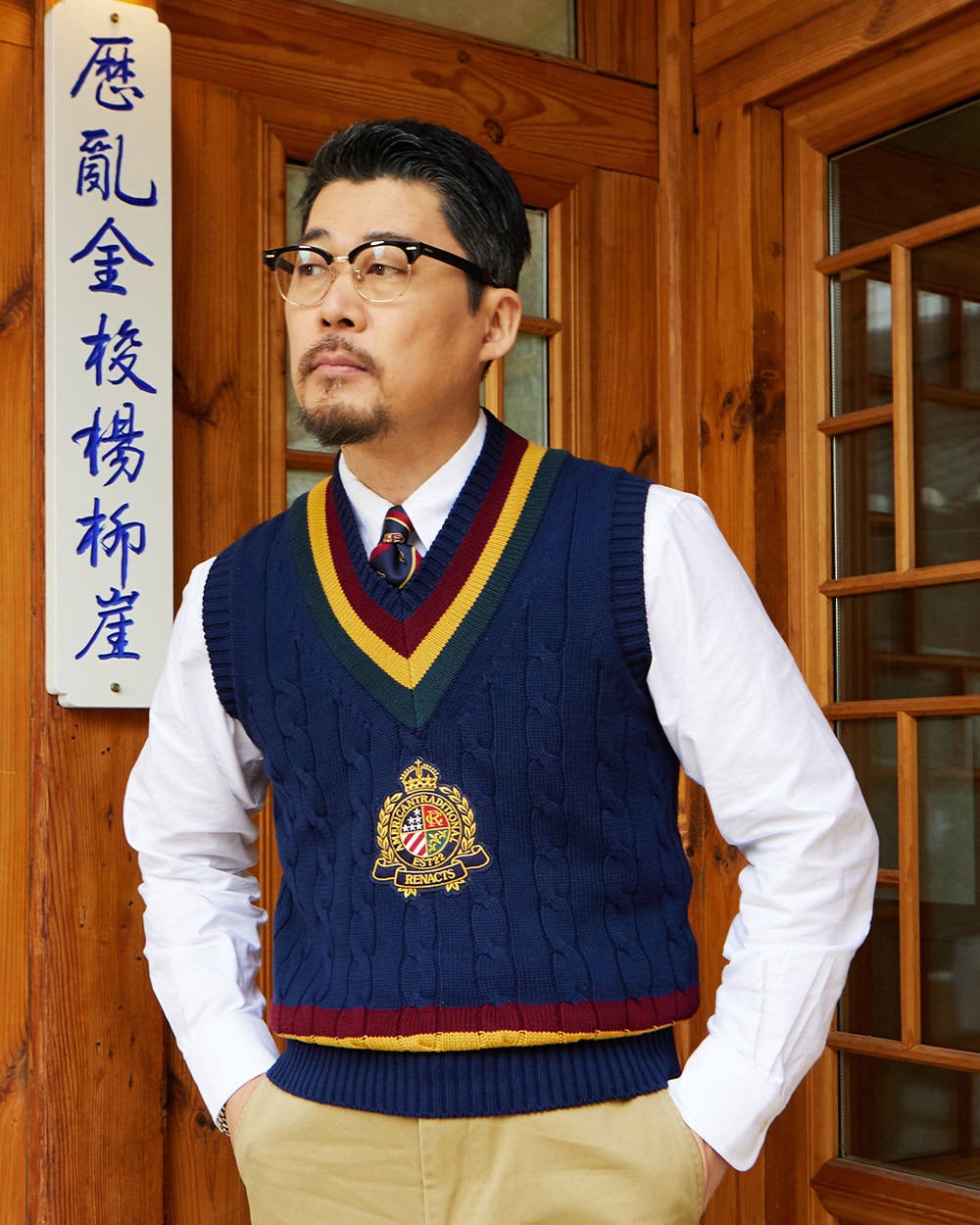
Roll the shirt sleeves if you want it casual. Leave them down with a tie and it passes in most Seoul offices.
Fit and Fabric: What to Check Before You Buy
A few non-negotiables for a cricket sweater to actually work:
- Cotton, not synthetic. Traditional cricket sweaters were wool. In Seoul’s humidity, cotton is more wearable and drapes similarly. Avoid acrylic blends — they shine and pill.
- Visible cable. The cable panel should be visible from two metres away. If the cable is flat or the knit is too tight, the sweater loses its period character.
- Two-stripe or three-stripe tipping. Single stripes look amateur. Three stripes (as on club heraldry) look correct. Two is the most common and still works.
- Ribbed cuff and hem. Should have real depth — at least 2-3 inches — not a thin band.
- V-neck depth. Should land at the second button of a dress shirt when worn. Too-deep V is modern distortion; too-shallow V is school uniform.
Why the Cricket Sweater Works in Seoul
Seoul is a city with real seasons. April is still cold in the shade, November lingers above zero. The cricket sweater is specifically a shoulder-season garment — warmer than a shirt, cooler than a coat-weight knit. The crest vest extends that window by a few weeks on either side.
From November it goes under a coat, which is where the ivory body earns its place against a camel or navy overcoat.
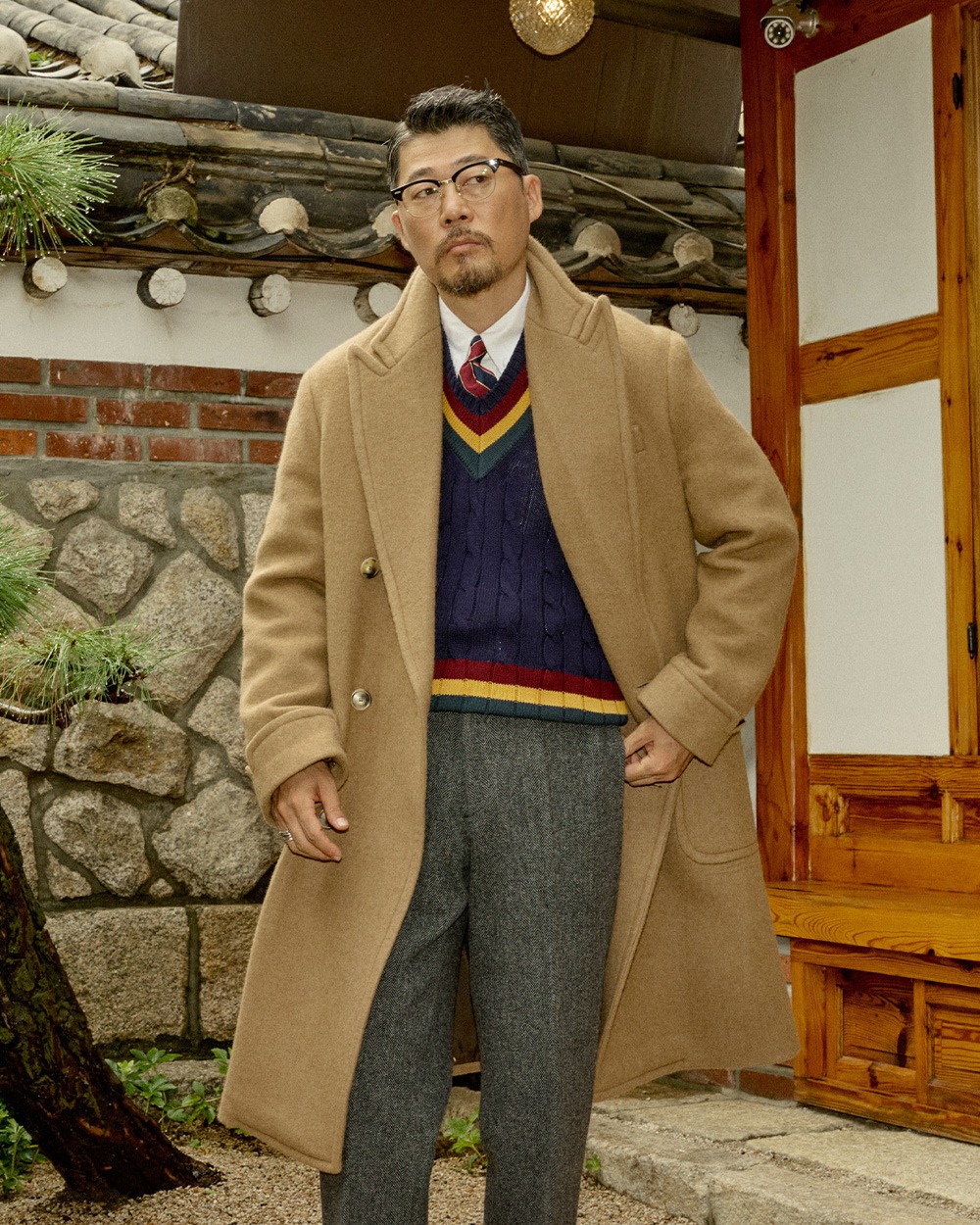
There is no direct Seoul cricket tradition to lean on — Korea isn’t a cricket nation. The sweater arrives here through a different path: English sportswear to American Ivy to Japanese trad to Korean menswear. By the time it reaches Seongsu or Yeonhui-dong, it has stopped being about cricket and started being about legible craft heritage. That is fine. Clothing doesn’t owe its original sport anything.
If you want to try one in person, Renacts’ cotton cricket sweater and crest vest are both stocked at Gentlemens House in Yeonhui-dong, Seoul. Cream V-neck, navy V-neck, ivory vest, navy vest — four products, one cut, the same 1920 logic Alan Paine codified in Godalming a century ago.