
Penny Loafer History: From New England Prep to Seoul Streets
The Penny Loafer History Starts in Norway, Not New England
Most people assume the penny loafer history begins somewhere on a leafy New England campus. It doesn’t. The story starts in rural Norway, around 1930, with a cobbler named Nils Gregoriusson Tveranger.
Ready to wear them? Once you know the story, see how to style them with real outfits in our Penny Loafer Outfit Ideas guide — six proven combinations for Seoul weather.

Tveranger designed a slip-on shoe inspired by the moccasins worn by Sámi fishermen in northern Scandinavia. He called it the “Aurland shoe” after his hometown. It had a simple leather strap across the instep — no laces, no buckles, nothing fussy.
Norwegian tourists brought the shoe back to America and Europe throughout the 1930s. American shoemakers noticed. And then everything changed.
How Bass Weejuns Created an American Icon
In 1936, G.H. Bass & Co. in Wilton, Maine released the “Weejun” — a play on “Norwegian.” They kept Tveranger’s slip-on design but added a key detail: a leather saddle strap across the vamp with a diamond-shaped cutout.

That cutout was decorative. Students at Ivy League schools turned it functional — or at least symbolic — by slipping a penny into the slot. Nobody knows exactly why. The leading theories range from “emergency phone call money” to “it just looked cool.” I’m betting on the second one.
By the late 1950s, the penny loafer was as much a part of the Ivy League uniform as the sack blazer and the oxford button-down. The trio shared the same retailers — J. Press, Brooks Brothers, The Andover Shop. It wasn’t a dress shoe. It wasn’t a casual shoe. It sat perfectly in between, which is exactly why it worked everywhere.
The Penny Loafer History on Campus: Why Students Loved It
Here’s the thing about mid-century college life: dress codes were strict but students were lazy. You had to wear a jacket to class at Princeton. You had to wear leather shoes at Harvard dining halls. Nobody wanted to fuss with laces between football practice and a lecture.

The penny loafer solved this. Slip it on, slip it off. Wear it with grey flannels for a seminar, or with chinos and a crewneck sweater on Saturday. Wear it sockless — scandalous at the time — to a mixer.
The shoe’s versatility wasn’t a marketing pitch. It was discovered by the students who wore them every single day. That’s the best kind of endorsement a shoe can get.
Anatomy of a Penny Loafer: What Makes It Different
Not all loafers are penny loafers. The penny loafer has specific features that distinguish it from tassel loafers, bit loafers, and Venetian loafers.

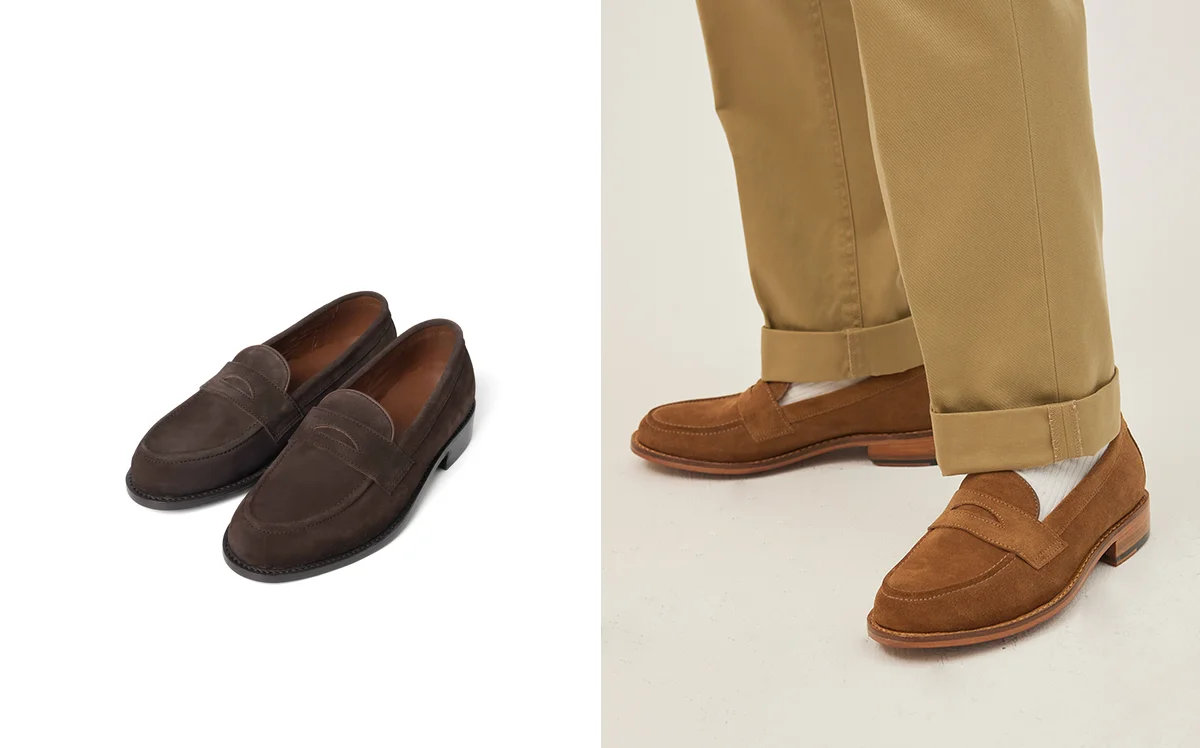
The saddle strap crosses the vamp with that signature diamond cutout. The moc toe stitching gives the toe a slightly rounded, casual shape. The heel sits low — usually under an inch. And the sole was traditionally leather, though many modern versions use rubber or a combination.
Within the penny loafer world, there are two main construction styles. The dress penny has a flat, stitched-down strap and a sleeker profile. The beef roll has a chunky, rolled seam where the strap meets the vamp, creating a more rugged, textured look. For the Seoul Traditional approach — Ivy-leaning, practical, slightly heavy — the beef roll is the better choice. It has more character.
The Three Loafer Types
The slip-on has branched into three shapes worth knowing. Only one of them is fully at home in a trad wardrobe.
| Type | The detail that names it | Where it sits |
|---|---|---|
| Penny | A saddle strap with a diamond cutout across the vamp. Beef roll versions have the strap rolled and stitched at the edges, which reads chunkier and more casual. | Buy this first. It carries denim and odd trousers alike, and it is the type most tied to the Ivy tradition. |
| Tassel | Two leather tassels hanging from a lace threaded across the vamp. Alden’s version became the East Coast lawyer’s shoe through the 1960s — Paul Newman and JFK both wore them. | A step dressier. Best with a blazer and grey flannels. |
| Bit | A metal snaffle across the vamp, introduced by Gucci in 1953. | The most European of the three, and the hardest to place in a trad outfit. Worth knowing it exists. |
Penny Loafer History Meets Seoul: Why This Shoe Works Here
In the original Ivy context, the penny loafer was a shoe for walking between lecture halls and eating clubs. In Seoul today, it’s a shoe for navigating subway transfers, café meetings, and weekend walks along the Han River.

Seoul’s style leans layered and practical. People walk more than they drive. The weather swings from humid summers to freezing winters. A penny loafer fits the warm-weather months perfectly — March through October, roughly — and pairs naturally with the chinos-and-OCBD combinations that form the backbone of Seoul Trad dressing.
I’ll be blunt: the penny loafer is the single most versatile shoe in the Seoul Traditional wardrobe. A blazer with loafers looks polished for a client dinner in Gangnam. Chinos with loafers works for a Saturday in Seongsu. Shorts with loafers handles a July afternoon in Hannam. Name another shoe that covers all three. You can’t.
Choosing the Right Penny Loafer: Leather, Color, and Sole
Start with color. Your first pair should be burgundy (also called #8 or cordovan color) or a medium brown. Not black — black penny loafers look like waiter shoes. Burgundy is the Ivy classic. It pairs with navy, grey, khaki, and olive without thinking.
For leather, full-grain calfskin is the standard. It develops a patina over time and takes a polish well. Some brands offer cordovan shell leather — beautiful but expensive and stiff until broken in. For everyday Seoul wear, calfskin is the practical choice.
Soles matter more than people think. Leather soles look correct but can be slippery on Seoul’s marble subway floors. A rubber sole or leather sole with a rubber heel cap gives you the traditional look with actual grip. Pure leather soles on a rainy Seoul day are a disaster waiting to happen.
How to Wear Penny Loafers the Seoul Traditional Way
The penny loafer’s superpower is range. Here are the combinations that work best within the Seoul Trad framework.

The weekday default: Oxford cloth button-down tucked into slim chinos, penny loafers, no socks or invisible socks in summer. Add a blazer when the meeting matters. This is the uniform. It works because every piece is pulling equal weight — nothing is trying too hard.
The weekend layer: Crewneck sweater over an OCBD, chinos or casual slacks, penny loafers. When the temperature drops in fall, swap the crewneck for a heavier knit and throw an anorak over everything. The loafers anchor the outfit and keep it from looking too sporty.
The summer move: Well-fitted shorts that hit just above the knee, a tucked OCBD with sleeves rolled twice, penny loafers sockless. Ivy students in the 1950s wore exactly this combination. It still looks right because the proportions haven’t changed.
One rule: always match your belt leather to your loafer leather. Brown belt with brown loafers. Burgundy belt with burgundy loafers. A small detail. But it signals you understand how clothes work together.
Penny Loafer Care: Making Them Last Years
Penny loafers take more abuse than most shoes because they’re slip-ons — the heel counter gets stressed every time you force your foot in. Use a shoehorn. Every single time.
After each wear, insert cedar shoe trees. They absorb moisture and hold the shape. This alone will double the life of your loafers. Wipe the leather with a damp cloth after wearing, and condition with a quality leather cream once a month.
For polishing, use a matching cream polish — not wax — for a subtle, natural shine. Wax polish gives a mirror finish that looks too formal for a shoe designed to be easygoing. You want the leather to glow, not gleam.
Rotate your loafers. If you wear them daily, own two pairs and alternate. Leather needs 24 hours to fully dry between wears. This isn’t optional advice — it’s the difference between loafers that last two years and loafers that last ten.
The Penny Loafer History Continues — On Seoul’s Streets
The penny loafer has survived every fashion cycle since the 1930s. Preps wore them. Mods wore them. Michael Jackson wore them. Korean college students are wearing them right now in Sinchon and Hongdae.
What makes the penny loafer’s staying power so striking isn’t that it started in a Norwegian fishing village. It’s that the shoe has never needed to change. The silhouette, the strap, the slip-on ease — it all works as well today as it did when Bass first released the Weejun in 1936.
In the Seoul Traditional philosophy, that kind of endurance matters. We’re not chasing trends. We’re looking for pieces that work across years, across contexts, across the gap between a Tuesday meeting and a Sunday walk. The penny loafer does all of that. Always has.