Cinch-Back Chino History: From 1937 Army Spec to Ivy Campus
Cinch-Back Chino History Starts Before Belt Loops Existed
Every cinch back chino history article begins the same way — with the U.S. Army in 1937. But the story actually starts eighty years earlier. The cinch back, that small adjustable buckle strap at the rear waistband, is a vestige of an era when belt loops simply didn’t exist on trousers.
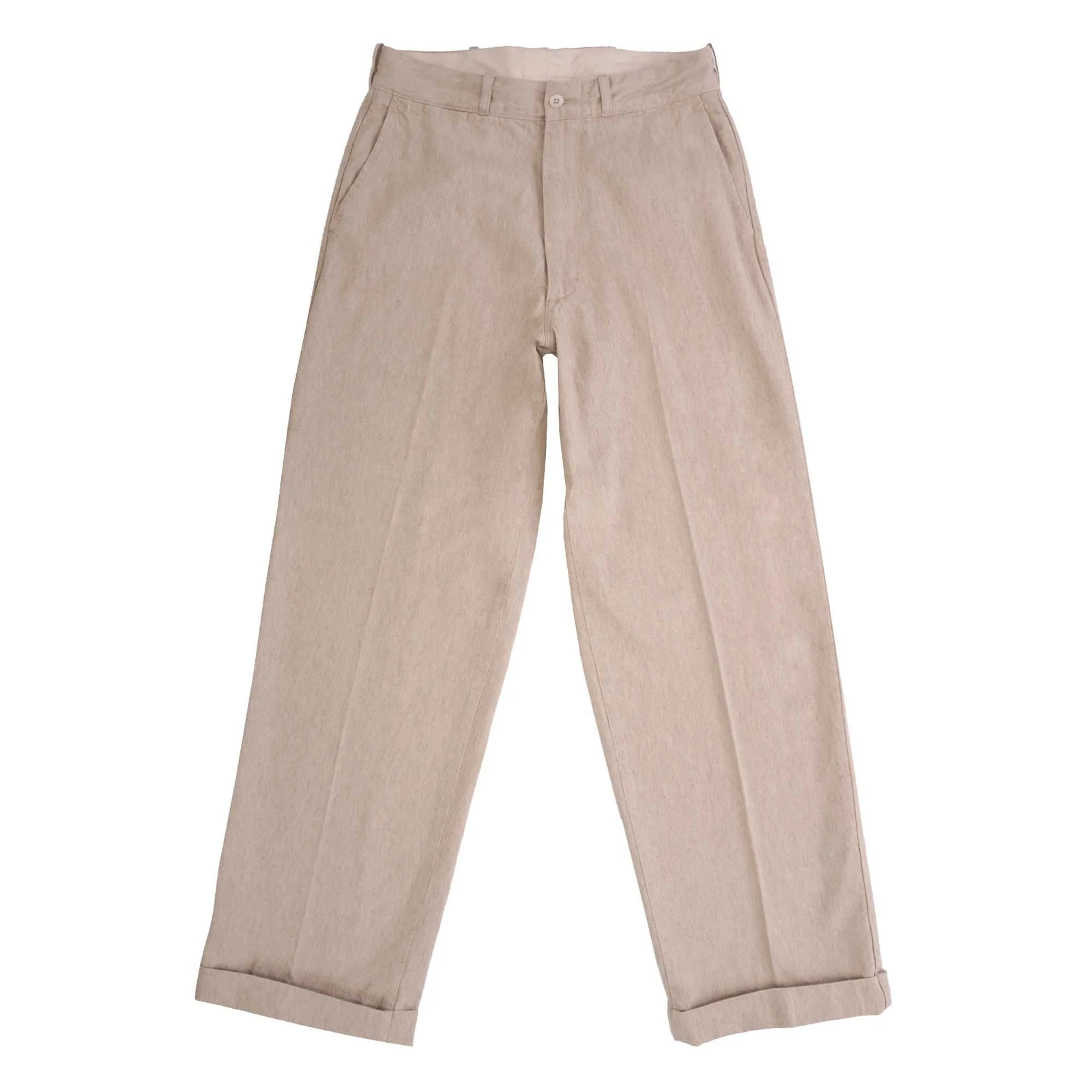
The detail predates the 1950s significantly. By the mid-19th century, work trousers commonly featured rear-waistband adjustment straps — what we’d now call a buckle-back or cinch-back. An 1857 tailoring reference cited in Cunnington & Cunnington’s Handbook of English Costume in the Nineteenth Century already describes trousers that “may be worn without braces as the waistband may be fastened behind by buckle and strap.” At that time, men relied on suspenders, side adjusters, or these rear cinch straps to keep their pants up. Belt loops wouldn’t become standard on civilian trousers until the 1920s. This deep prehistory is what makes cinch back chino history more than a 20th-century footnote.
Here’s the thing: when belt loops finally arrived, the cinch back should have disappeared. It was functionally redundant. But it didn’t vanish — it migrated into military specification, where it would begin its most famous chapter.
US Army Specification QMC 6-254: The Chino Gets Official
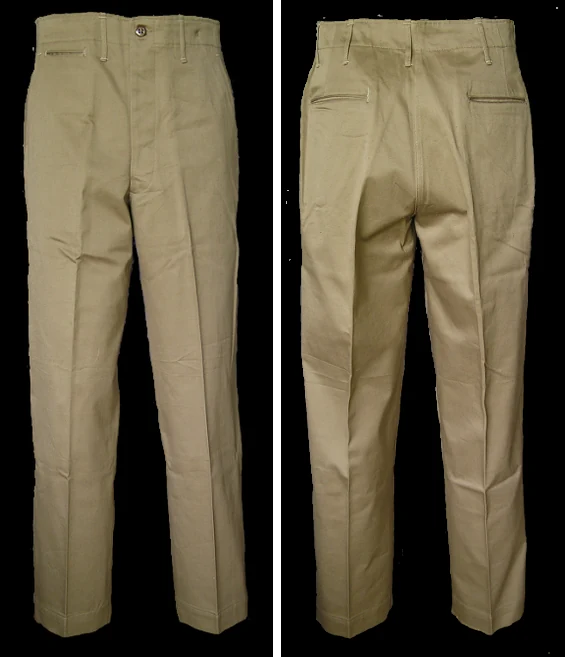
On November 8, 1937, the United States Army Quartermaster Corps issued Specification QMC 6-254. This document defined the standard-issue cotton khaki trouser in precise detail: 8.2-ounce cotton twill, khaki-dyed, with a cinch-back waistband adjuster at the rear.
The spec wasn’t trying to be fashionable. It was solving a practical problem. Military trousers needed to fit a wide range of body types without bespoke tailoring. The cinch strap allowed one trouser to accommodate a range of waist sizes — cheaper and faster than producing dozens of exact measurements.
The 8.2oz cotton twill weight set the template for what we still call a “chino.” Heavier than dress trousers, lighter than canvas workwear. That specific weight — dense enough to hold a crease, light enough for tropical postings — became the foundation of an entire garment category. This is the inflection point of cinch back chino history: the moment a vestigial detail became codified military equipment.
From Barracks to Main Street: The Post-WWII Civilian Crossover
Sixteen million Americans served in World War II. When they came home, they brought their khakis with them — literally. Surplus Army chinos flooded the civilian market in the late 1940s, and returning GIs kept wearing what they already owned.
This is a pattern that repeats throughout menswear history. The bomber jacket, the peacoat, the field jacket — all followed the same path from military issue to civilian wardrobe. But the chino’s crossover was uniquely democratic. Officers and enlisted men alike had worn them. They carried no class connotation.
By 1949, surplus stores across America were selling Army-spec cinch-back chinos for a fraction of what department stores charged for dress trousers. College students, who were themselves often veterans on the GI Bill, snapped them up. The stage was set for the Ivy campus craze — the most-photographed chapter of cinch back chino history.
1952–1956: The Cinch-Back Chino Conquers the Ivy Campus
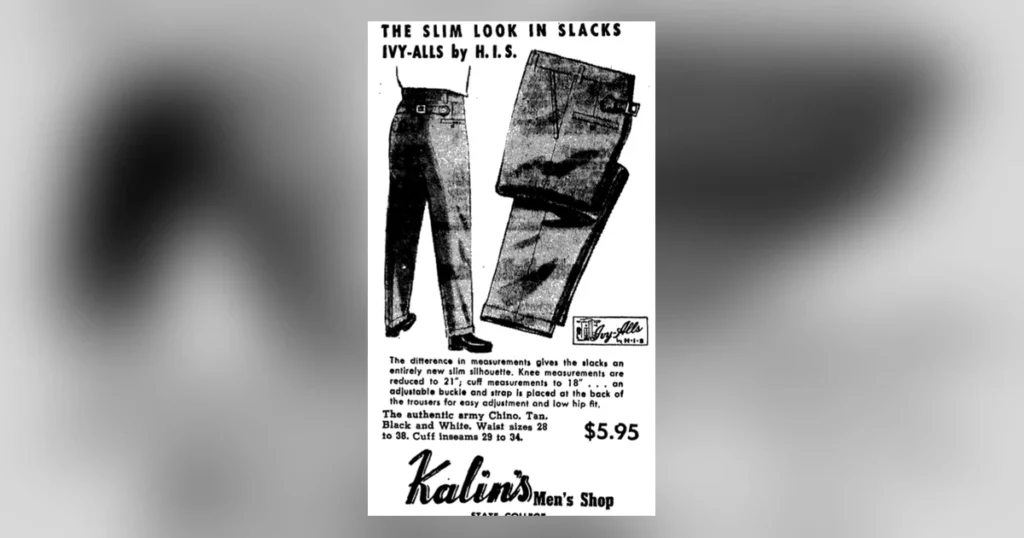
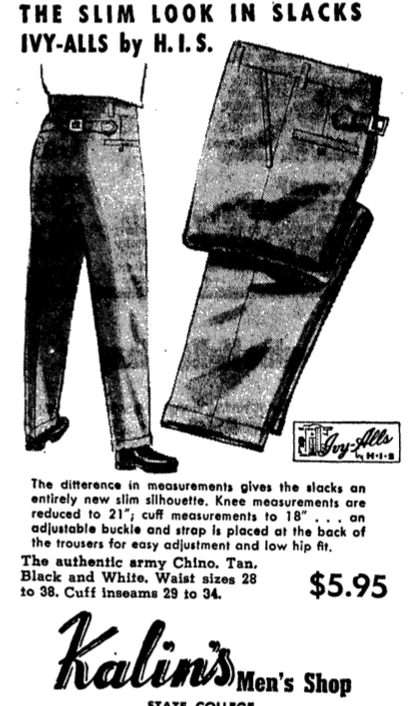
The early 1950s are the golden era of cinch back chino history. In 1952, the brand H.I.S. launched a product called “Ivy-Alls” — cinch-back chinos marketed directly at college students. The name tells you everything about the target market.
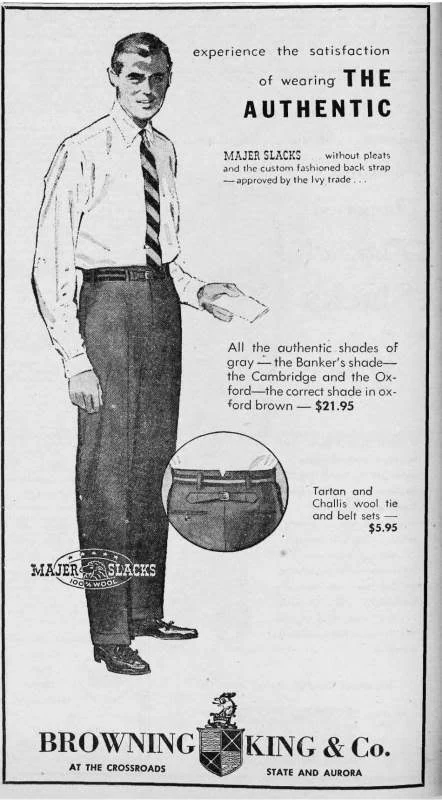
That same period saw established Ivy clothiers adopt the cinch back. Chipp, Browning King, and J. Press all offered their own versions. When J. Press — arguably the most conservative Ivy retailer — puts a cinch back on their chinos, you know it’s not a fad. It’s the standard.
Between 1952 and 1956, the cinch-back chino was the default trouser on campuses from New Haven to Cambridge to Princeton. Worn with white bucks, penny loafers, or dirty white sneakers. Usually washed until soft, often with the cuffs rolled once.
The buckle at the back was as much a tribal marker as the OCBD collar roll — it signaled that you belonged.
Tea and Sympathy: The Cinch Back on Screen in 1956
If you want a single freeze-frame from cinch back chino history at its peak cultural moment, watch the 1956 film Tea and Sympathy. Adapted from Robert Anderson’s Broadway play, it’s set at a New England prep school — exactly the milieu where cinch-back chinos were uniform.
The costume design captures the era with documentary precision. The young male characters wear their chinos high-waisted, slightly loose through the leg, with the cinch back visible when jackets ride up. It’s a snapshot of Ivy style before it became self-conscious — before anyone was trying to “dress Ivy.” They were just wearing what everyone wore.
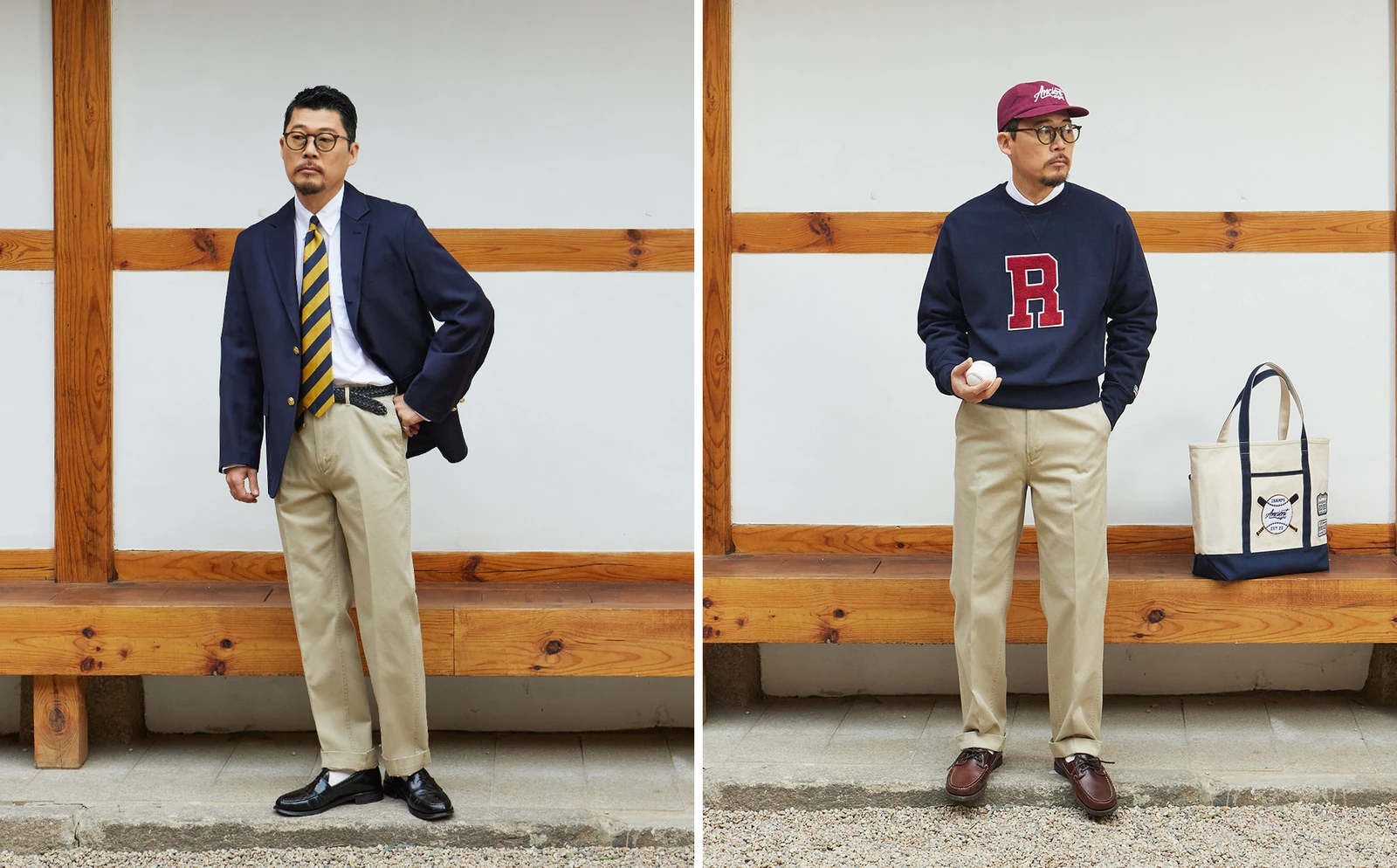
This distinction matters. The cinch-back chino wasn’t an affectation in 1956. It was the most normal trouser a young American man could own. Seventy years later the formula still reads — a navy blazer, a striped tie, and a soft Light Beige cinch-back chino do the same work today as they did in the prep school dining hall. This frame-by-frame fidelity is why cinch back chino history reads as continuous, not nostalgic.
The 1958 H.I.S. Ad: Signaling the End of an Era
By 1958, H.I.S. was still advertising cinch-back chinos, but the tone had shifted. The ads now positioned the cinch back as a nostalgic feature rather than a current necessity. Belt loops had won. The adjustable rear strap was becoming decorative — a nod to tradition rather than a functional element.
What killed the cinch back? Partly the rise of permanent-press fabrics, which demanded cleaner, simpler waistband construction. Partly the general trend toward slimmer, more streamlined trousers in the early 1960s.
Add to that the rise of the leather belt as a style element rather than a mere functional accessory — once the belt itself became part of the look, the rear adjuster lost both its purpose and its visual rationale. The cinch back’s slightly bulky appearance at the rear waistband felt old-fashioned next to the flat-front revolution.
Fair warning: this is where cinch back chino history gets a little sad. By the early 1960s, the buckle strap had largely disappeared from mainstream new production. A detail that had been standard for over a century retreated to vintage shops and specialty makers in roughly four years.
Levi’s 1950s Archive and the LVC Reproduction
The cinch-back chino might have been forgotten entirely if not for the vintage reproduction market. Levi’s Vintage Clothing (LVC) line eventually produced a “Cinch Back Pants” model based on their 1950s archive patterns.
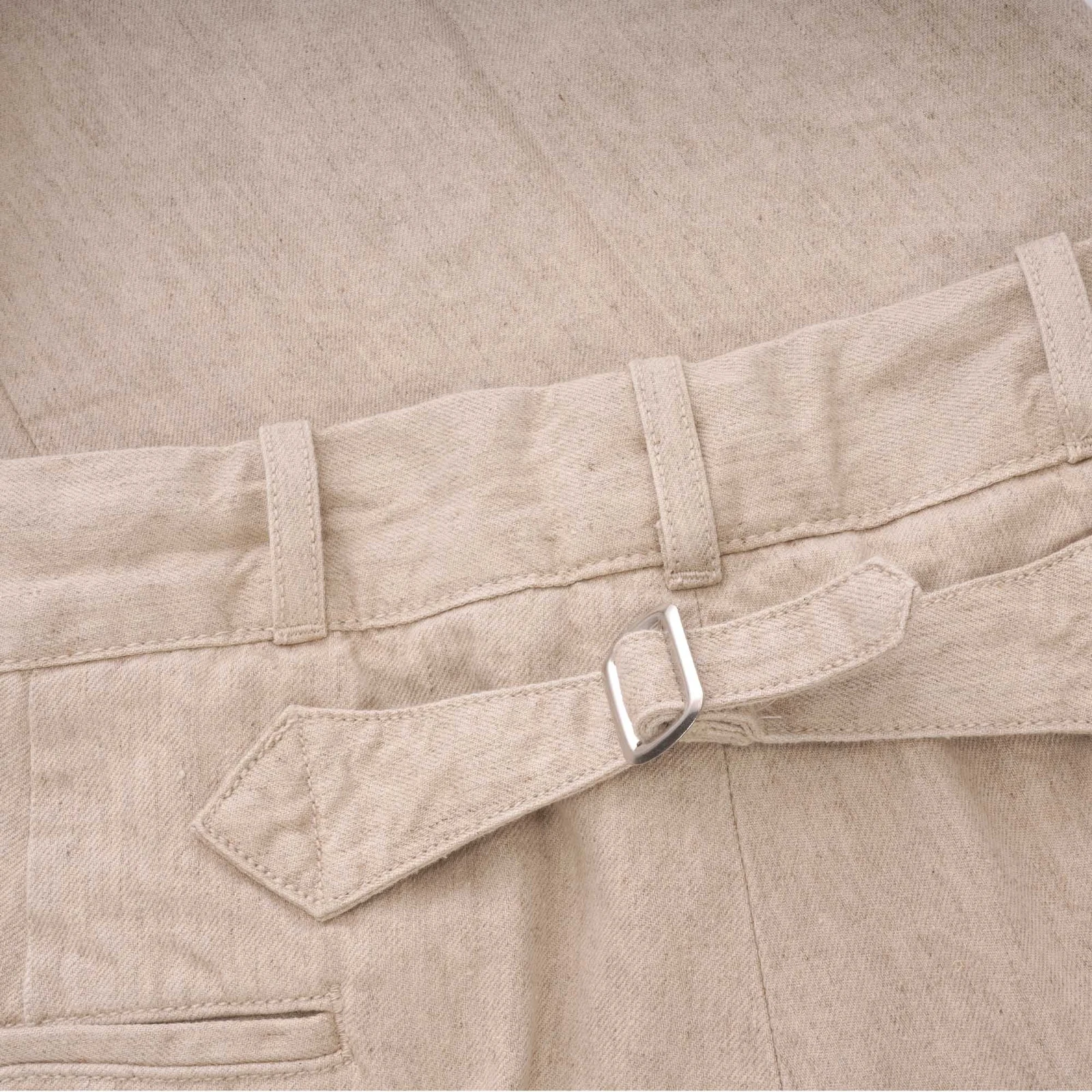
The LVC reproduction matters because Levi’s actually held original 1950s samples in their archive. This wasn’t a guess at what the trousers looked like — it was a direct reproduction from surviving garments. The details were faithful: the rear cinch strap with buckle, the wide waistband, the fuller leg.
Stuart’s London and other specialty retailers stocked the LVC Cinch Back Pants, introducing a new generation to the detail. For many younger menswear buyers, this was their first encounter with the cinch back — not through vintage hunting, but through a modern reproduction of a 1950s original. Without LVC’s archive work, cinch back chino history might have stayed a niche of vintage shops and specialty resellers.
Sta-Prest 1964 vs. the Cinch-Back Era: Two Different Worlds
To understand what replaced the cinch-back chino, look at Levi’s Sta-Prest trousers, introduced in 1964. Sta-Prest used a resin-treated fabric that held a permanent crease without ironing. It was the future — or at least it felt like it in 1964.
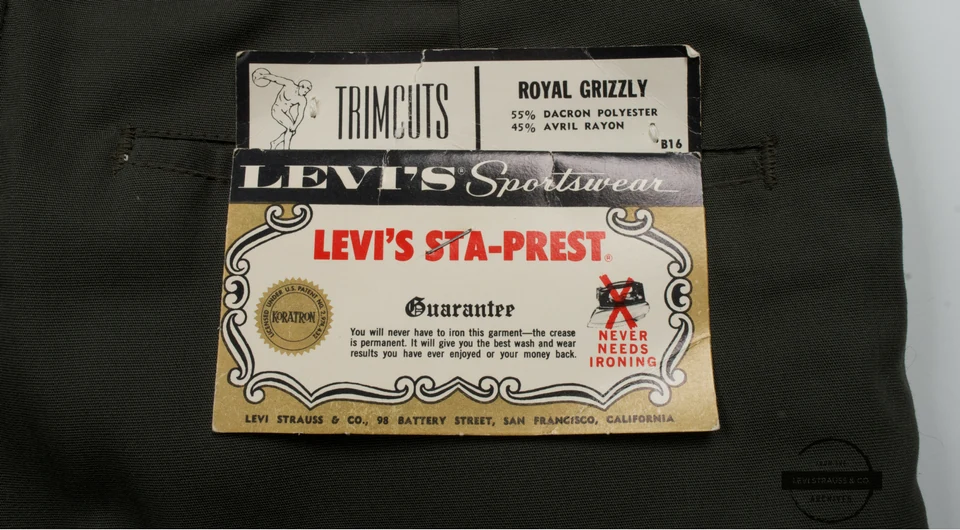
The contrast with the cinch-back era couldn’t be sharper. Cinch-back chinos were meant to be washed, beaten up, softened over time. They looked better after fifty washes than after five. Sta-Prest was about looking freshly pressed at all times — a chemical solution to a problem that the previous generation hadn’t considered a problem at all.
This is the fork in the road for American trousers. One path leads to permanent-press synthetics, polyester blends, and eventually the wrinkle-free Dockers of the 1990s. The other — the cinch-back path — leads to garment-washed cotton, natural wear patterns, and the understanding that a trouser should age with its owner. We know which path Seoul Traditional prefers.
The Cinch-Back Revival: Renacts Garment Washed Pipe Stem Chinos
Today, cinch back chino history isn’t just a topic for archive nerds. It’s relevant because the philosophy behind the cinch back — adjustability, durability, character through wear — is making a comeback.
![Cinch back chino history revival — Renacts Garment Washed Pipe Stem [Light Beige] front and back showing restored functional cinch back buckle](https://seoultrad.com/wp-content/uploads/2026/05/renacts-pipe-stem-light-beige-product.webp)
![Cinch back chino history revival in navy — Renacts Garment Washed Pipe Stem [Navy] front and back with the same 1950s cinch back detail](https://seoultrad.com/wp-content/uploads/2026/05/renacts-pipe-stem-navy-product.webp)
The Garment Washed Pipe Stem from Renacts is the revival made literal. The cinch back here isn’t decorative — the buckle actually moves through its strap, allowing a measurable amount of waist adjustment at the rear, exactly as the 1937 Army spec intended. Garment-washed 100% cotton softens the hand and accelerates the patina that vintage examples developed over years of wear. Buffalo horn buttons on the welt pockets and a YKK zip fly are the modern concessions; the rest is faithfully 1950s.
The “Pipe Stem” name itself is a nod to the silhouette — the way those original cinch-back chinos draped straight from the hip like a pipe stem, before the slim-and-tapered revolution of the 2000s. Available in Light Beige and Navy at $155, the pair covers the spectrum — the lighter shade for summer Ivy and warm-weather styling, the darker for autumn-winter and dressier registers. Pair either with an OCBD tucked in and penny loafers, and you’re wearing something a 1954 Yale sophomore would recognize instantly.
Why the Cinch Back Still Matters in Seoul
In the original Ivy context, the cinch-back chino represented something specific: practicality dressed up as style. It was a military surplus garment adopted by the most privileged students in America. That tension — utilitarian origins, elite adoption — is exactly what makes it interesting.
On the streets of Seoul, that translates: Navy Pipe Stem chinos with a cricket sweater and Y cap on one register, with an OCBD and a striped knit tie on another — both inheriting the same 1937 spec, both carrying the cinch back as a small functional detail.
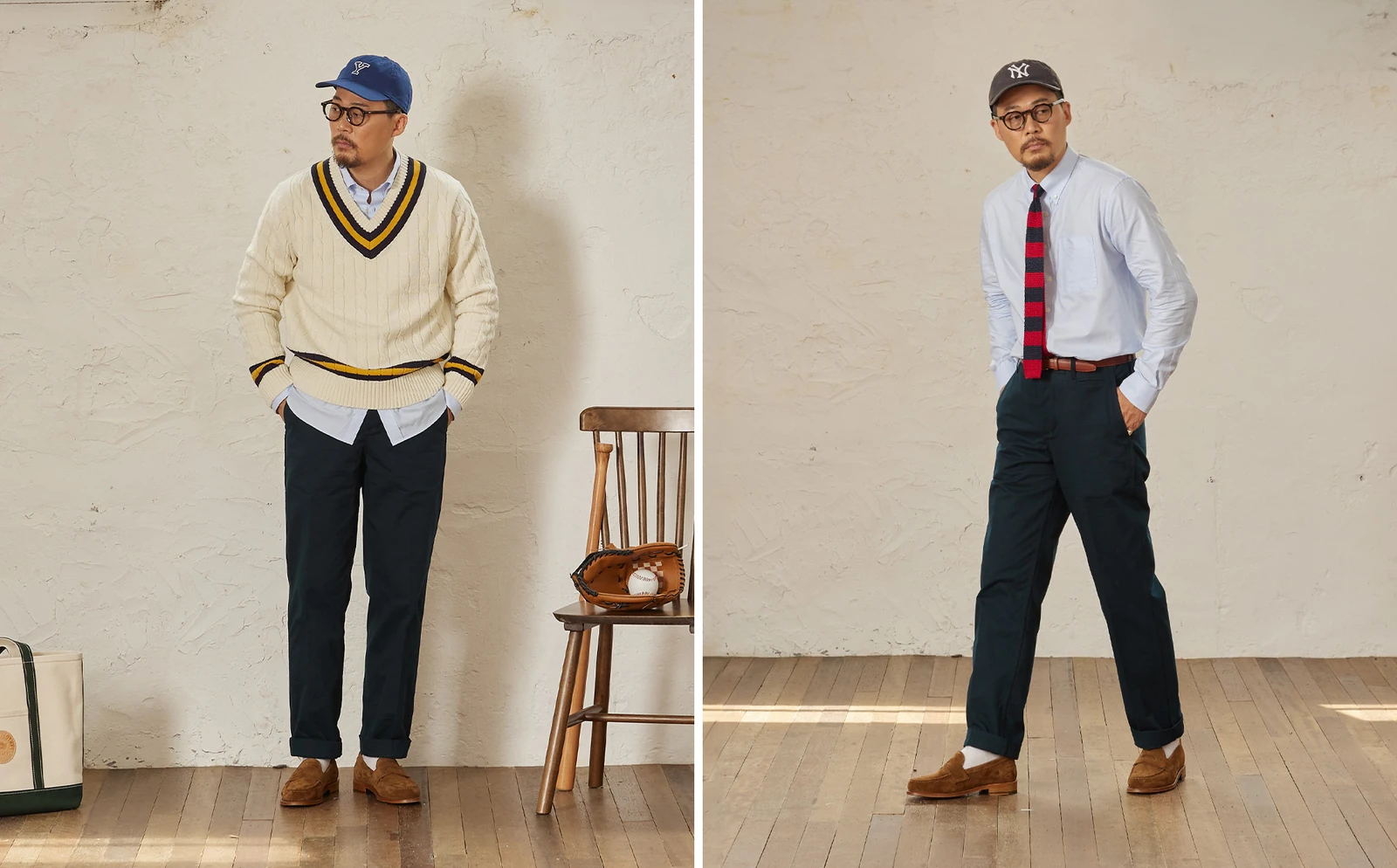
In Seoul today, the cinch back chino history resonates for different reasons. Korean menswear culture values garment knowledge — knowing why a detail exists, what it references, where it came from. A pair of chinos with a cinch-back detail isn’t just trousers; it’s a conversation about American military history, Ivy League campus culture, and the question of which vintage details deserve revival and which should stay in the archive.
That’s the Seoul Traditional approach to any garment: understand it completely before you wear it. The cinch back earned its place in trouser history. Knowing this story changes how the garment feels on your body. That’s the whole point. Cinch back chino history isn’t museum content — it’s the operating manual for a trouser you can still wear tomorrow.