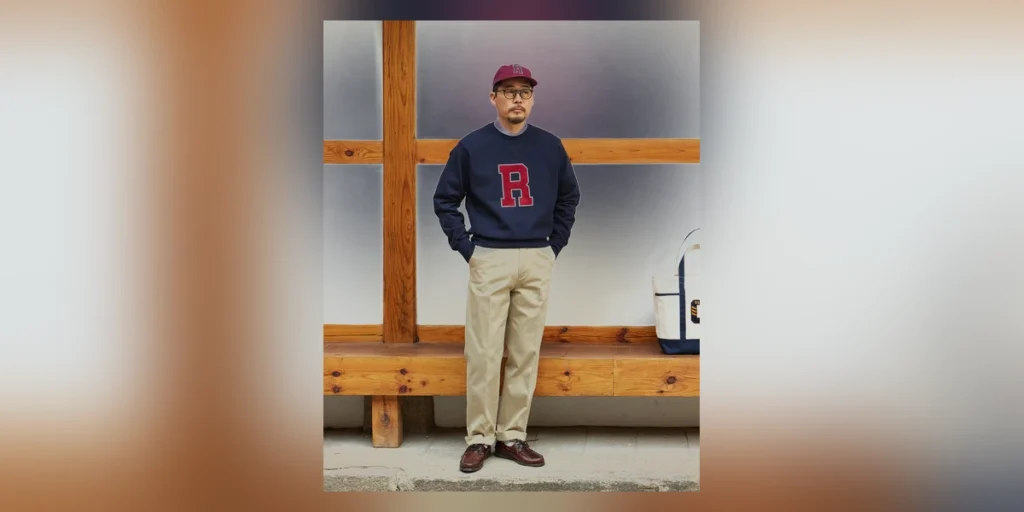
How to Wear a Reverse Weave Sweatshirt: 7 Ivy Outfit Ideas
The Reverse Weave Sweatshirt Outfit Starts With Understanding the Garment
A reverse weave sweatshirt outfit isn’t just any sweatshirt outfit. The reverse weave is a specific Champion construction. The brand began developing the technique in 1934 and received its first US patent in 1938 — fabric rotated ninety degrees so the loops run horizontally, which keeps the shoulder seam from collapsing after wash and dry. The mechanism is simple: standard sweatshirt fleece shrinks far more lengthwise than crosswise, so rotating the panels redirects that shrinkage across the body instead of down it. The chest measurement might give a fraction; the shoulder-to-hem length stays where you bought it. That single technical detail is why a forty-year-old reverse weave sweatshirt still hangs the same way it did the first time someone pulled it on.
For our purposes, that means a reverse weave sweatshirt outfit can be worn with the structure intact. The sweatshirt holds its line under a blazer instead of bunching at the armhole. The hem stays where you put it instead of riding up over chinos. Every formula below assumes that structural integrity — without it, half of these would fall apart visually within a season.
Why the Reverse Weave Sweatshirt Outfit Belongs in Ivy Style
By the 1950s, the sweatshirt was already firmly part of American campus casual wear — it had migrated out of varsity athletics and into everyday dress through the 1930s and 40s. By the 1960s, it sat alongside the OCBD and the chino as one of the standard pieces an undergraduate actually owned — the foundation of a reverse weave sweatshirt outfit then and now, worn with white sneakers or penny loafers depending on weather. The reverse weave version was the durable one — the heavyweight that stayed structurally honest through four years of laundromat abuse, the one upperclassmen still wore in their senior year.
What changed since then is layering. Modern Seoul Ivy treats the sweatshirt as a middle layer, not just a top. It goes under a blazer, under an anorak, under a Harrington. It also goes over an OCBD with the collar showing. Both moves require a sweatshirt that holds its shape — the reverse weave does, and that’s what makes the seven outfits below work the way they do.
Outfit 1: The Layered Ivy Standard — Blazer Over Sweatshirt Over OCBD
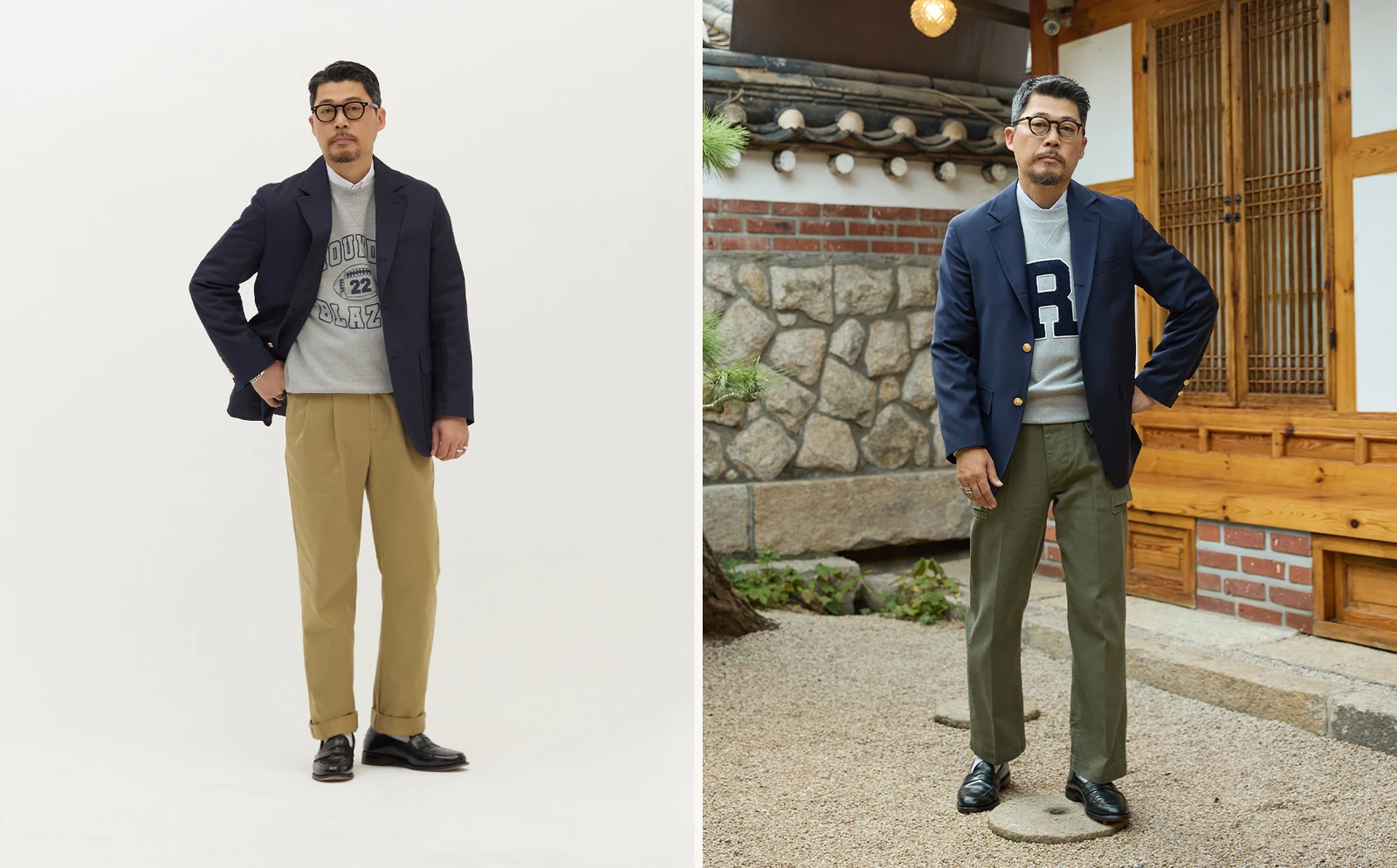
This is the maximum-layered version of a reverse weave sweatshirt outfit and the one that most directly references 1950s campus tailoring. Navy blazer with brass or horn buttons, reverse weave sweatshirt with collegiate or athletic graphics, white OCBD with the collar visible at the neck, cuffed chinos, black penny loafers. Five layers of menswear vocabulary stacked cleanly.
The pant is what changes the register. Standard khaki chino on the left reads classic Ivy — what a Yale junior would have worn to a casual Saturday lunch in 1958. M-1943 HBT (herringbone twill, US Army 1943 issue) on the right adds a military-archive note that pulls the outfit slightly grittier, more closely aligned with the cinch-back chino tradition. Either way the rule holds: tuck the OCBD, leave the sweatshirt loose over it, button the blazer’s middle button when standing. This reverse weave sweatshirt outfit reads almost identically to a 1958 Yale junior at a Saturday lunch — proof that the formula has held for seventy years.
Outfit 2: Blazer Goes Casual — Drop the OCBD
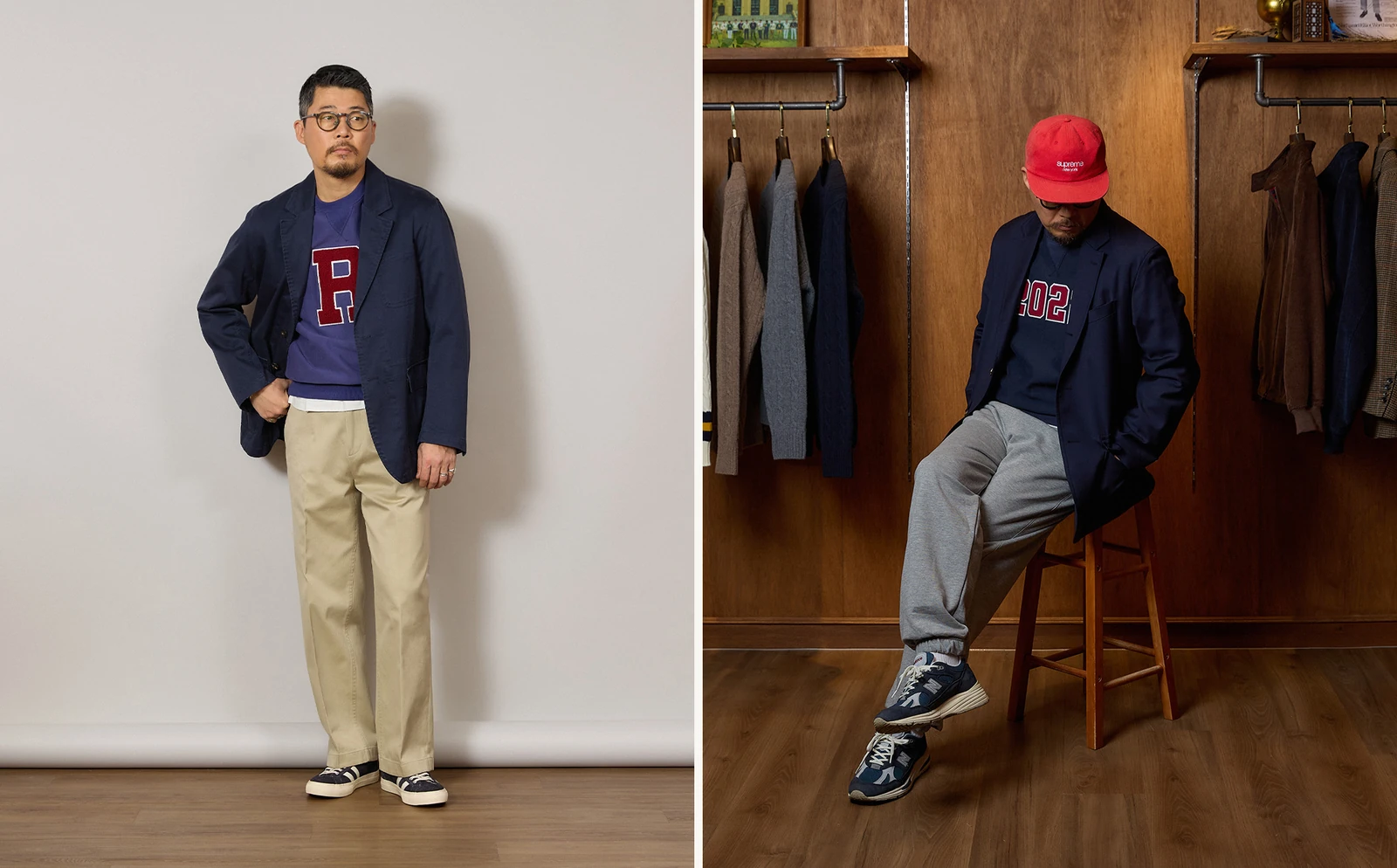
Same blazer, no OCBD underneath. The reverse weave sweatshirt is now the visible top under the blazer, and the outfit’s formality drops three notches without losing the silhouette. With khaki chinos and deck shoes (left) it’s an errand outfit that still respects the rules. With grey sweatpants, a ball cap, and New Balance 991v2 (right), you’ve crossed into Ivy-meets-athleisure — the matching sweat set is doing the work that a suit would do, and the blazer is the corrective adult layer.
The athleisure-prep variant is more aggressive than the rest of this guide — and more aggressive than most Ivy purists would endorse. It earns its place because the blazer’s precise construction (soft shouldered, undarted, no extra hardware — the same natural shoulder tailoring the sack suit relies on) reframes the sweatpants as a deliberate choice rather than a fallback. Treat this as one defensible move at the edge of the rulebook, not a default. Wear it to a casual gallery opening or weekend brunch and it reads as someone who knows the conventions and is choosing to bend them — the most ambitious reverse weave sweatshirt outfit in this guide, and the one that requires the most discipline.
Outfit 3: Drop the Blazer, Keep the OCBD

This is the version of a reverse weave sweatshirt outfit that does the most work in actual life. Sweatshirt over a tucked OCBD with the collar showing at the neck, khaki chinos, ball cap. The shoes change the register: white sole boat shoes (left) for warm weather and easy weekends; brown suede penny loafers (right) for cooler days and when the rest of your day requires a half-step up.
The reason this layering works is the OCBD’s collar — it provides a structural break between face and chest that a crewneck tee can’t match. Without that collar the outfit falls into “I just rolled out of bed” territory. With it, the sweatshirt becomes a deliberate choice rather than the default — and the reverse weave sweatshirt outfit lives where smart-casual menswear actually happens.
Outfit 4: Dress the Bottom Up — Slacks or Ivory Chinos
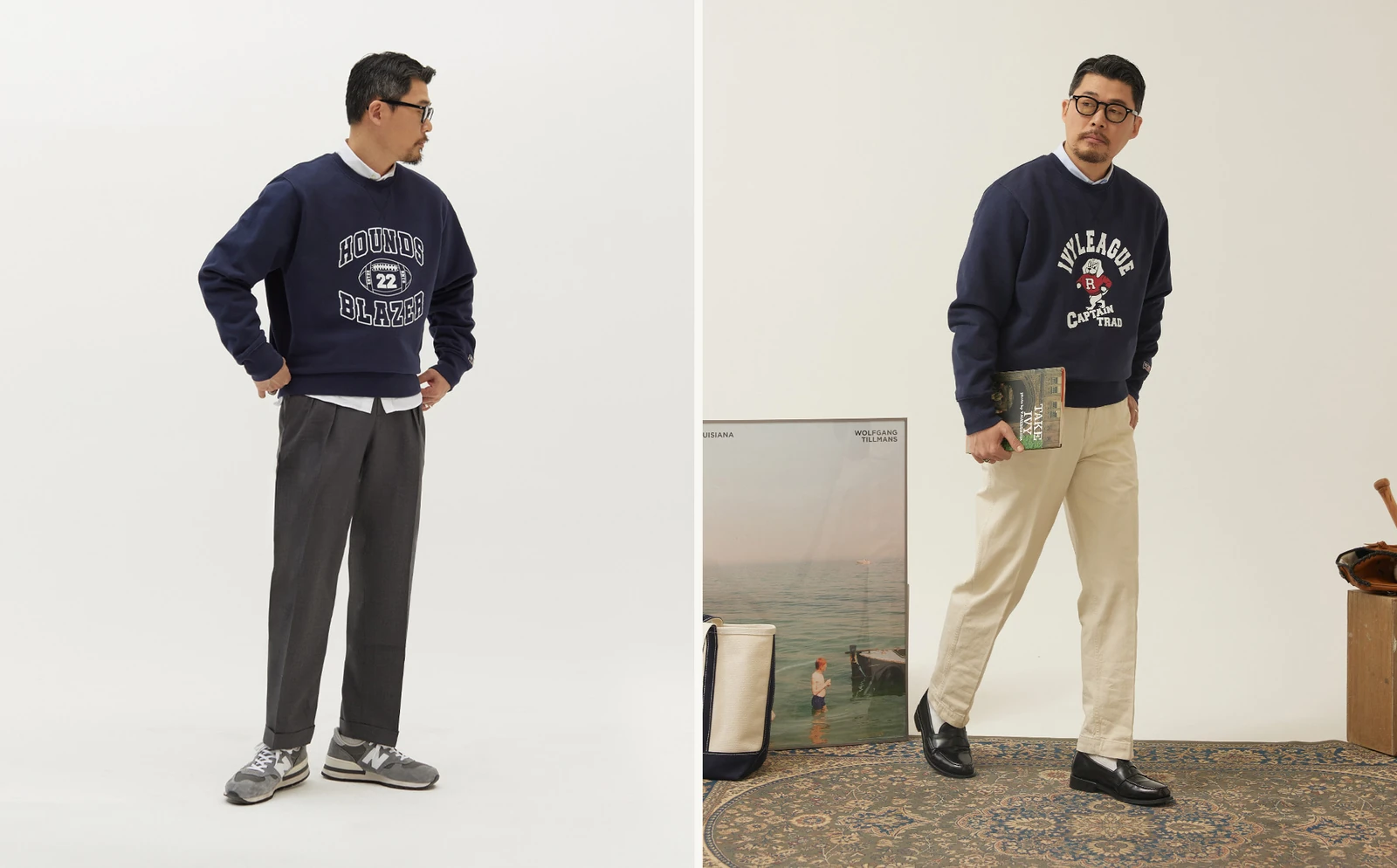
The trick most people miss with a reverse weave sweatshirt outfit: you can put it on top of dressy bottoms and the contrast does the work. Charcoal grey wool slacks with grey New Balance 990v1 (left) takes the sweatshirt into smart-casual office territory — somewhere a quarter-zip would normally live but with more character. Ivory chinos with black penny loafers (right) reads cleaner than khaki and slightly more European; the OCBD collar provides the only crisp white note.
Both versions assume you’re not wearing the sweatshirt as a sports garment. The fit is precise, the bottom is structured, the shoes are correct. The casual element is just that one sweatshirt — and against everything else, it functions as a personality detail rather than a comfort default. The same reverse weave sweatshirt outfit logic applies: structured bottom, precise shoes, deliberate casual top.
Outfit 5: With Denim — The Original Pairing

The reverse weave was a college athletic garment before it was an Ivy garment, and denim is where it grew up. This pairing is the historical default — what a 1960s student wore to walk between dorm and dining hall on a cold Saturday. The OCBD layered underneath is the elevation that makes it Ivy rather than just casual.
Grey New Balance 990v1 with a ball cap (left) keeps the outfit in college-grounds territory. Brown suede penny loafers with the same cap (right) lift it half a step toward weekend dinner. The denim is the constant — straight cut, mid wash, cuffed once, hitting the loafer at the right break. This is the reverse weave sweatshirt outfit at its most historically accurate.
Outfit 6: Plain or Layered — Sweatshirt as the Top
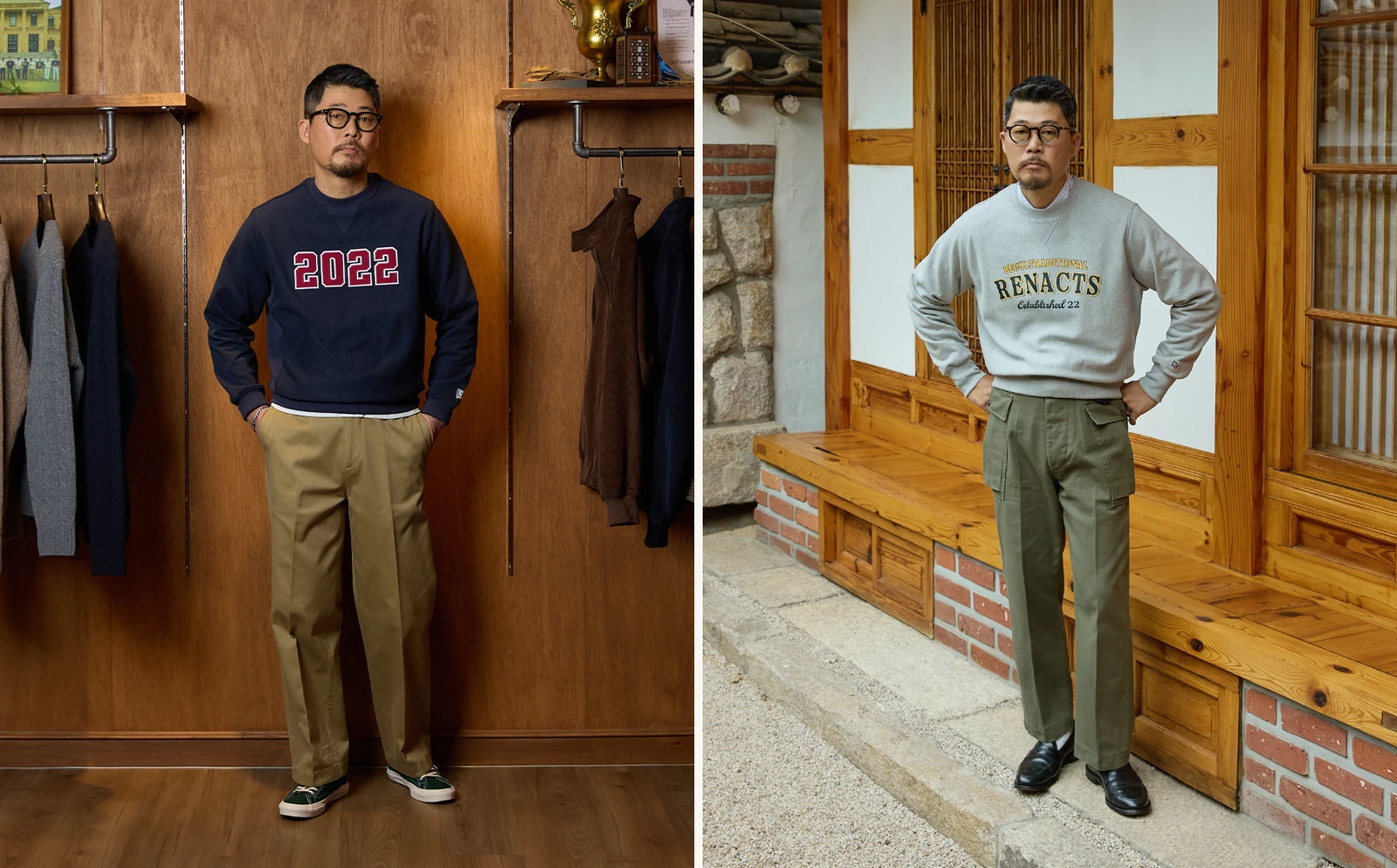
The simplest correct reverse weave sweatshirt outfit and the most layered version of the same idea. Just sweatshirt with khaki chinos and deck shoes (left) is what a confident dresser wears on the day they don’t want to think about clothing — but the proportions and shoes still need to be right or it collapses into laundry-day territory.
Pull the OCBD back through and swap to M-1943 HBT trousers with black penny loafers (right) and the same garment is doing entirely different work. The first version is a good Saturday morning; the second works for a casual weekday office, a non-formal dinner, or — in Seoul — a gallery walk in Yongsan or Itaewon when the weather doesn’t justify a blazer. A reverse weave sweatshirt outfit at this register is the modern equivalent of what an Ivy senior would have thrown on for a study session.
Outfit 7: Outerwear and Summer Layer — Two Seasons
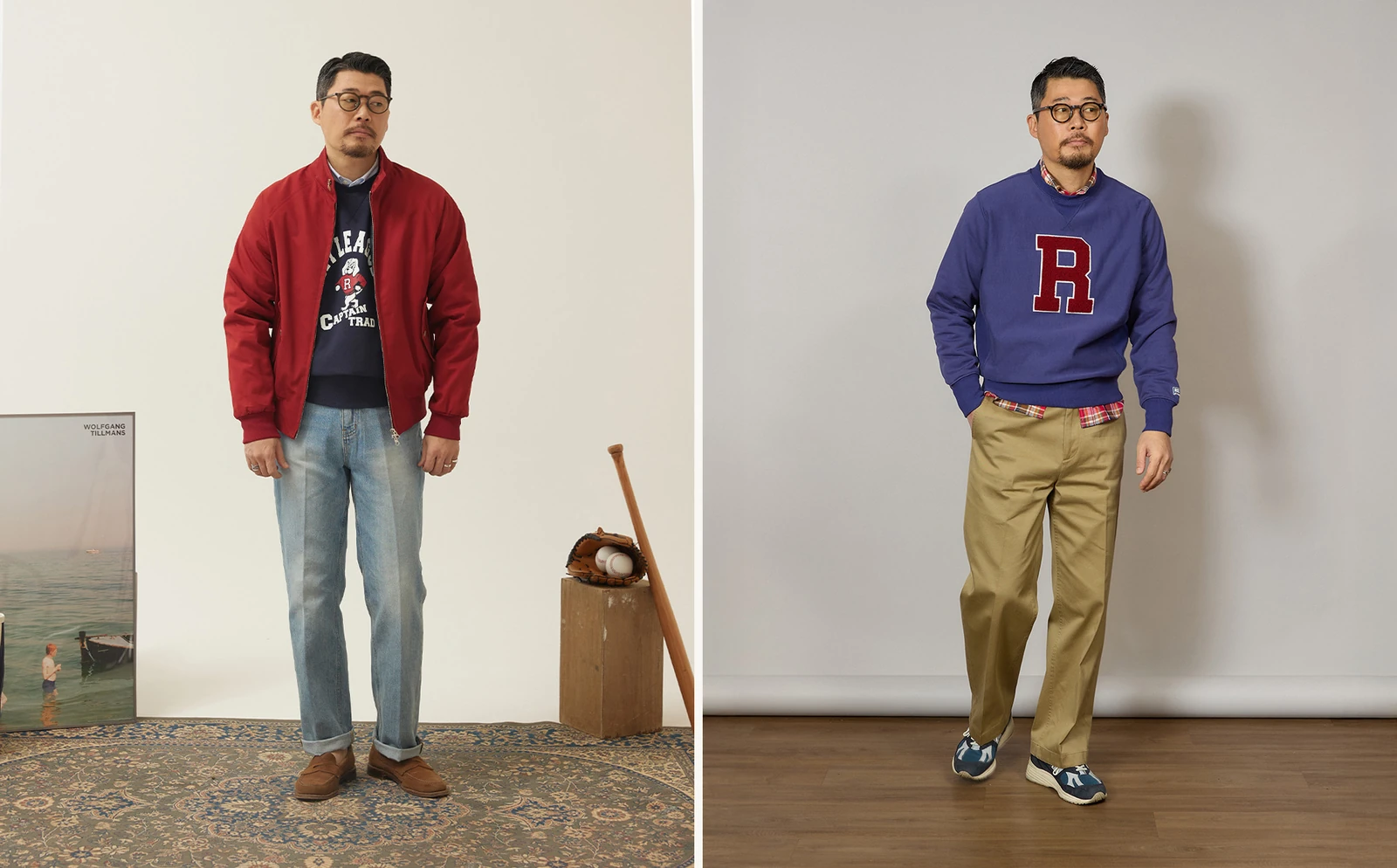
The reverse weave is most useful at the seasonal edges — too warm for a sweater, too cool for a single shirt. A red Harrington over the sweatshirt-OCBD-denim stack (left) is autumn and early spring; the Harrington’s elastic hem sits cleanly over the sweatshirt’s hem so the silhouette stays trim. Brown suede penny loafers ground it.
The other direction: madras shirt under the sweatshirt instead of OCBD (right), with khaki chino and New Balance 991v2. This is the sweatshirt’s early-summer move — when the temperature drops at night but the day is too warm for full Ivy layering. The madras pattern peeks out at the collar and cuffs, doing all the visual work the OCBD would normally do but with summer color. The reverse weave sweatshirt outfit is one of the few menswear formulas that scales cleanly across all four seasons.
Picking the Right Reverse Weave Sweatshirt
Not every reverse weave is equal. The original Champion construction has a specific weight (around 12 oz cotton, sometimes more), a specific pebbled face, and side gussets that prevent rolling. Modern reproductions vary widely — some are lighter, some skip the gusset, some print on a non-reverse-weave base and call it that. For a reverse weave sweatshirt outfit to work the way these formulas intend, the garment needs the structural properties, not just the marketing.
Fit-wise: shoulders should hit at your shoulder bone, not past it. Length should hit just below the natural waistband, not over the seat. Sleeves should hit the wrist with a centimeter of cuff turn-back available. These proportions are what separate a reverse weave sweatshirt outfit from a generic sweatshirt-and-pants combination. Collegiate or athletic graphics — left chest, full chest, or sleeve — are correct period detail; oversized streetwear graphics are a different garment doing different work. A reverse weave sweatshirt outfit only reads correctly when the garment itself is correct.
Colors That Actually Work
Heather grey is the foundation. It’s what every Champion archive sweatshirt was, it’s what looks right under a blazer, and it’s what reads correctly across all seven outfits above. Navy is the second color — slightly dressier, works better with khaki bottoms, less collegiate.
Cream and off-white are seasonally restricted (warm months only) but striking when worn correctly. Forest green and burgundy work with the right collegiate graphic. Avoid black for this category. Heather grey, navy, and cream are the historic Champion colors — they connect the garment directly to its athletic and Ivy lineage. Black reverse weave reads as a 2010s streetwear reissue rather than a campus garment, and the entire styling vocabulary shifts with it. The whole point of a reverse weave sweatshirt outfit is the garment’s softness and lineage; black flattens both.
Why the Reverse Weave Sweatshirt Still Matters in Seoul
In the original American context, the reverse weave was campus athletic wear that drifted into everyday rotation. In Seoul today it operates differently — as a heritage garment with a documented technical history, worn by people who know what reverse weave actually means and why the side gusset matters. That knowledge transforms the styling. A Seoul wearer pairing a fifty-year-old Champion silhouette with a navy blazer or M-1943 HBT trousers isn’t dressing nostalgically. They’re treating the sweatshirt the way our sack suit series treats the soft-shouldered jacket: as a form whose technical integrity earns it a place in serious wardrobes, regardless of where the wearer happens to live.
That’s the Seoul Traditional approach to any garment — understand the construction, respect the lineage, and let the styling follow. A reverse weave sweatshirt outfit done well is small evidence of a larger principle: heritage menswear doesn’t belong to one country. It belongs to whoever bothers to learn how the clothes were built and why.
Heavyweight sweatshirts in the line:
- 2022 Ivy Sweatshirt [Navy] — $94
- 2022 Ivy Sweatshirt [Grey] — $94
- Rugby Collar Sweatshirt [Grey] — $113
- Rugby Collar Sweatshirt [Navy] — $113