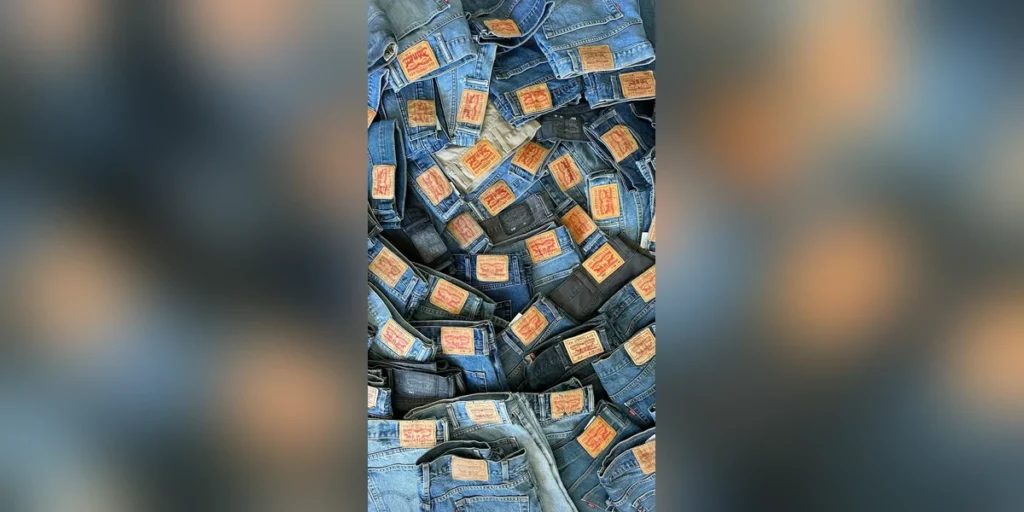
Levi’s 501: The 1873 Patent That Built American Denim
Most American clothing has a year you can point at. The sack suit got its full Brooks Brothers articulation in the late 19th century. The cinch-back chino was specified by the US Army in November 1937. But the Levi 501 history starts earlier than any of those — May 20, 1873, when a Reno-based tailor named Jacob Davis and a San Francisco wholesaler named Levi Strauss received US Patent #139,121 for “Improvement in Fastening Pocket-Openings.” The patent itself was boring: copper rivets at the corners of pant pockets to keep them from ripping off under load. The consequences took the next century to play out.
What follows is the Levi 501 history as Trad denim wearers need to know it: the patent, the lot number, the cultural pivot from workwear to youth rebellion, the Ivy adoption, and the Cone Mills lineage that ended in December 2017. For the lookbook on how to wear the silhouette today, see our 8-color Renacts trad denim lookbook. For the global brand picks, see 17 American Vintage Brands Every Trad Collector Should Know.
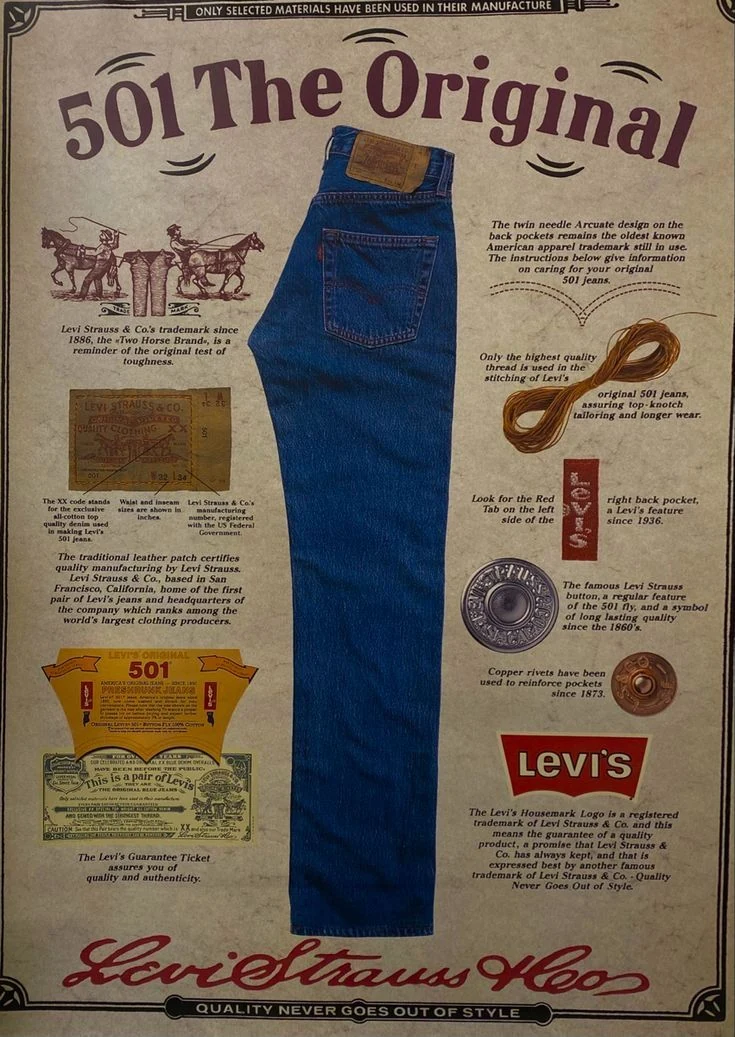
The 1873 Patent — How a Reno Tailor and a San Francisco Wholesaler Solved the Pocket Problem
The Levi 501 history begins not in San Francisco but in Reno, Nevada. Jacob W. Davis (1831-1908) was a Latvian-born tailor working there in the late 1860s. His shop made horse blankets, wagon covers, and the heavy cotton-duck and denim work pants miners and railway workers wore in the Comstock Lode era. The pants kept coming back with the same complaint: the pockets ripped off under the weight of tools and ore samples. Davis’s solution, sometime in late 1870 or 1871, was small: hammer copper rivets through the stress points where pocket fabric met the pant body. The pockets stopped tearing. Customers told other customers, and Davis couldn’t keep up with orders.
Davis wanted to patent the idea but couldn’t afford the $68 filing fee. He had been buying his denim from Levi Strauss & Co. — the San Francisco wholesaler that had supplied his shop with bolt fabric since the late 1860s — and in 1872 he wrote to Strauss proposing a partnership. Strauss put up the money. The patent was granted on May 20, 1873, in both their names. Davis moved to San Francisco to oversee production at Strauss’s new manufactory; Strauss handled the wholesale distribution. The arrangement held until Davis’s death in 1908.
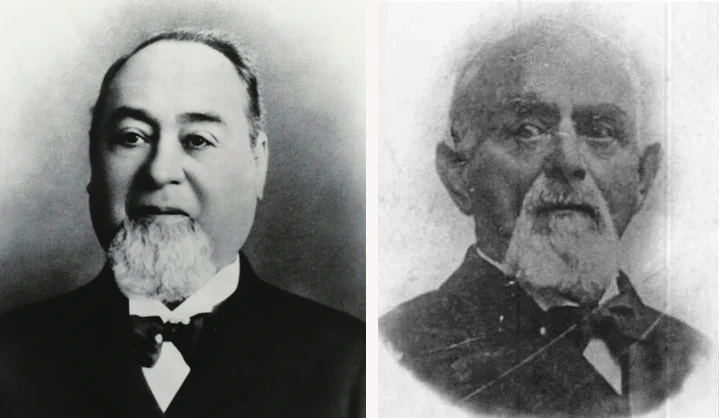
Levi Strauss (left, 1829-1902) and Jacob W. Davis (right, 1831-1908). Strauss was the wholesaler whose name attached to the brand; Davis was the Reno tailor who actually invented the rivet — and who needed Strauss’s $68 to file the patent.
The patent itself ran for seventeen years. When it expired in 1890, every other workwear brand in the United States immediately adopted riveted pockets — which forced Levi Strauss & Co. to find a different way to differentiate the product. The answer was the lot number, the next chapter of the Levi 501 history.
From XX to 501 — The Lot Number That Stuck
The next chapter of the Levi 501 history is the lot number itself. The original riveted pant was called the XX waist overall — “XX” referred to the heaviest weight of denim in Levi Strauss’s lineup. There was no “501.” The number entered the catalog in 1890, the same year the patent expired, as part of an internal lot numbering system Levi Strauss & Co. introduced to organize their expanding workwear range. Lot 501 was the company’s flagship XX denim waist overall — heaviest fabric, copper-riveted, single back pocket. The number stuck because it was easier for retailers to order by than “XX waist overall, copper-riveted variant.”
For the next sixty years, “501” was an internal accounting code. It didn’t appear on the product itself until the 1936 Red Tab addition (more on that below), and it didn’t enter mainstream consumer vocabulary until the post-war period. By the time American teenagers were buying 501s in the 1950s, they were buying a number that had been a wholesale lot reference for half a century.
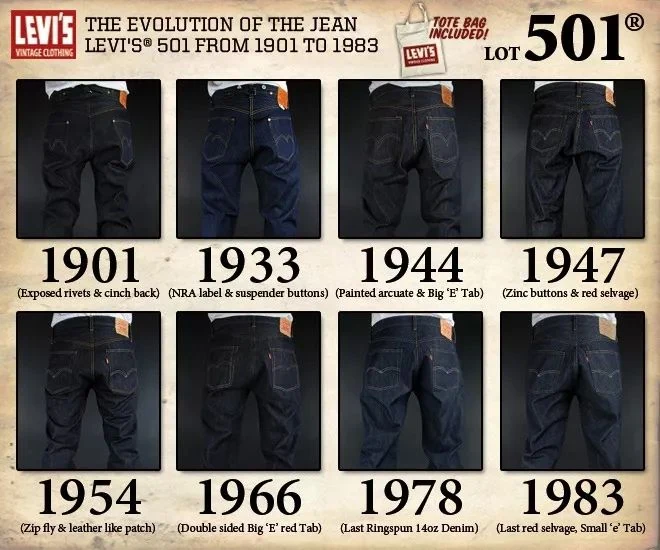
The other distinguishing element of the 501 was the cut: full thigh, neutral knee, no taper, button fly, single back pocket (the second back pocket was added in 1901). That silhouette — what the modern Trad denim register treats as canonical — was finalized essentially in the 1890s and barely changed for the next 130 years. The 1955 reproductions Levi’s Vintage Clothing makes today honor the same cut as the 1890s original, with only minor adjustments to rise and inseam to match modern proportions.
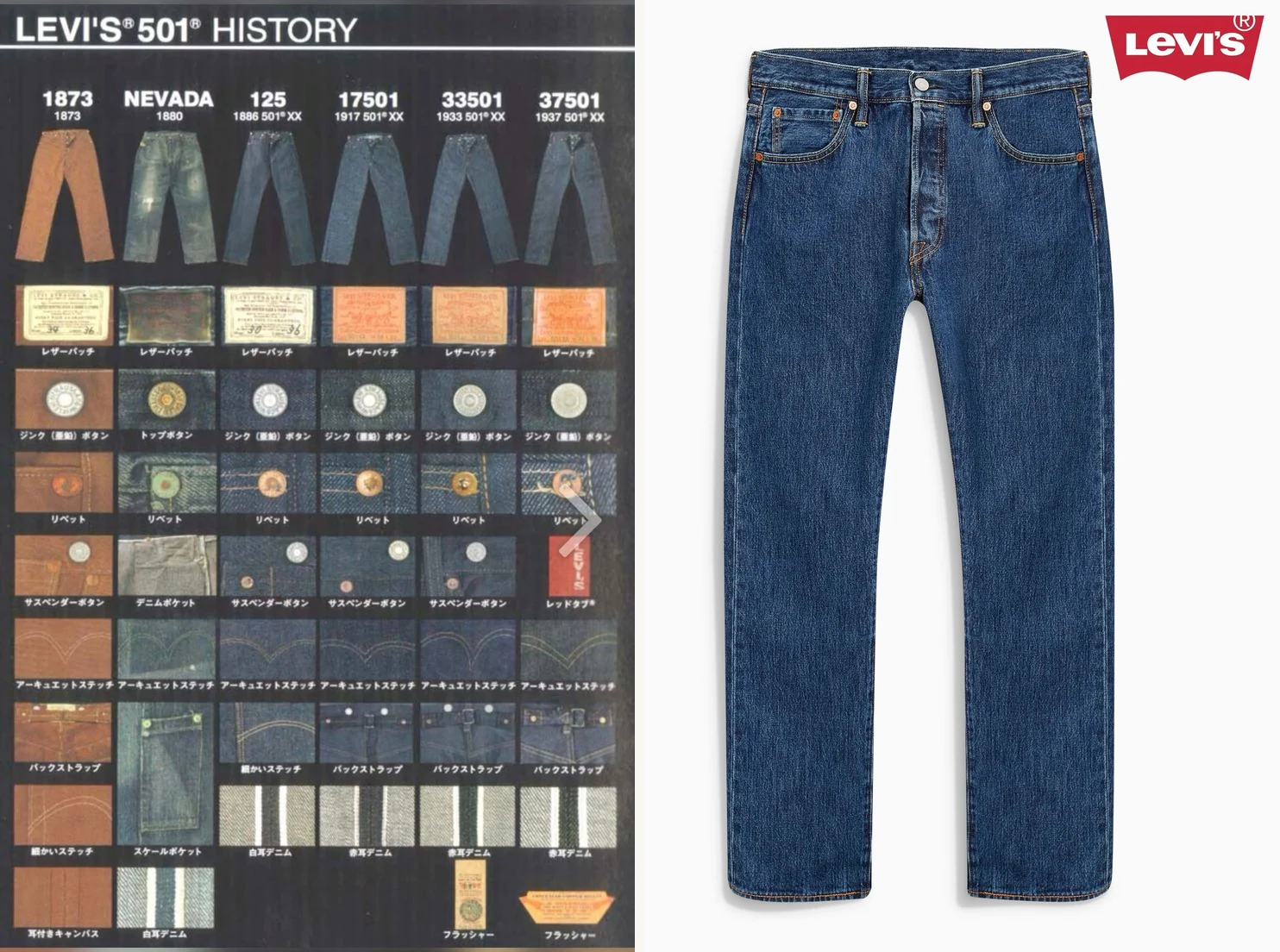
Quality Made Visible — 9 oz Amoskeag, Belt Loops, Red Tab
The next visible chapter of the Levi 501 history is the fabric. The early 501 was built from Amoskeag Manufacturing Company denim — 9 ounce, indigo-dyed, rope-dyed warp on white weft, made in Manchester, New Hampshire. Amoskeag was the largest textile manufacturer in the world at its 1900s peak; their denim went into Levi’s, into competitors, and into railroad uniforms across the country. The 9 oz weight was light enough to break in within weeks but heavy enough to outlast multiple seasons. (Modern Cone Mills 14 oz, used in the 1950s through 2017 era, is significantly heavier — a different generation of denim that produces a different fade pattern.)
Two visible details were added later. Belt loops appeared in 1922, replacing the suspender buttons that had been standard since 1873. The change was practical: by the early 1920s American men had largely moved from suspenders to belts, and the 501 followed the customer. The buttons remained on the waistband as decorative reference until the 1930s; Levi’s Vintage Clothing still includes them on the 1944 and earlier reproductions.
The red Tab appeared on the right back pocket in 1936. The reasoning was anti-counterfeit: by the mid-1930s, competing brands had been making riveted denim for forty-six years and the visual difference between a Levi’s pant and a competitor’s was negligible from a distance. The red Tab — at the time a small folded fabric label woven with the word LEVI’S in capitals — was a branding marker visible at twenty feet. It was patented and stayed exclusive to the brand. Every Trad denim register reproduction today either honors the red Tab (LVC, RRL, Renacts via license) or explicitly avoids it (Buzz Rickson’s, Sugar Cane).
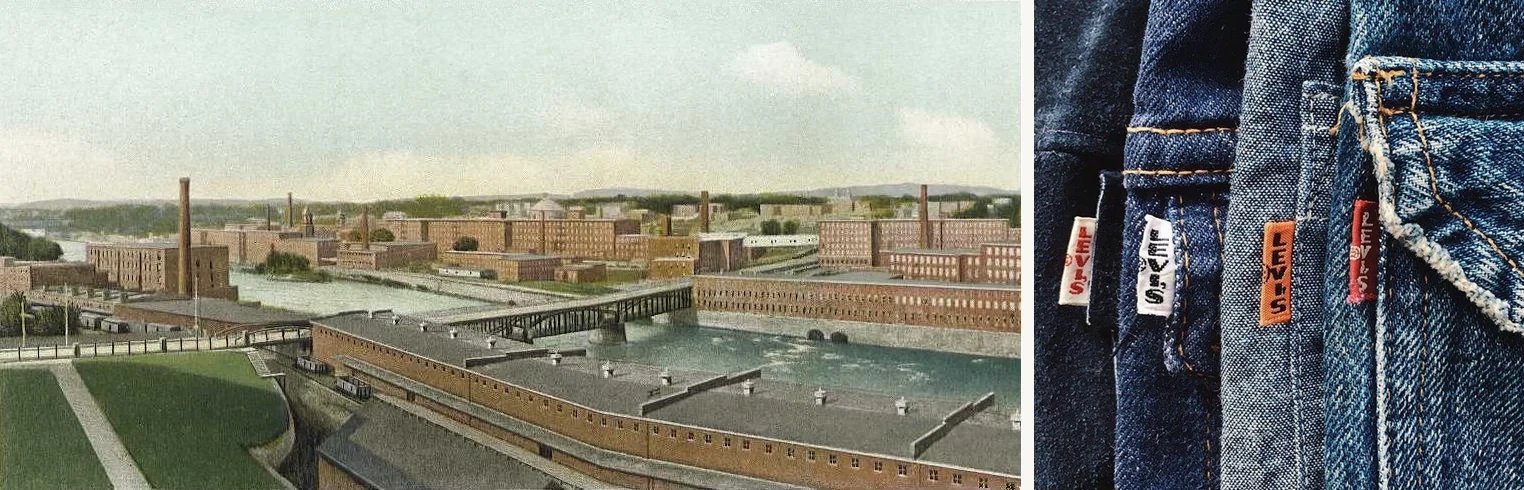
Left: Amoskeag Manufacturing Company in Manchester, NH, c. 1911 — the mill that supplied early Levi’s 501 denim until 1936. Right: four Red Tab variations showing the 1936 anti-counterfeit branding marker and its era-by-era evolution. Two visible halves of the Levi 501 history: the fabric source and the Tab that branded it.
Brando, Dean, and the 1950s Crossover
Through the first eighty years of the Levi 501 history, the pant was workwear. It went on miners, railwaymen, and ranch hands. Hollywood occasionally put it on cowboys (John Wayne wore Levi’s in westerns through the 1940s), but the audience read that as costume — a marker of the working West, not a fashion item. The crossover from workwear to youth uniform happened in two films two years apart, both built around 501s.
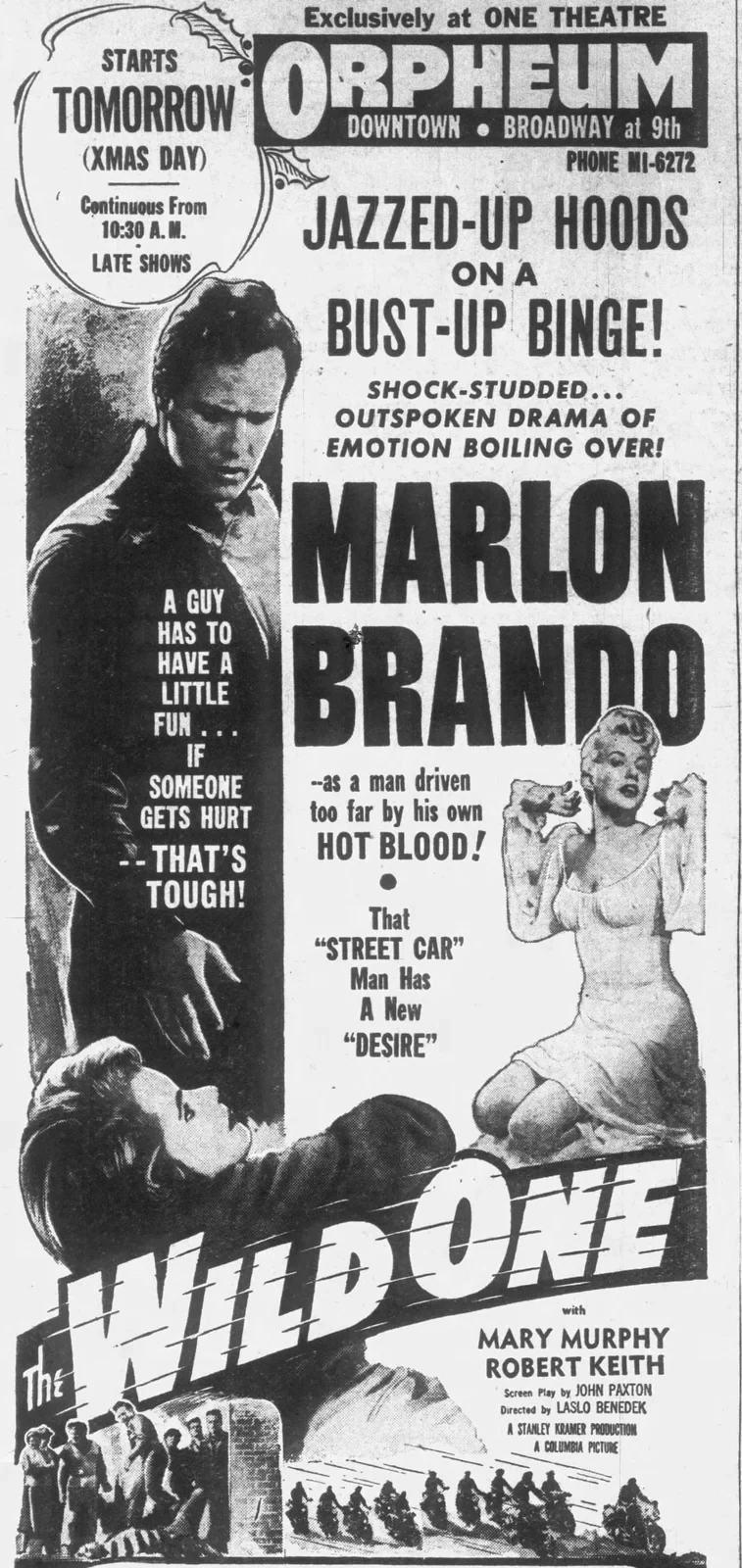
The Wild One (1953). Marlon Brando in 501s and a leather jacket — the image that moved Levi Strauss’s copper-riveted workwear from mining camp to teenage Saturday night.
The Wild One opened in December 1953. Marlon Brando played Johnny Strabler, leader of a fictional motorcycle gang, wearing 501s, a black leather jacket, and a slouched-collar tee. The image was so unsettling at the time that the film was banned in the United Kingdom for fourteen years. American teenagers, however, watched it and understood: the 501 was no longer just what your grandfather wore to the railroad yard. It was what the dangerous boy at the diner wore.

Rebel Without a Cause opened in October 1955, three weeks after James Dean’s death in a car accident. Dean wore 501s throughout the film, paired with a white tee and a red windbreaker in the most reproduced still in twentieth-century American publicity photography. The film returned $4.5 million in theatrical rentals on a $1.5 million budget. More importantly, it made Levi’s 501 the visual shorthand for adolescent disaffection — a meaning that took American Trad another five years to absorb and re-domesticate.
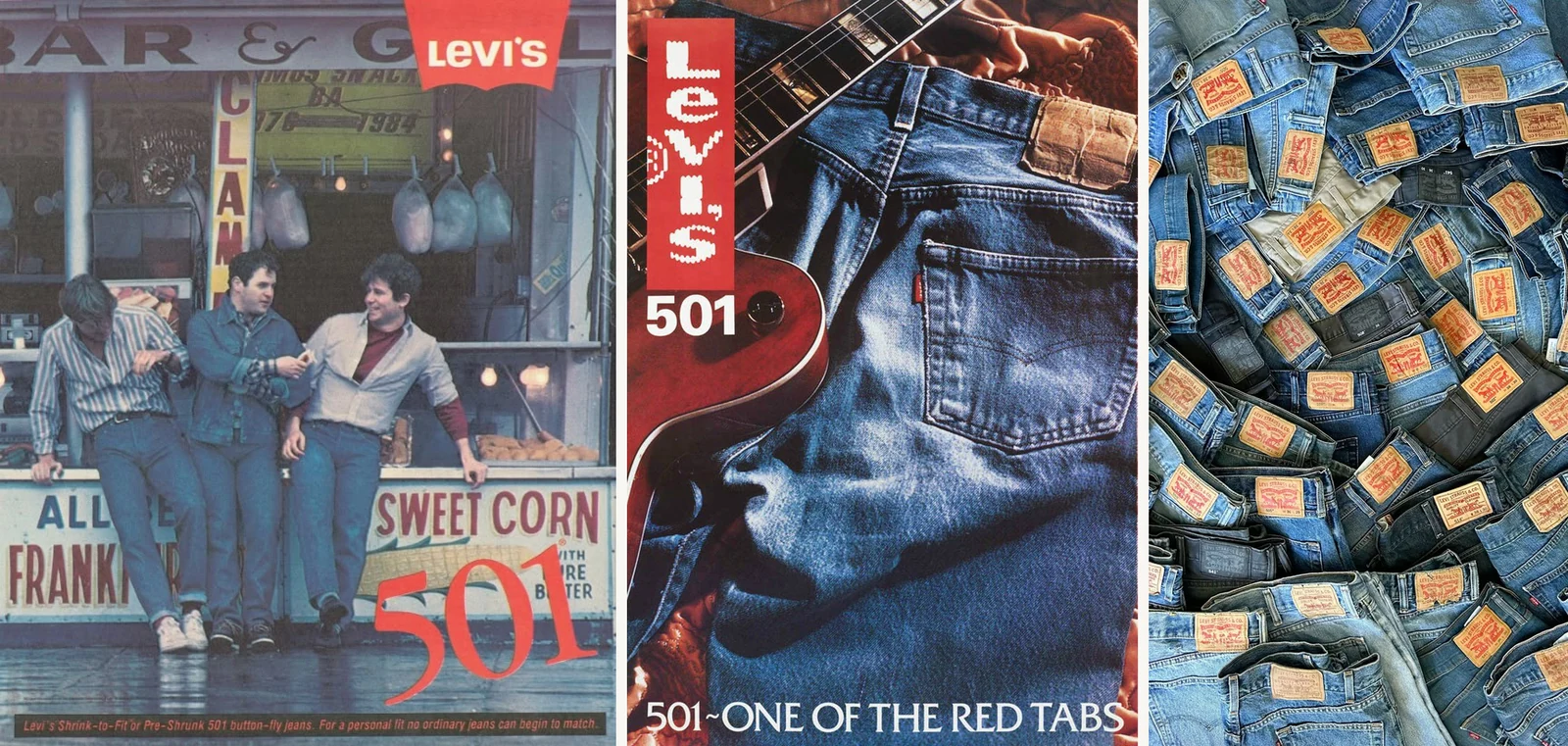
The two films completed a transformation no marketing campaign could have achieved. Levi Strauss & Co. did not pay Brando or Dean to wear their pants — both films picked 501s because they were the period-correct workwear of working-class American men, and both wardrobe choices accidentally crossed denim into the vocabulary of youth culture. By the late 1950s, sales of 501s to American teenagers had grown dramatically. The pant Levi Strauss had patented in 1873 was now selling to a market that didn’t exist seventy years earlier.
Late 1950s — How Ivy Campuses Adopted the Saturday Jean
The Ivy chapter of the Levi 501 history is sometimes framed as a paradox — how did the pant of motorcycle gangs end up in Cambridge and New Haven? The answer is that Ivy never adopted the rebellion register. Ivy adopted the workwear register: the same pant John Wayne wore on a ranch in 1940, but worn on a Saturday instead of a Wednesday. The Yale and Princeton students who started wearing 501s on weekend afternoons in 1956-1958 were not signaling rebellion. They were signaling weekend casualness, paired with the same OCBDs and penny loafers they wore the rest of the week.
The proportions made the move possible. The 501’s full thigh, neutral knee, and clean break sat on a penny loafer the same way a flat-front chino sat — same line, different fabric. The OCBD’s untucked length covered the waistband (no need to commit to a belt versus suspenders), and the indigo’s deep cool tone played with both warm jackets (tweed sport coat, brown harrington) and cool ones (navy hopsack blazer). What Ivy’s Saturday register added to Brando’s Wednesday register was simply: leather on your feet, a pressed shirt above the waist, and absolutely no leather jacket.
The mid-1960s photographic documentation of New Haven, Cambridge, and Princeton — the body of imagery that defined Ivy style for a generation of Japanese and Korean retailers — caught the moment fully. Chinos most days, jeans on Saturdays, both cut from the same architectural philosophy. The continuation of that register is what we wear in Seoul today: the lookbook in our Renacts trad denim lookbook is the 1962 register, four hundred miles east of Battell Chapel.
Cone Mills White Oak — 1915 to 2017, the Selvedge Lineage
The fabric of the Levi 501 history is mostly the fabric of one factory. Amoskeag supplied early Levi’s denim until 1936, when the Manchester mill closed. From 1915 onward, Levi Strauss had been diversifying its denim sourcing to include the Cone Mills White Oak plant in Greensboro, North Carolina — and after Amoskeag’s closure, White Oak became the primary supplier. The relationship lasted 102 years.
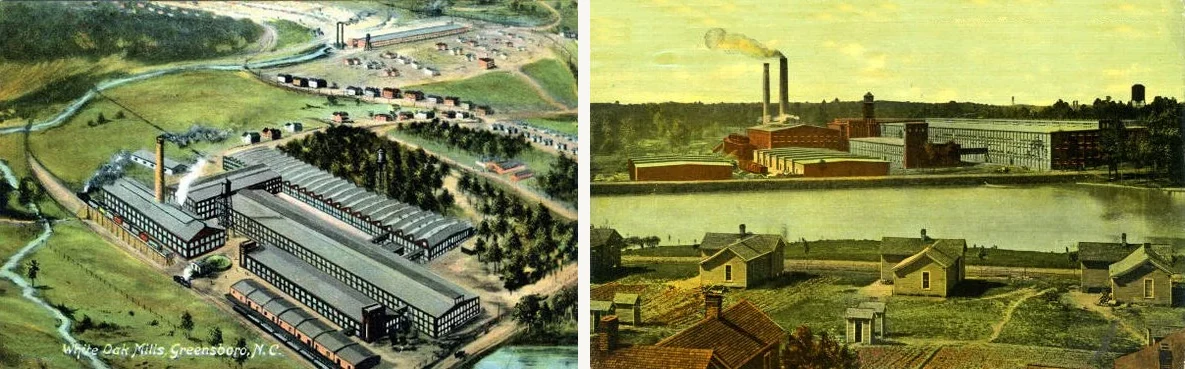
Cone Mills White Oak in Greensboro, NC. Left: the plant in 1909, six years before it began supplying Levi Strauss with selvedge denim. Right: the mill village in 1914 — the factory and the company-built worker housing. American selvedge denim was a community as well as a fabric.
White Oak was not just a factory. It was a company town. The Cone family built the original mill in 1905, surrounded it with company-owned worker housing through the 1910s, and ran the entire production cycle — from raw cotton bale through warp dyeing through selvedge weaving — on a single site in Greensboro. The plant produced selvedge denim on narrow Draper X3 shuttle looms, the machines that produced the self-finished edge that gives selvedge denim its name. By the 1960s, White Oak was producing nearly all of Levi’s domestic selvedge denim, and into the 2010s it remained the only major American mill still running shuttle looms.
White Oak shut down on December 31, 2017. The closure had been telegraphed for years — global denim production had shifted to Japan, Mexico, and the Indian subcontinent, and American shuttle-loom selvedge had become uneconomical. Cone Mills had been in bankruptcy since 2003 and operating under various private equity ownerships since 2004. When the last shift ended on the last day of 2017, the American shuttle-loom selvedge denim era ended with it. What remained was inventory: hundreds of thousands of yards of fabric still in warehouse, and the brands that had bought long-position contracts before the closure.
The Cone Mills closure marked the end of the American chapter of the Levi 501 history. Levi’s Vintage Clothing reproductions made between 2017 and approximately 2020 honored the lineage with the remaining Cone Mills inventory; after that, LVC switched primarily to Japanese Kuroki Mills selvedge for ongoing reproduction lines. RRL Slim Fit and Buzz Rickson’s also primarily use Kuroki today. The Cone Mills closure ended the American chapter of the Levi 501 history; the Japanese chapter (which had run in parallel since the late 1970s — first through Big John in 1973, expanding in the 1980s through Studio D’Artisan and Toyo Enterprise’s Sugar Cane line, and again in the 1990s through Buzz Rickson’s and Real McCoy’s archive-strict reproductions of the 501XX) became the dominant production lineage.
The Reproductions — LVC, RRL, Buzz Rickson, Renacts
The contemporary chapter of the Levi 501 history is a reproduction culture. Modern Trad denim builds on archive specifications rather than current production. The original Levi’s 501 still exists as a mass-market product (the 501 STF, available at any Levi Strauss & Co. retailer), but the version Trad wearers actually buy is one of the lot-specific reproductions: 1947 501XX, 1966 501, and other lot-specific years. Each reproduction line targets a specific year of production and honors the cut, fabric weight, and detail conventions of that year exactly.
Levi’s Vintage Clothing (LVC) is the in-house reproduction line, started in the late 1990s. LVC’s catalog includes 1933 NS501, 1944 S501XX (wartime simplified), 1947 501XX, and 1966 501 — each cut from period-correct fabric weight and finished with period-correct hardware. RRL (Ralph Lauren’s heritage label) takes a less archive-strict approach but operates in the same Trad denim register, with cuts (Slim Fit, Slim Straight) tailored to modern proportions on vintage fabric. Buzz Rickson’s (Toyo Enterprise, Japan) is the most archive-strict — their Lot.401XX is essentially indistinguishable from a 1947 501XX at 14 oz selvedge weight.
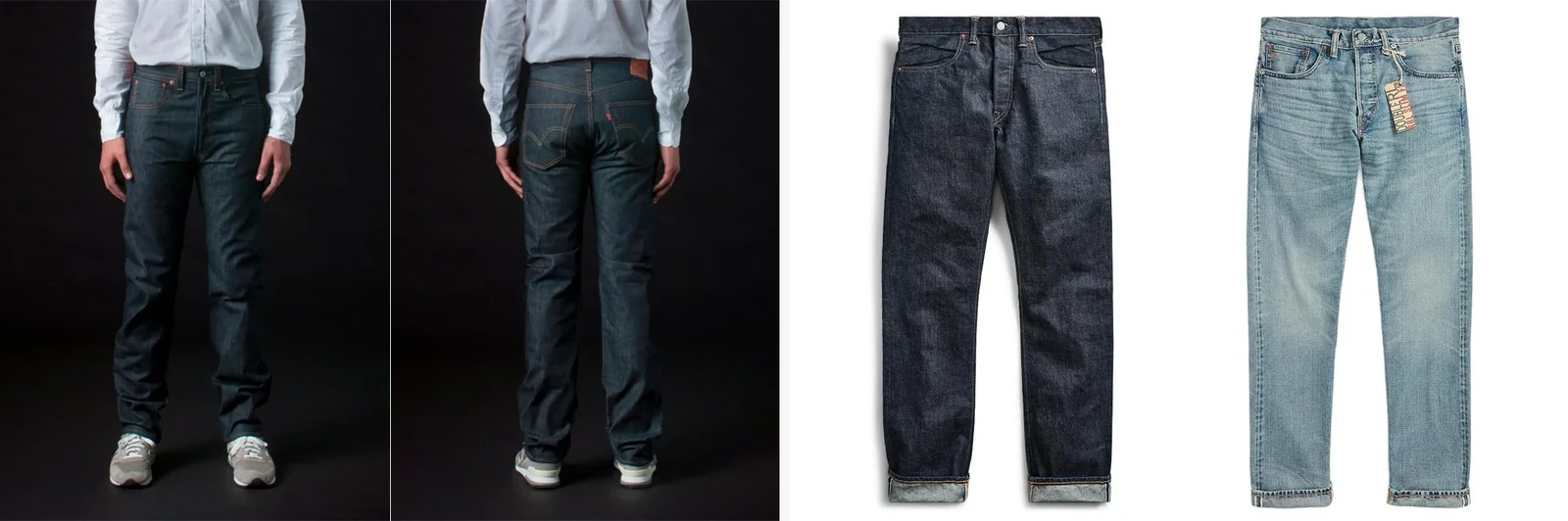
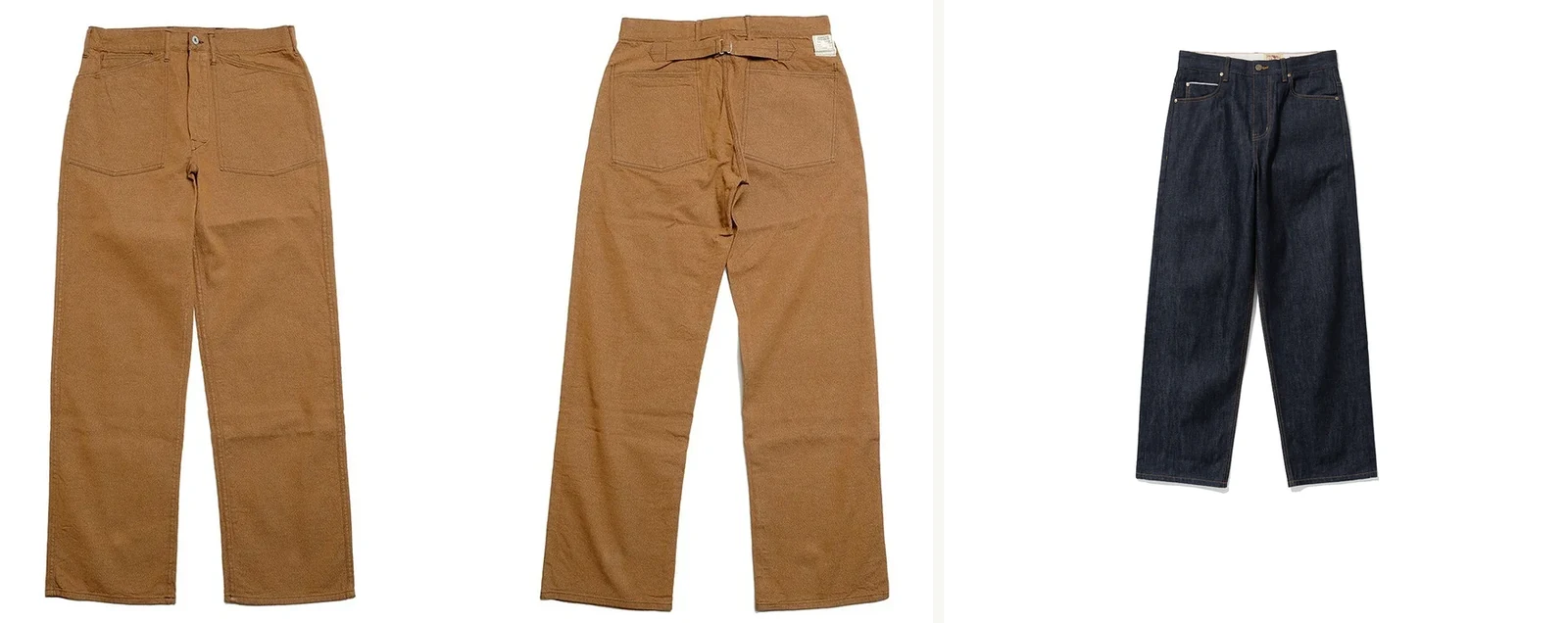
Renacts sits in a specific position in this ecosystem. The Korean brand sources remaining Cone Mills inventory from the pre-2017 stockpile and finishes each pair in Korea with chain-stitch hems, bronze rivets, and YKK Excella zippers. Eight colorways across the Tailored Straight and Two Tuck silhouettes — indigo, D.Blue, D.Blue Cat, M.Blue Cat, L.Blue Cat, Black, Cream, Two Tuck D.Blue — built on the same 14 oz weight that defined Levi’s domestic production from 1915 through 2017. The full register, paired with the actual outfits, lives in our trad denim lookbook; the global brand-by-brand comparison (where Renacts sits in the $145-230 entry tier and how it compares to LVC, RRL, Buzz Rickson, Sugar Cane, 3sixteen, and The Real McCoy’s) is in 17 American Vintage Brands Every Trad Collector Should Know.
Why It Still Matters in Seoul
The Levi 501 history matters in Seoul because the 1873 patent still describes the silhouette every reputable Trad denim brand produces today. Straight cut, full thigh, neutral knee, clean break, copper-riveted pockets — none of those decisions were fashion. They were engineering responses to the problem of pants that ripped under load, and the engineering solution was robust enough that 152 years later it still defines what we wear walking Hongdae and Itaewon.
The Cone Mills closure in 2017 ended the American production chapter, but the design lineage moved cleanly to Japan and Korea — Kuroki Mills supplies most of the modern selvedge reproduction industry, and Korean brands like Renacts work the remaining Cone Mills yardage. None of that changes the architecture of the Levi 501 history: the Trad denim register in Seoul today is the 1873 patent, plus the 1922 belt loops, plus the 1936 Red Tab, plus the 1950s cultural absorption, plus the 1960s Ivy domestication. Five layers of history, one pair of pants.
For the rest of the Ivy register — sack suit, OCBD, cinch-back chino, reverse weave — start at the Ivy Style guide. For how the silhouette wears today, the 8-color trad denim lookbook. For the brand picks beyond Renacts, 17 American Vintage Brands.
That brief is the one we work to as well. The Tailored Straight Denim keeps the straight leg, in mid blue and a lighter cat-brushed wash.