Trad Denim Lookbook: 8 Essential Renacts Outfits the Ivy Way
The Ivy League didn’t invent jeans. Levi Strauss and Jacob Davis did, when they patented riveted pocket reinforcement on May 20, 1873 — US Patent #139,121. Davis was the Reno-based tailor who invented the rivet; Strauss was the San Francisco wholesaler who put up the patent fee.
By the late 1950s, jeans drifted onto the Yale and Princeton lawns as weekend uniform — paired with the same OCBDs and penny loafers students wore the rest of the week. Period photography from the mid-1960s catches the moment in Cambridge and New Haven: chinos most days, jeans on Saturdays, both treated with the same restraint.
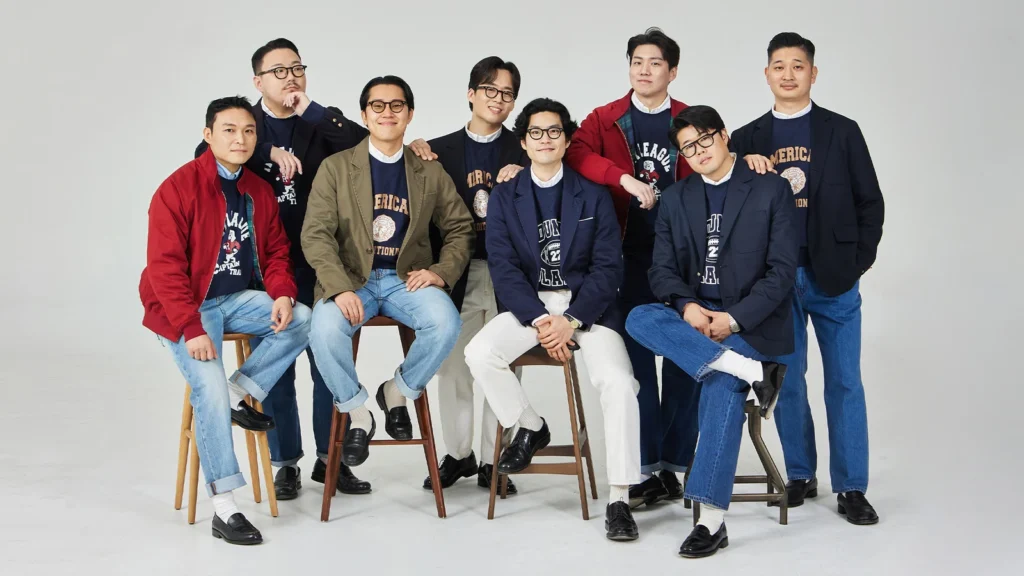
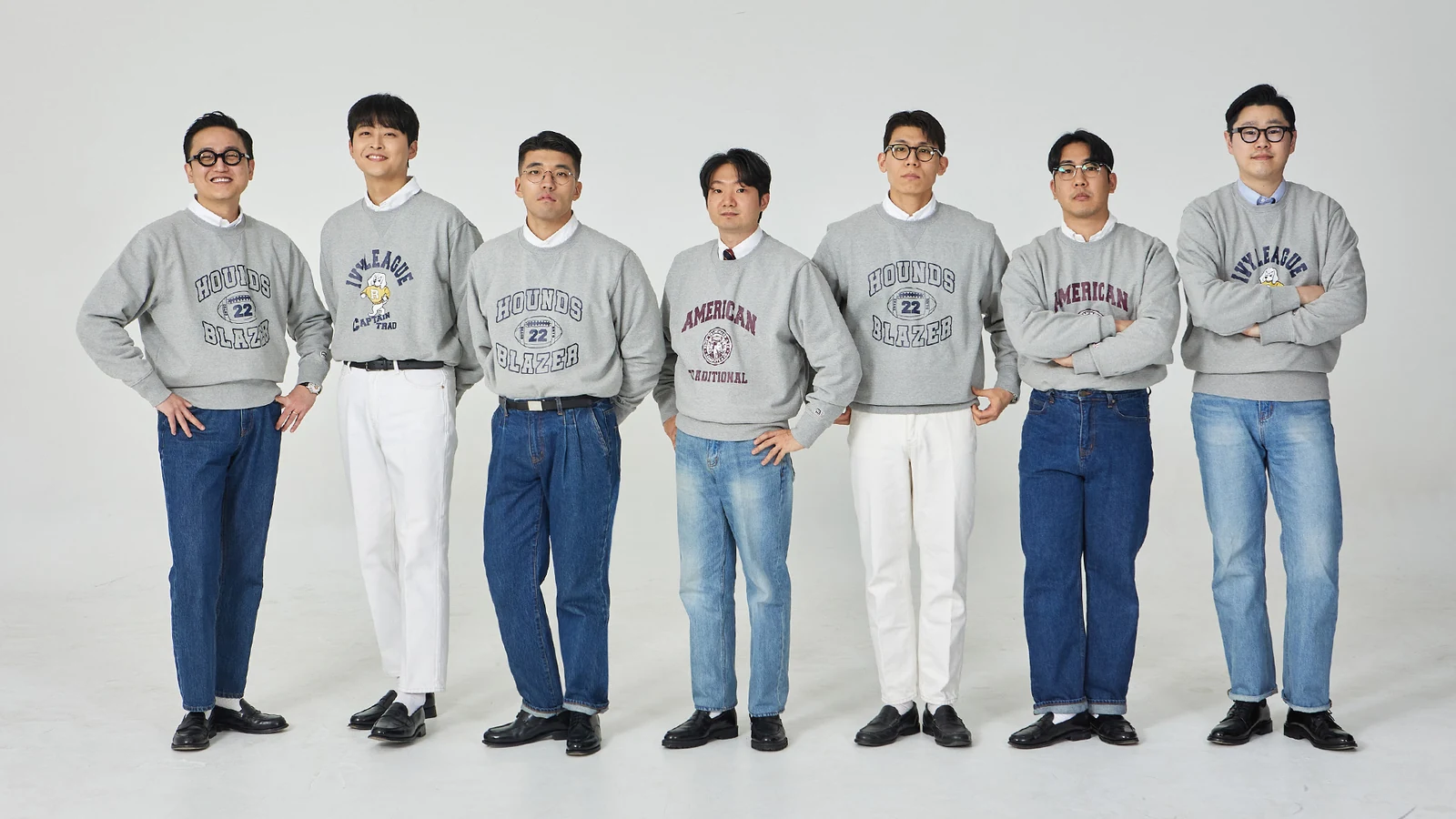
What follows is the Trad denim register as we wear it in Seoul, organized by color rather than by occasion. Eight Renacts colorways — all Cone Mills 14 oz, finished in Korea — each with the outfits we actually wear. Some registers (Indigo, D.Blue) carry across the week. Some (Cream, L.Blue Cat) are summer-only. One (Black) is the smart-casual exception. The hero photograph below is the lookbook thesis on display: seven team members, seven of the eight colorways, side by side under the same collegiate grey sweatshirt. Read for the color you own; the rest is the menu.
The Trad Denim Rule — Cut, Color, and Fade
The Trad denim rule, in one paragraph. Straight cut, dark indigo or honest fade, clean break, leather on your feet. Three axes — cut, color, fade — and trad denim tolerates exactly the variations the Renacts catalog covers below: eight colorways, all on the same Tailored Straight or Two Tuck silhouette.
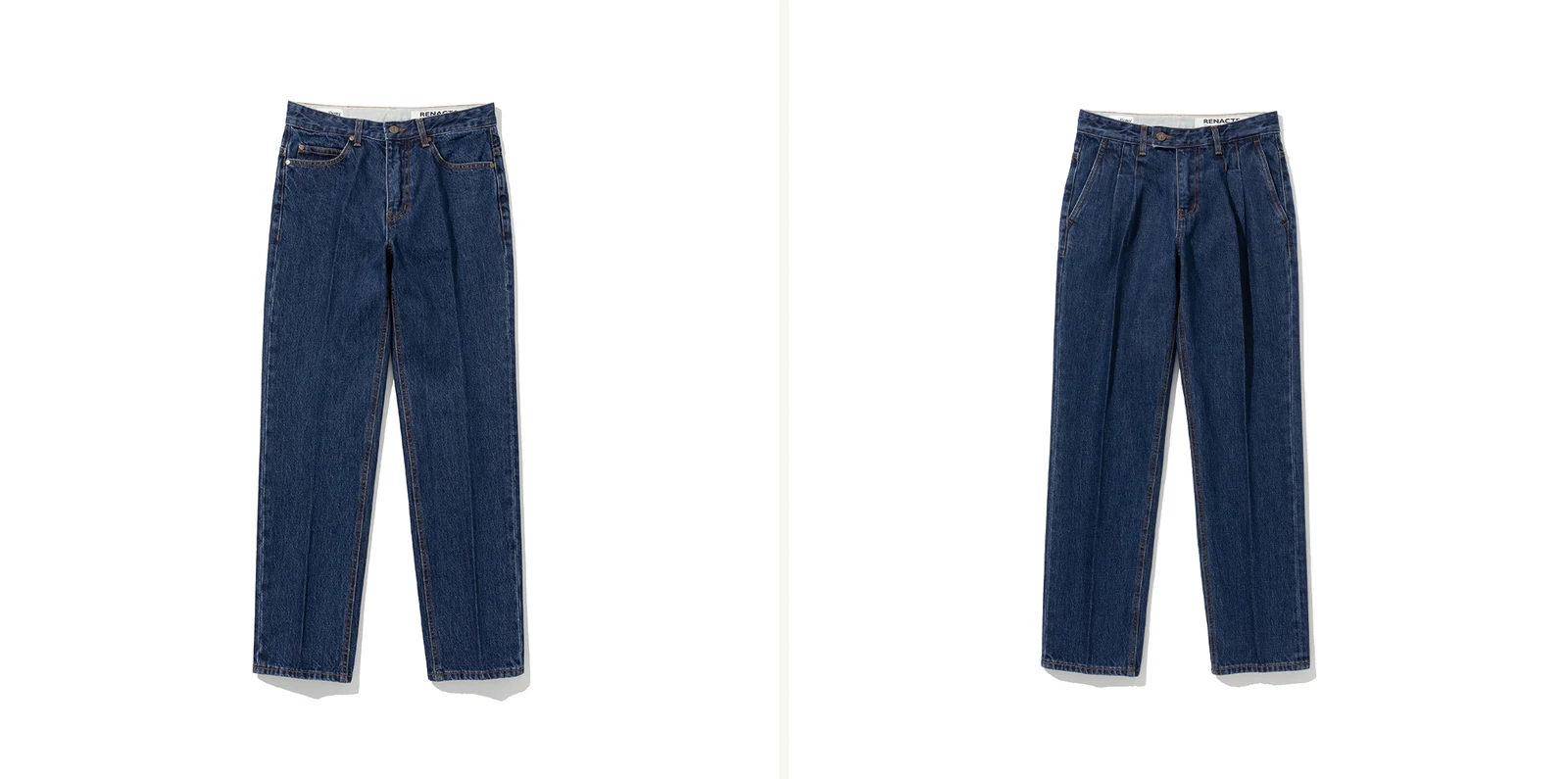
Cut. Straight leg only. The mid-century 501 silhouette and Renacts’s Tailored Straight both honor the same line: full thigh, neutral knee, no taper. The Two Tuck variant adds a single forward pleat — closer to a trouser than a jean — which shifts the register half a step dressier. Slim-tapered, skinny, and bootcut all read as trend cycles rather than trad architecture.
Color. Dark indigo is the baseline. Black is smart casual. Cream is the summer light register. Cat-brushed variants (M.Blue Cat, L.Blue Cat, D.Blue Cat) interpret the natural fade rather than fake it — what you get is the visual baseline of denim already worn for a year. What to avoid across all colors: pre-ripped, acid wash, light-blue washed, whiskered, sandblast fade. The fade should come from your knee and your wallet, not the factory.
Length and break. Clean break or no break. The hem should sit on your shoe with one shallow fold at most. Renacts hems all of their trad denim with chain stitch — Union Special 43200G or equivalent — which builds the characteristic roping fade over time. The hem is the difference between denim that ages and denim that stays flat.
For brand-by-brand comparison beyond Renacts, see 17 American Vintage Brands Every Trad Collector Should Know. For the heritage context behind the silhouette every Renacts pair references, see Levi’s 501: The 1873 Patent That Built American Denim.
Indigo — The Canonical Baseline
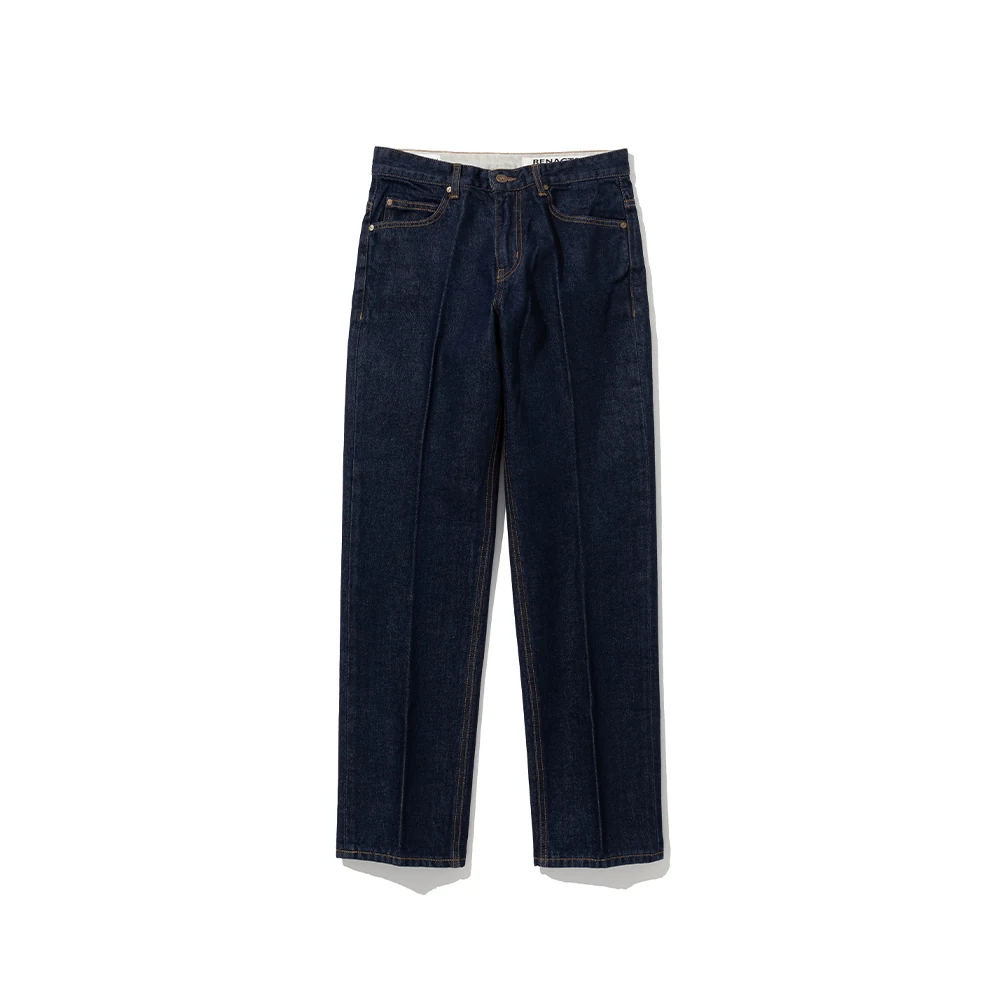
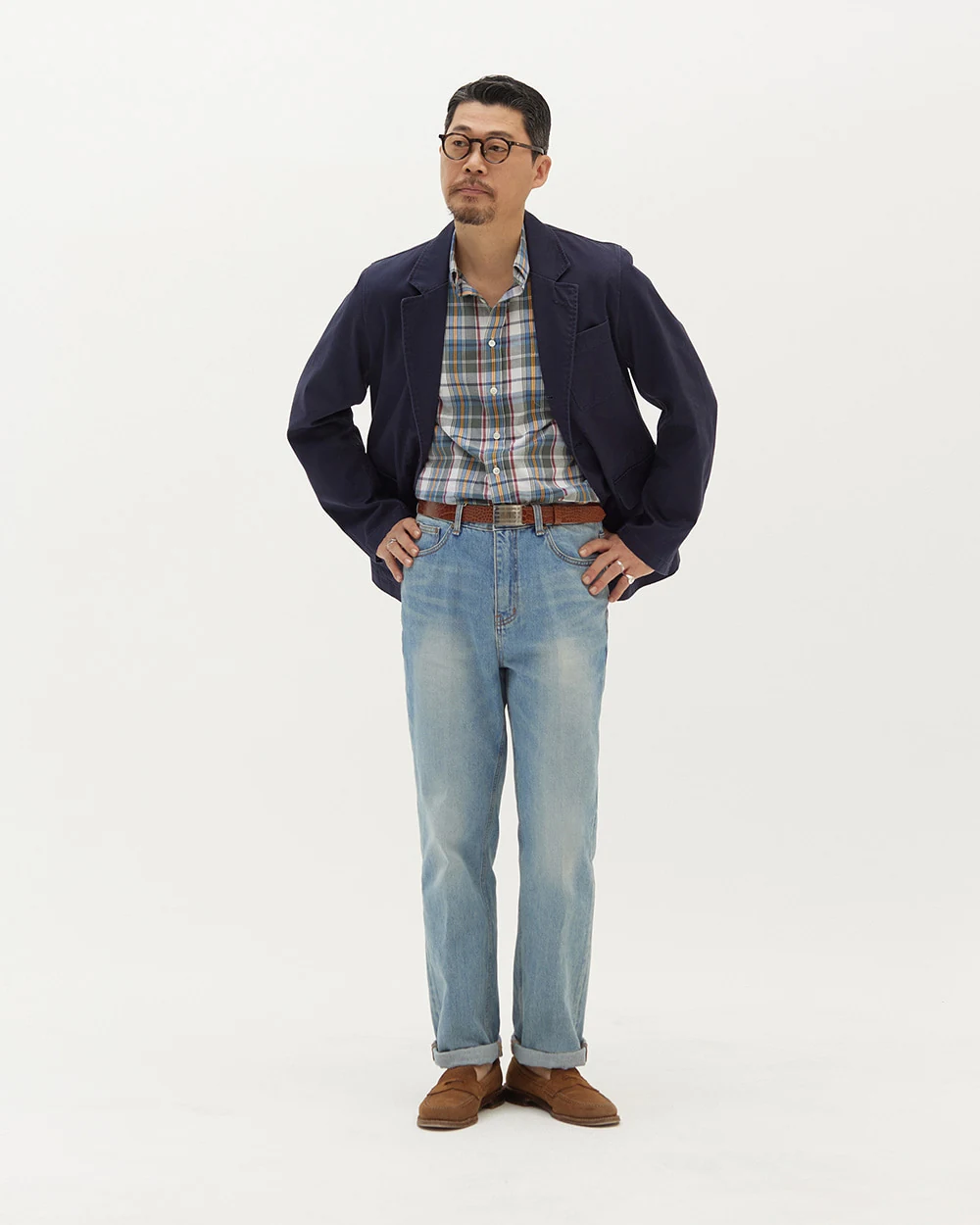
Indigo is where every other color in this lookbook starts. Cone Mills 14 oz, bio stone washed enough to lose factory rigidity but before any meaningful fade has formed. The pants you build the next ten years of trad denim against — the Saturday-1962-Yale baseline.
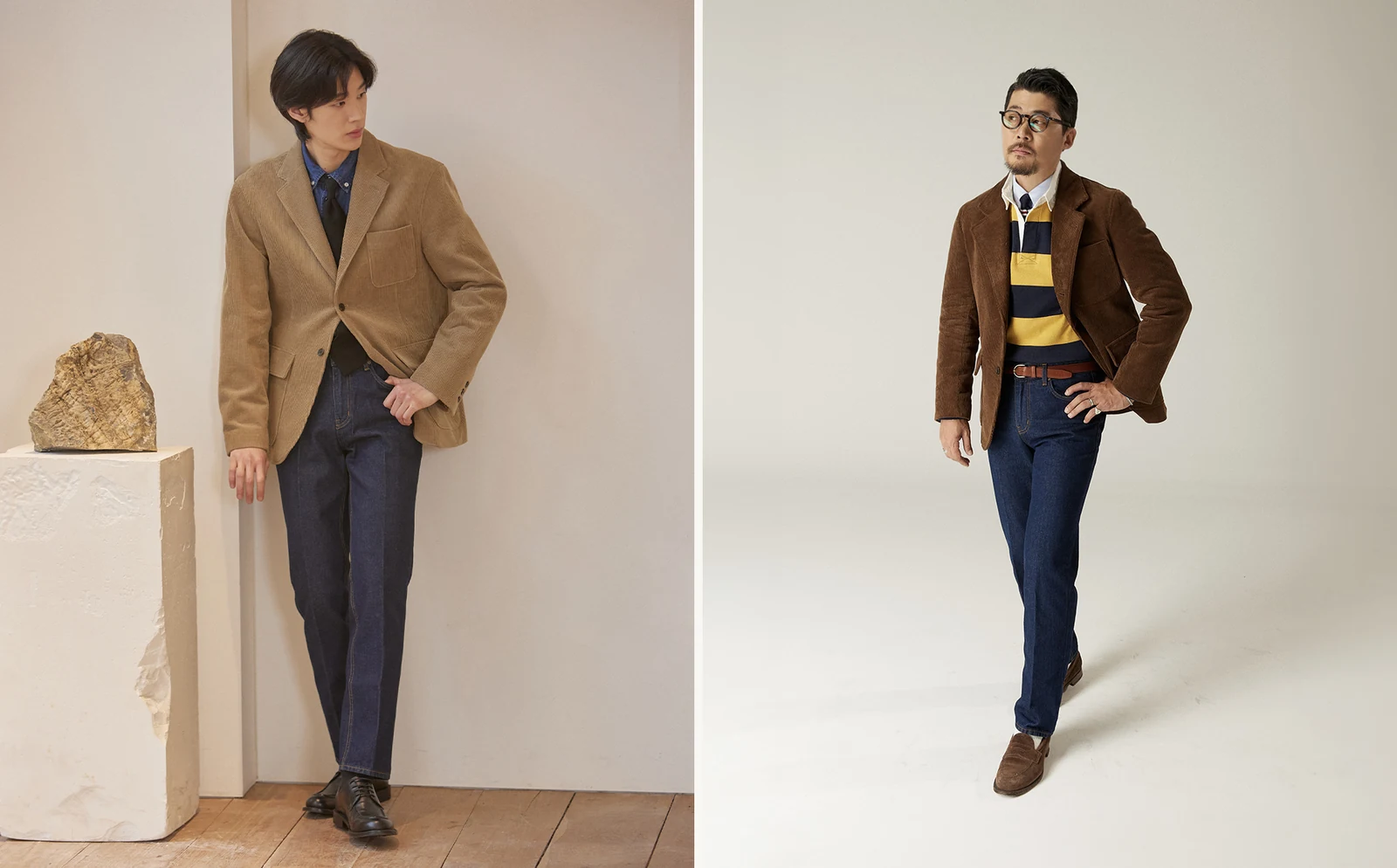
Indigo carries up the register cleanly — partly because the cool-toned baseline pairs with both warm and cool jackets, partly because the unbroken color holds a corduroy blazer and a denim shirt at the same time without the outfit collapsing into denim-on-denim cliché. The two looks below show the upper end of the register: black tie + denim shirt + corduroy blazer is the evening-cocktail register; rugby + regimental tie + suede penny is the after-game collegiate Saturday.
The third Indigo register is the one most people learn trad denim through — OCBD layered under a varsity letterman crewneck, suede penny loafer. The letterman knit (Renacts’s own crewneck) carries the campus signal without forcing a jacket; the OCBD collar peeking out at the throat is the entire trad detail.
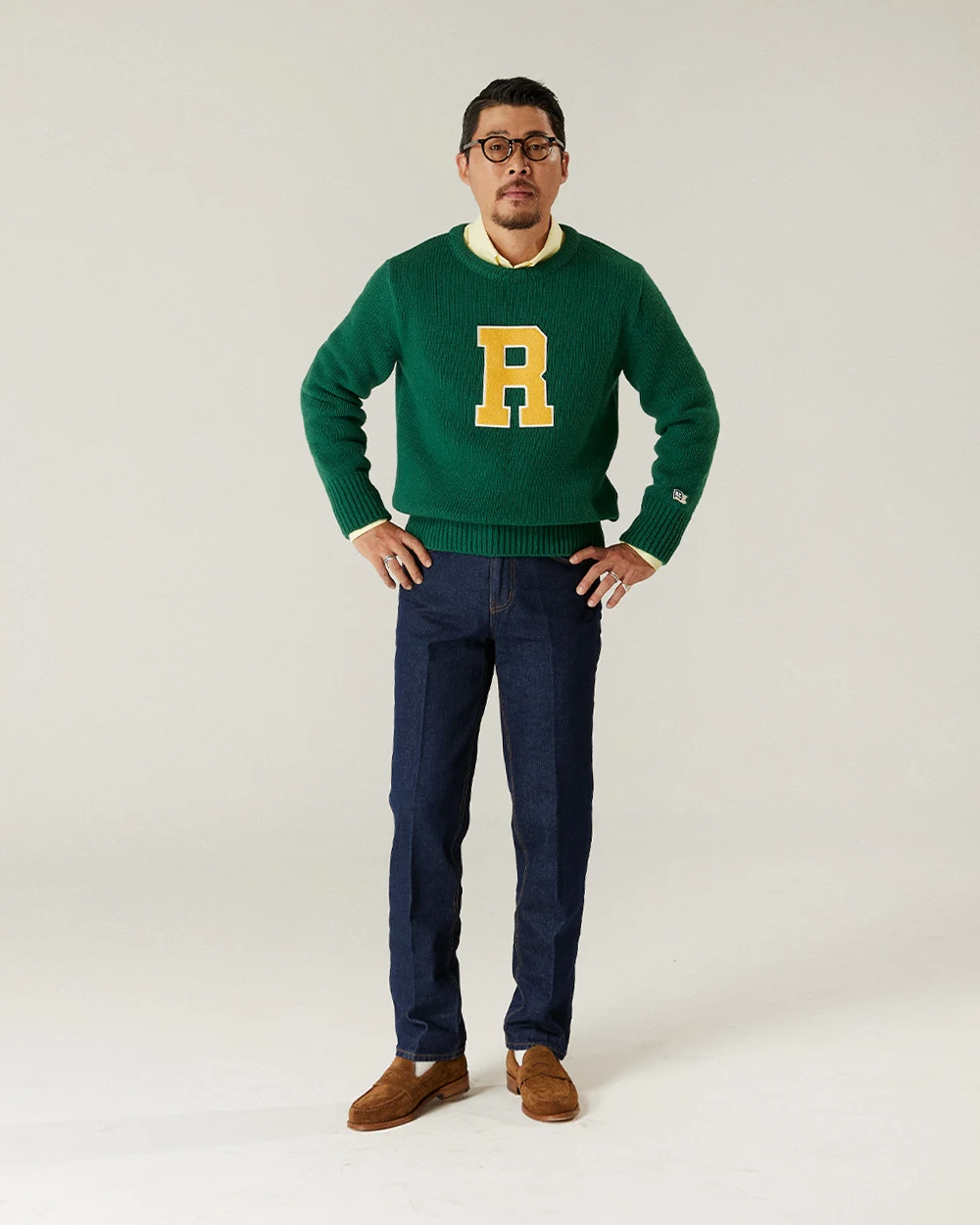
D.Blue & Two Tuck — Dressed Up Dark Blue
D.Blue sits half a register dressier than Indigo — slightly more saturated, slightly less green — and carries blazer-and-tie pairings more naturally. The Two Tuck variant adds a single forward pleat, which pushes the silhouette toward trouser. Together they cover everything from weekend game-day to Friday-club-evening.
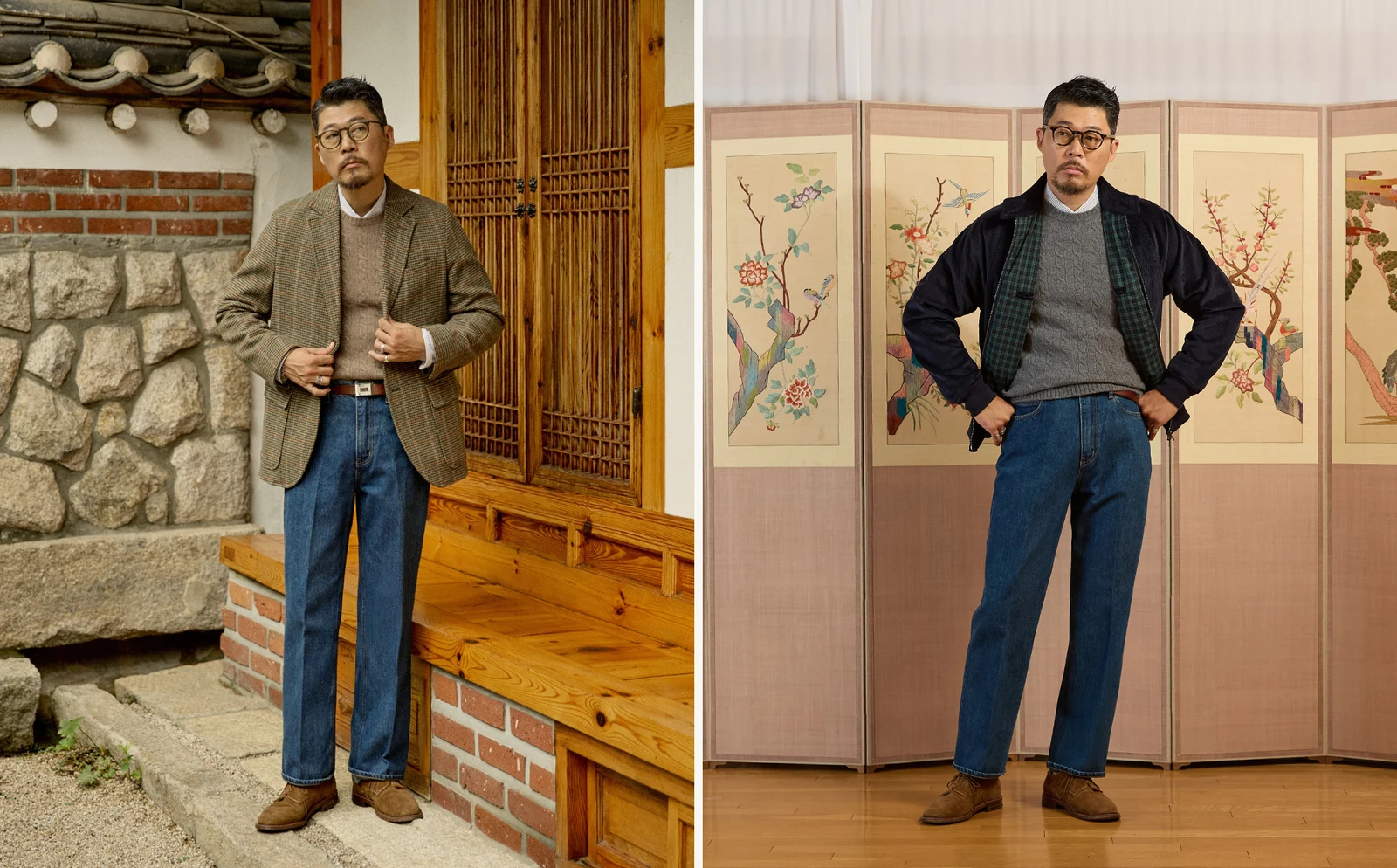
The two looks below show D.Blue’s strongest argument: a crewneck cable knit + OCBD + suede derby base, with two different outerwear takes. The gun club check blazer (left) is the campus-classic register; the navy corduroy harrington (right) is the weekend-rugged take. Same pants, same knit, same shirt, same shoes — different jacket, different decade.
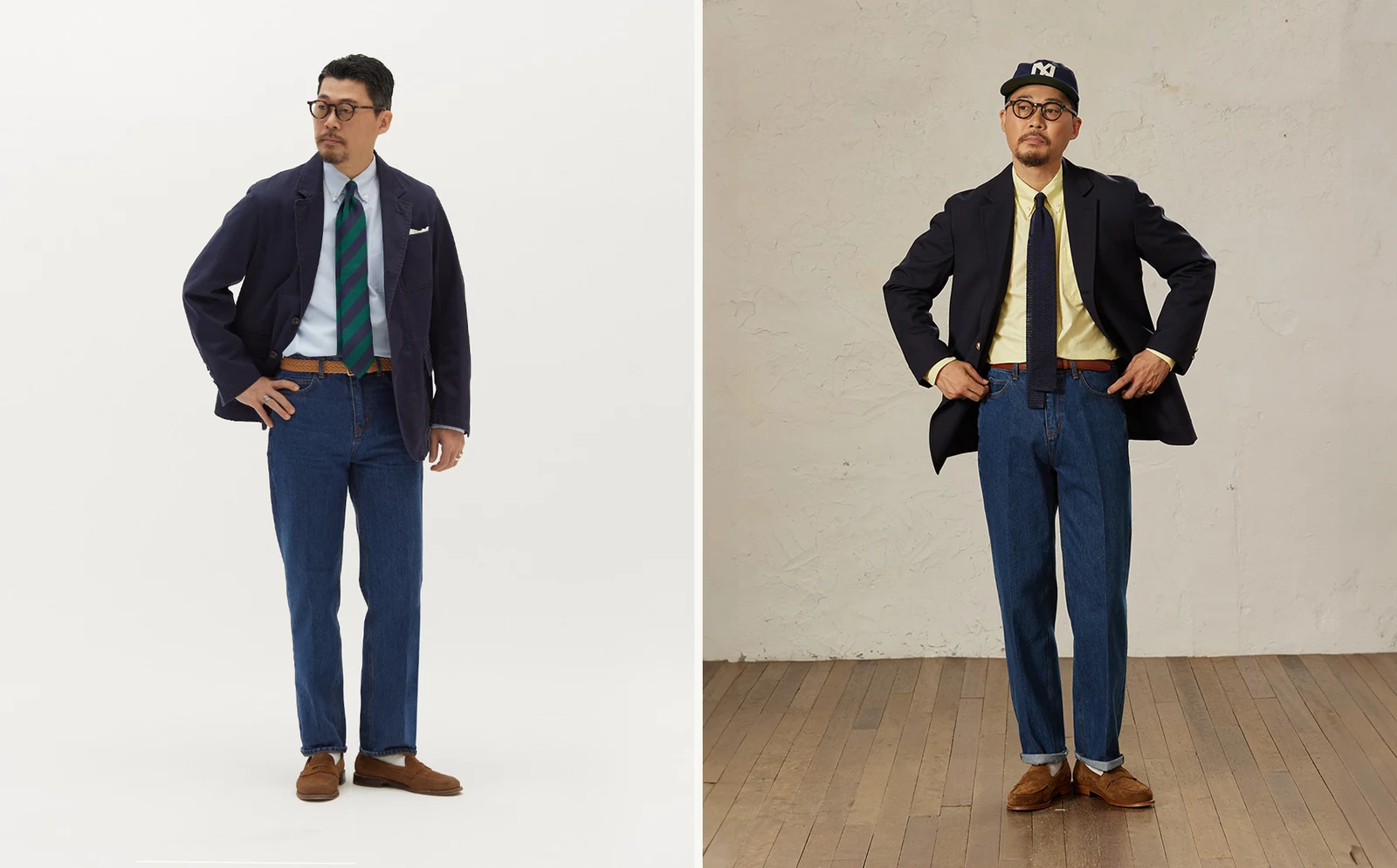
Blazer-and-tie on D.Blue. Navy corduroy + regimental silk + suede penny (left) is the East Coast preppy register, exactly. Gold-button hopsack + knit tie + ball cap (right) is the modern Trad relaxation — the same outfit register adjusted for someone who walks to the bar instead of driving from the country house. (For the blazer itself, see our navy gold-button blazer essentials guide.)
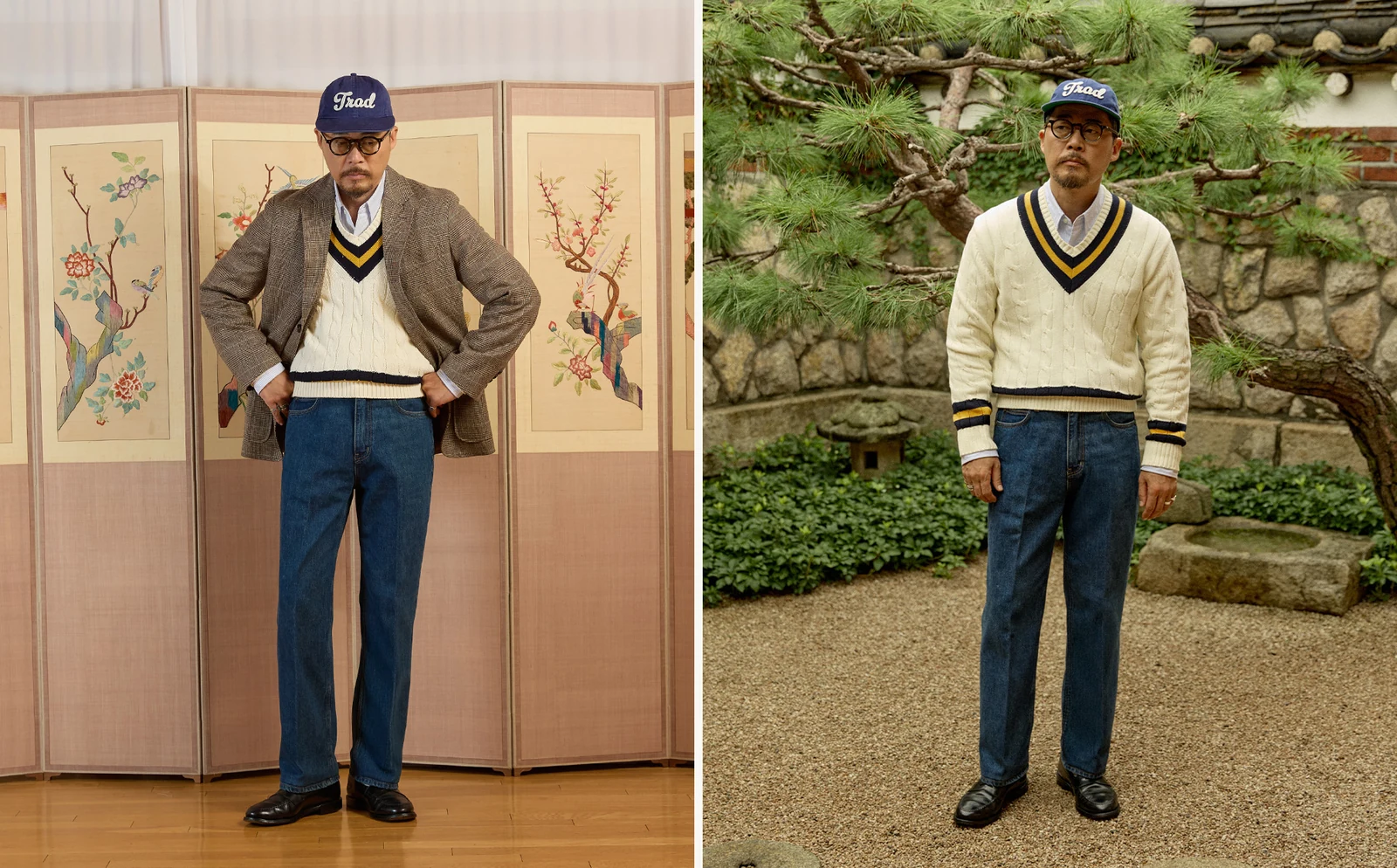
Cricket sweater is the trad denim cheat code — knit, unfussy, reads as athletic-collegiate without trying. Layered under glen check blazer (left) carries late-autumn weddings; alone (right) is spring weekend. Black penny + ball cap throughout — the cap is the modern Trad signal that you didn’t dress on purpose.
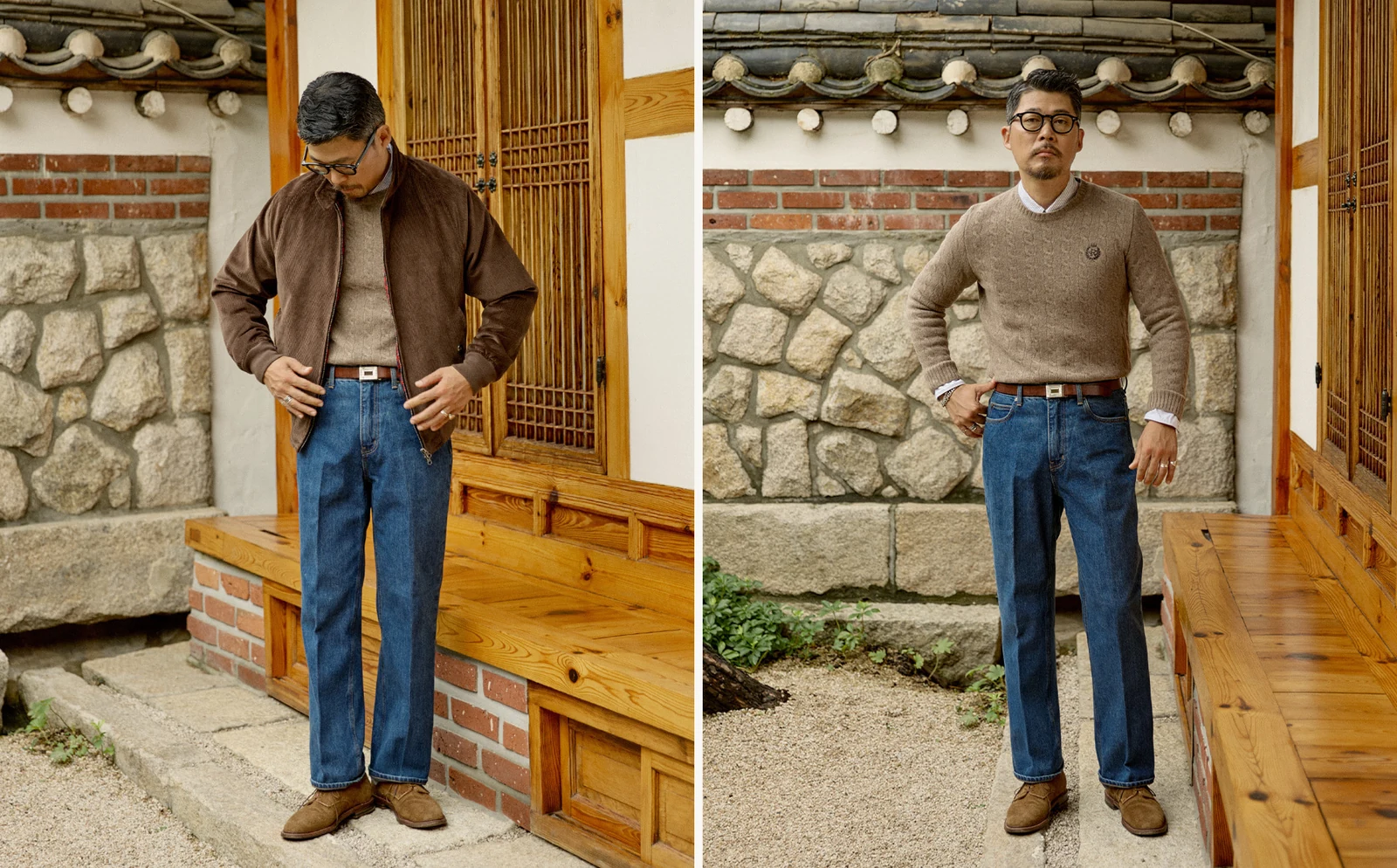
Brown corduroy harrington over crewneck cable + OCBD + suede derby (left), and the indoors version of the same outfit minus the harrington (right). The right-hand image is the knit-only version you wear to a coffee meeting; the left-hand version is the register up that you walk to it in.
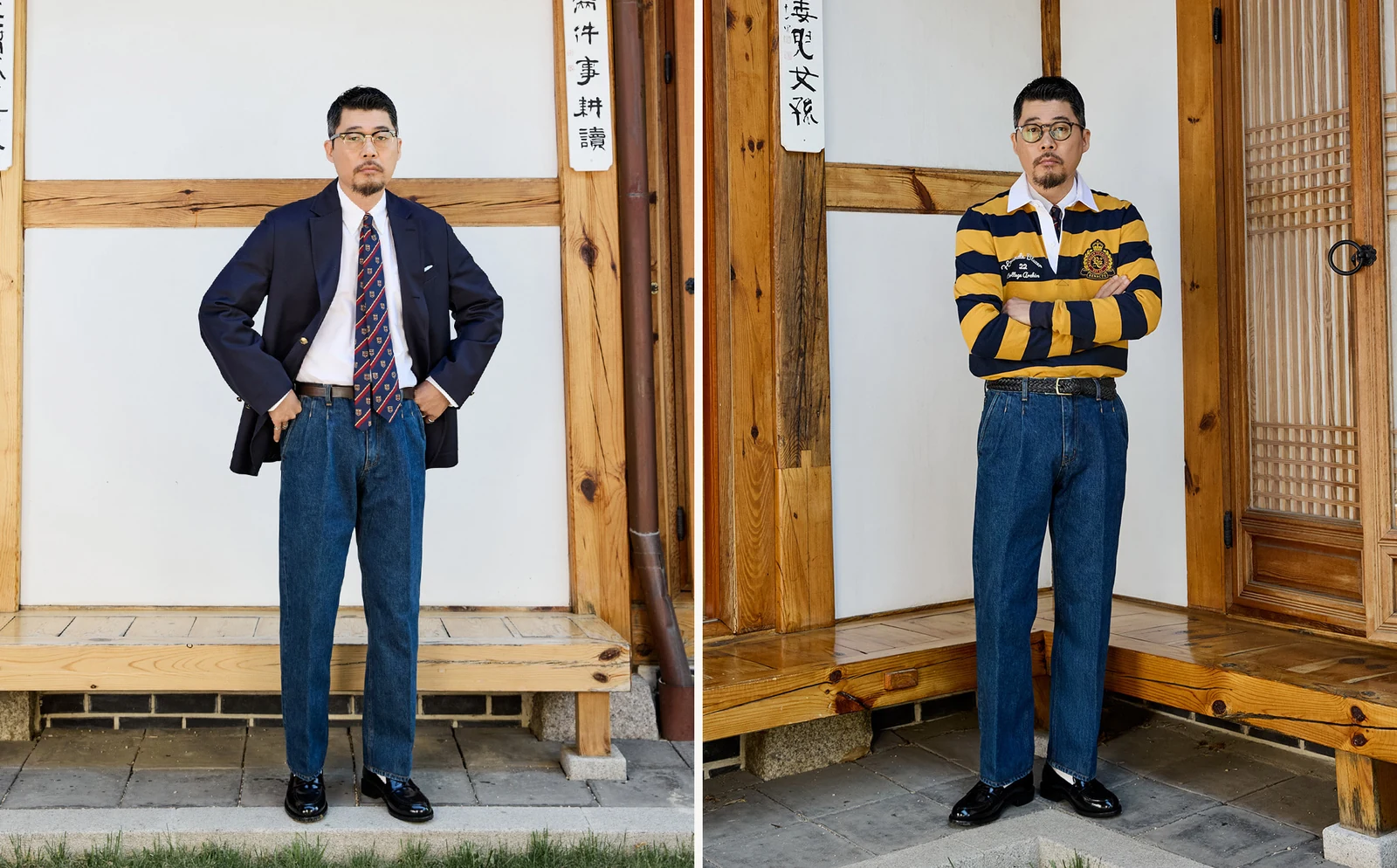
Two Tuck D.Blue with regimental silk. Gold-button blazer (left) for the Friday-night-club register; rugby shirt + OCBD + tie (right) for the campus game-day register. The single pleat is what lets the rugby shirt read as deliberate rather than casual; it would feel sloppy on flat-front jeans.
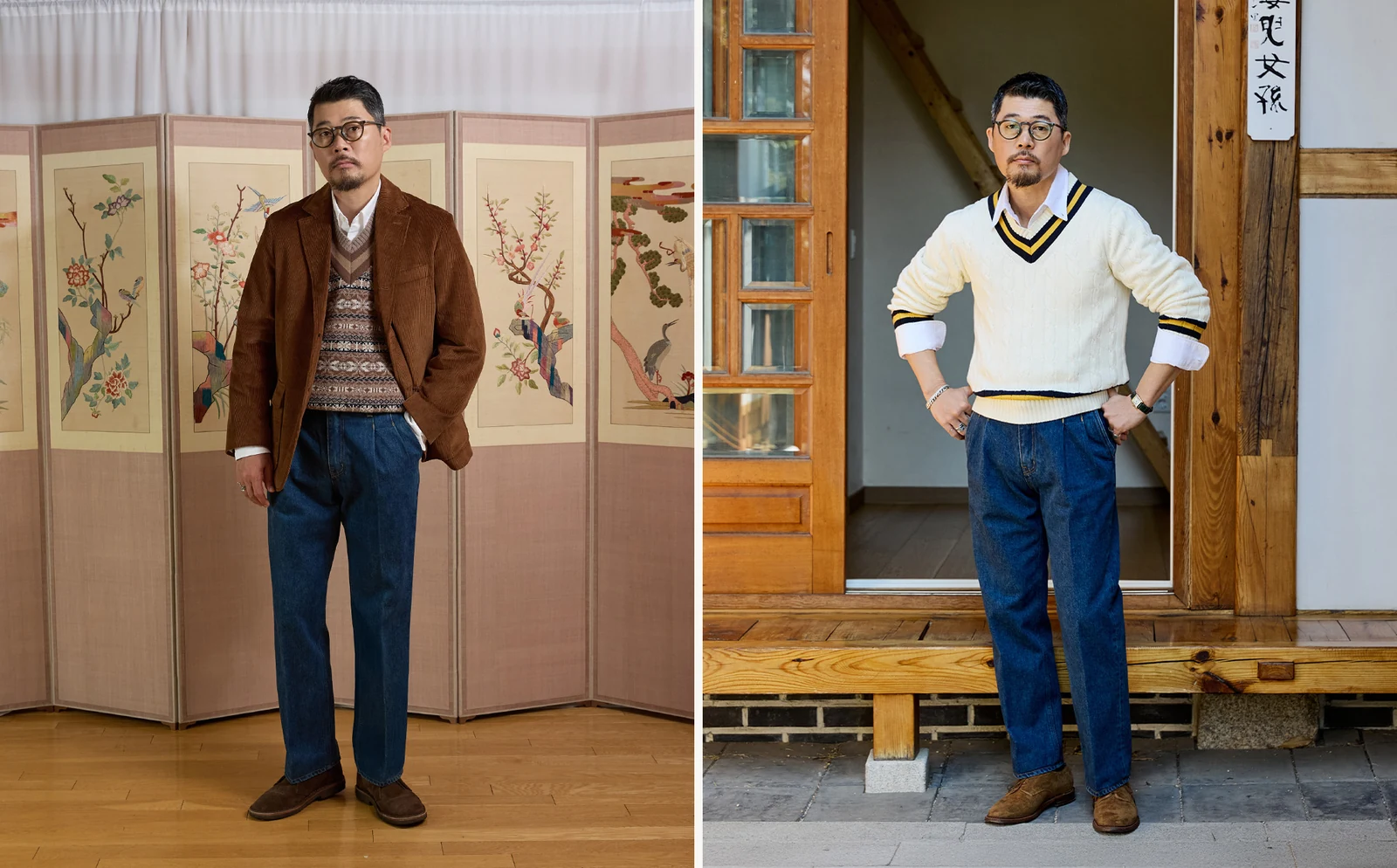
Knitwear-forward Two Tuck. Fair Isle vest under corduroy blazer (left) is the autumn-archive register — the J.Press archive look, basically. Cricket sweater + OCBD + suede derby (right) is campus-spring without trying.
D.Blue Cat — Vintage Wash Tailoring
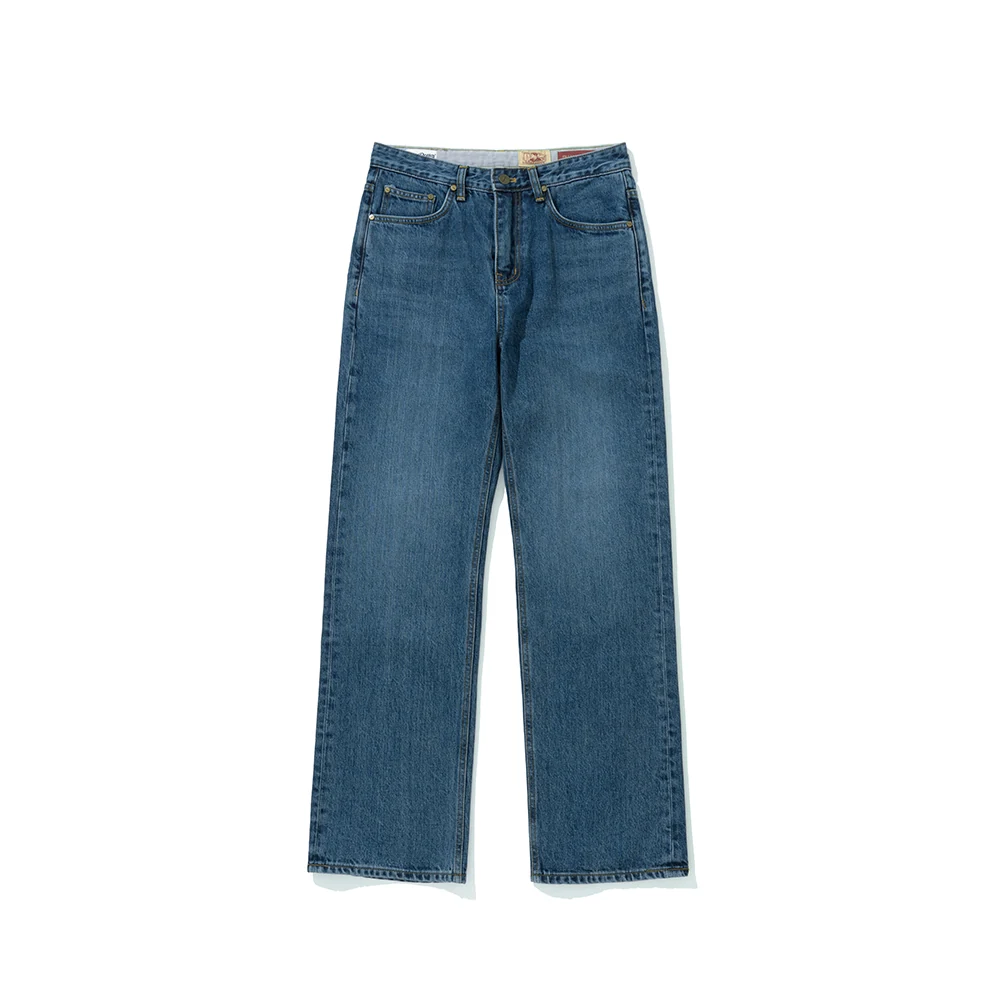
D.Blue Cat is D.Blue’s natural-fade variant — Cone Mills 14 oz with a cat brush wash that builds the visual baseline of a one-year-worn 501. The fade pattern lives above the knee where real wear would put it, and the contrast against a tailored jacket reads honest rather than artificial.
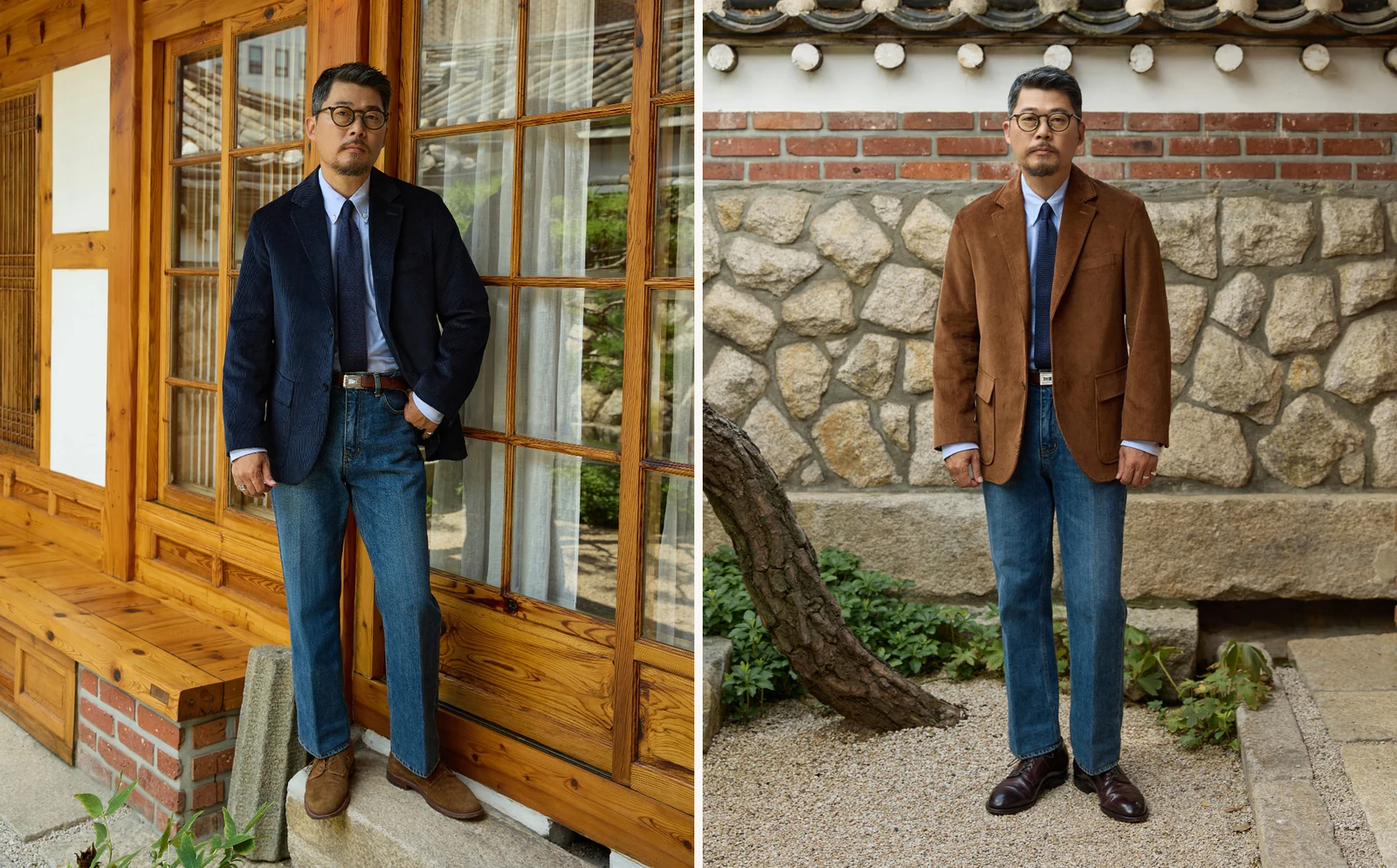
Corduroy blazer compare. Navy corduroy (left) is cooler and dressier; brown corduroy (right) leans warmer and more academic. Same OCBD + knit tie + brown derby base. The lesson of the pairing is that D.Blue Cat carries either color blazer with equal comfort — which not every denim does.
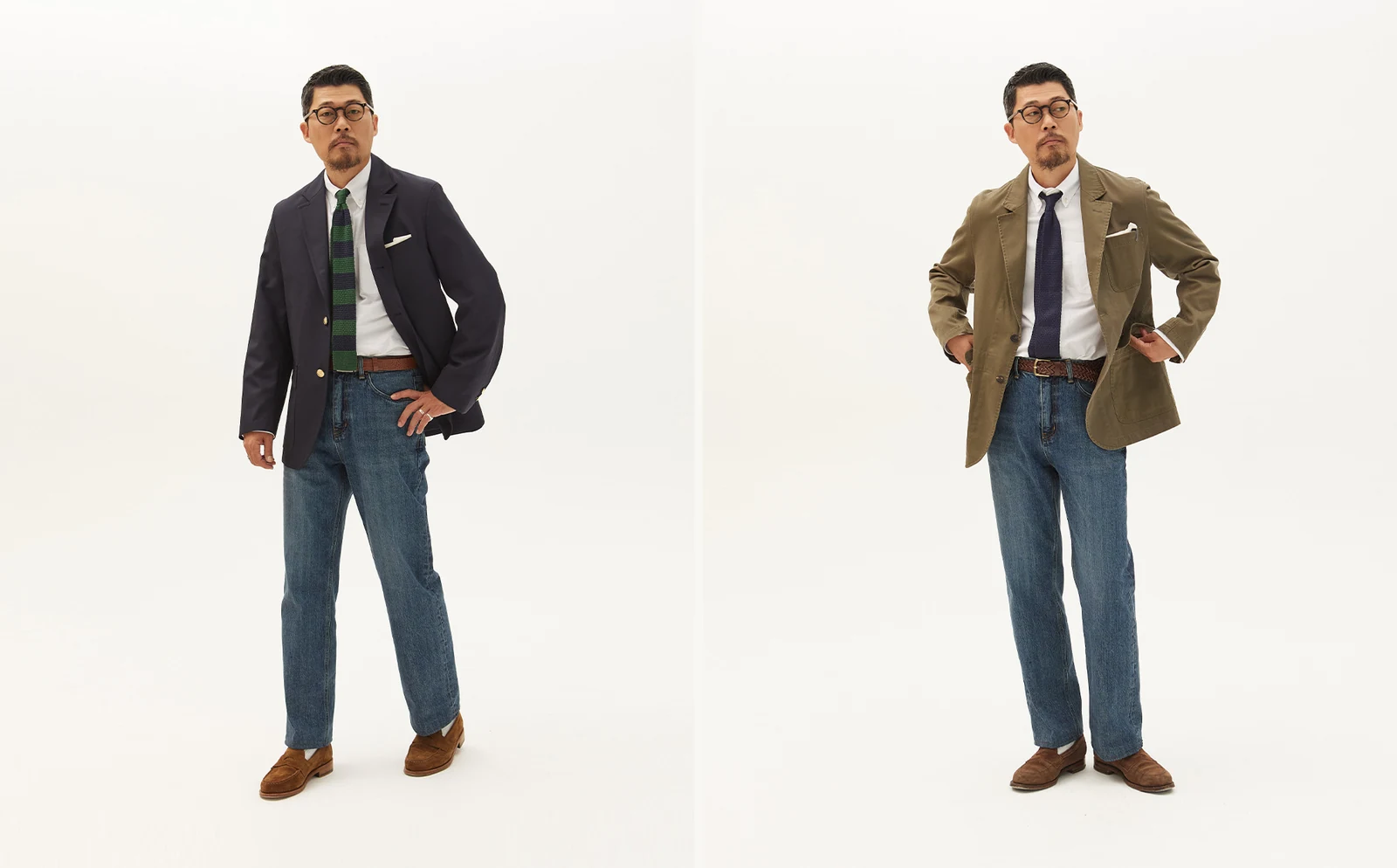
Same outfit base, two different blazer registers. Gold-button navy (left) is the canonical Trad club move — exactly what you wear to dinner. Olive blazer (right) bends the register toward sporting and heritage — exactly what you wear to lunch. The pants are the constant; the blazer is the dial.
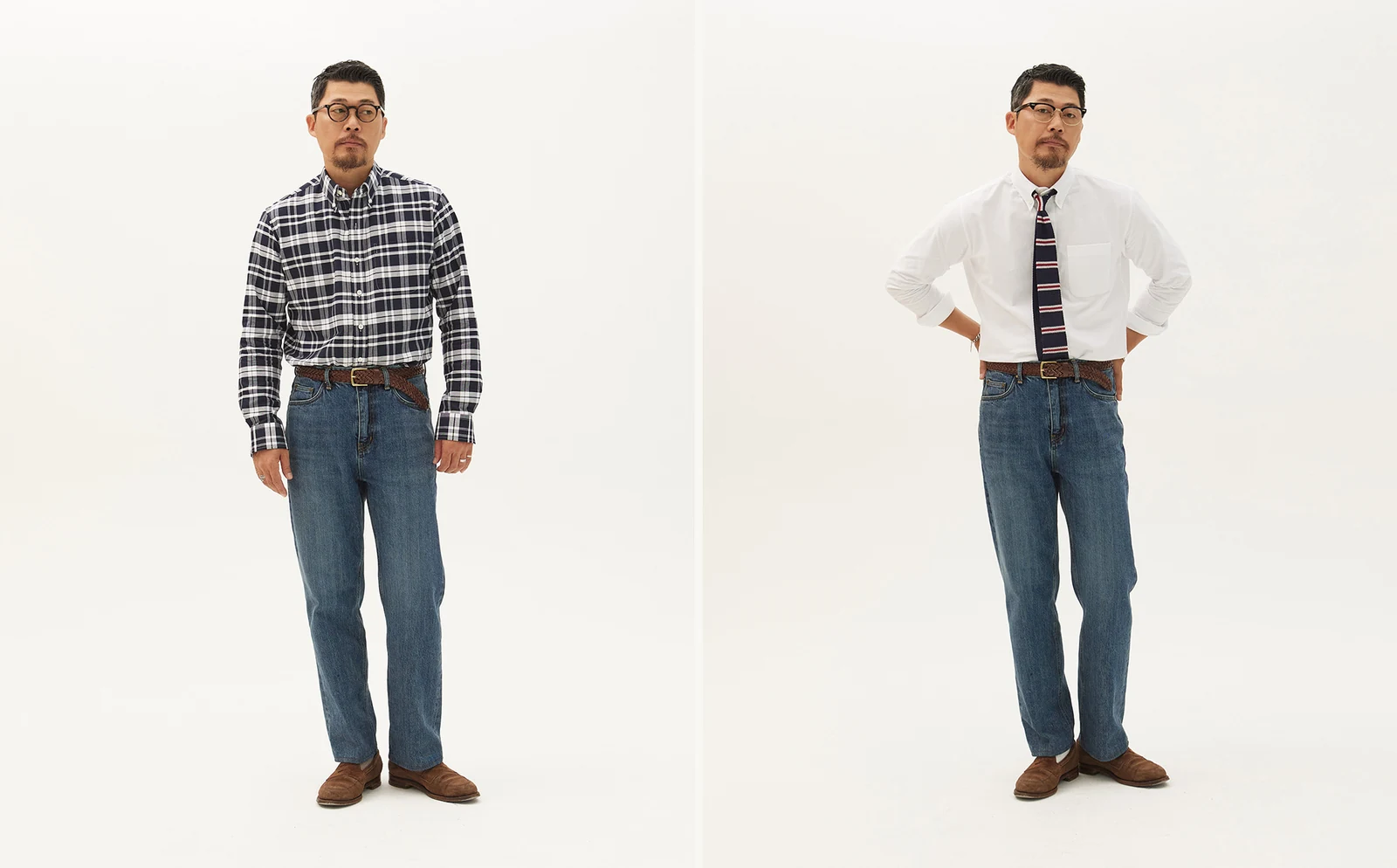
D.Blue Cat without a jacket. Madras shirt (left) for summer; OCBD + knit tie (right) for transitional. Suede penny is the through-line — the shoe that lets D.Blue Cat work whether the shirt is bright cotton plaid or quiet button-down oxford.
The full heritage-casual register on D.Blue Cat. Brown harrington + crewneck Aran cable + OCBD + brown suede derby — every layer earns its place, and the cat-brushed pants ground the outfit so the knit doesn’t read as costume. This is the look you build a Saturday around.
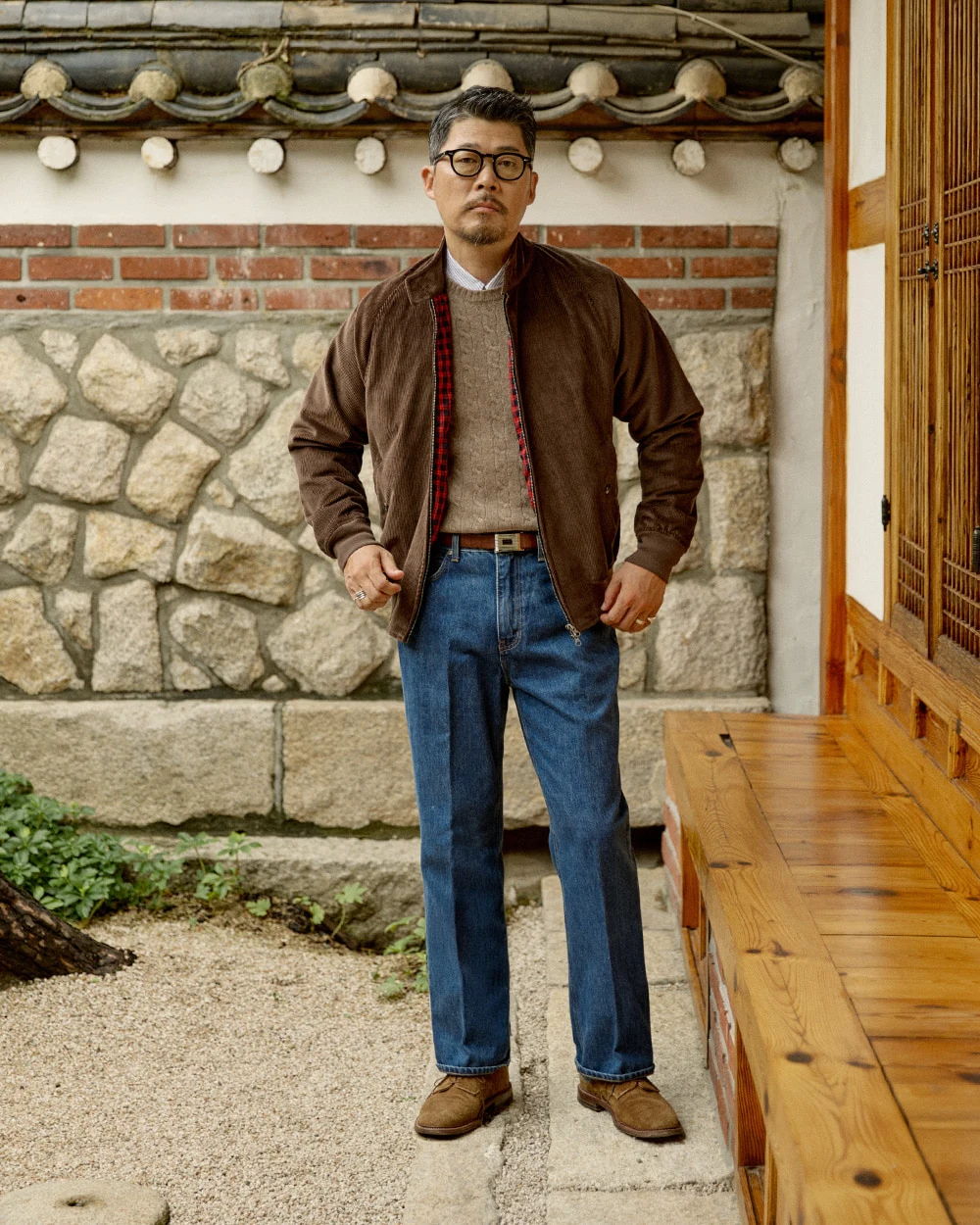
M.Blue Cat & L.Blue Cat — The Cat-Brushed Mid Register
Two cat-brushed variants on the lighter end of the register. M.Blue Cat reads as a one-year-worn 501; L.Blue Cat as two years worn. Pick by how much fade you want pre-built — neither is wrong, but they signal different things. M.Blue Cat carries blazer-and-tie pairings; L.Blue Cat is more weekend-leaning.
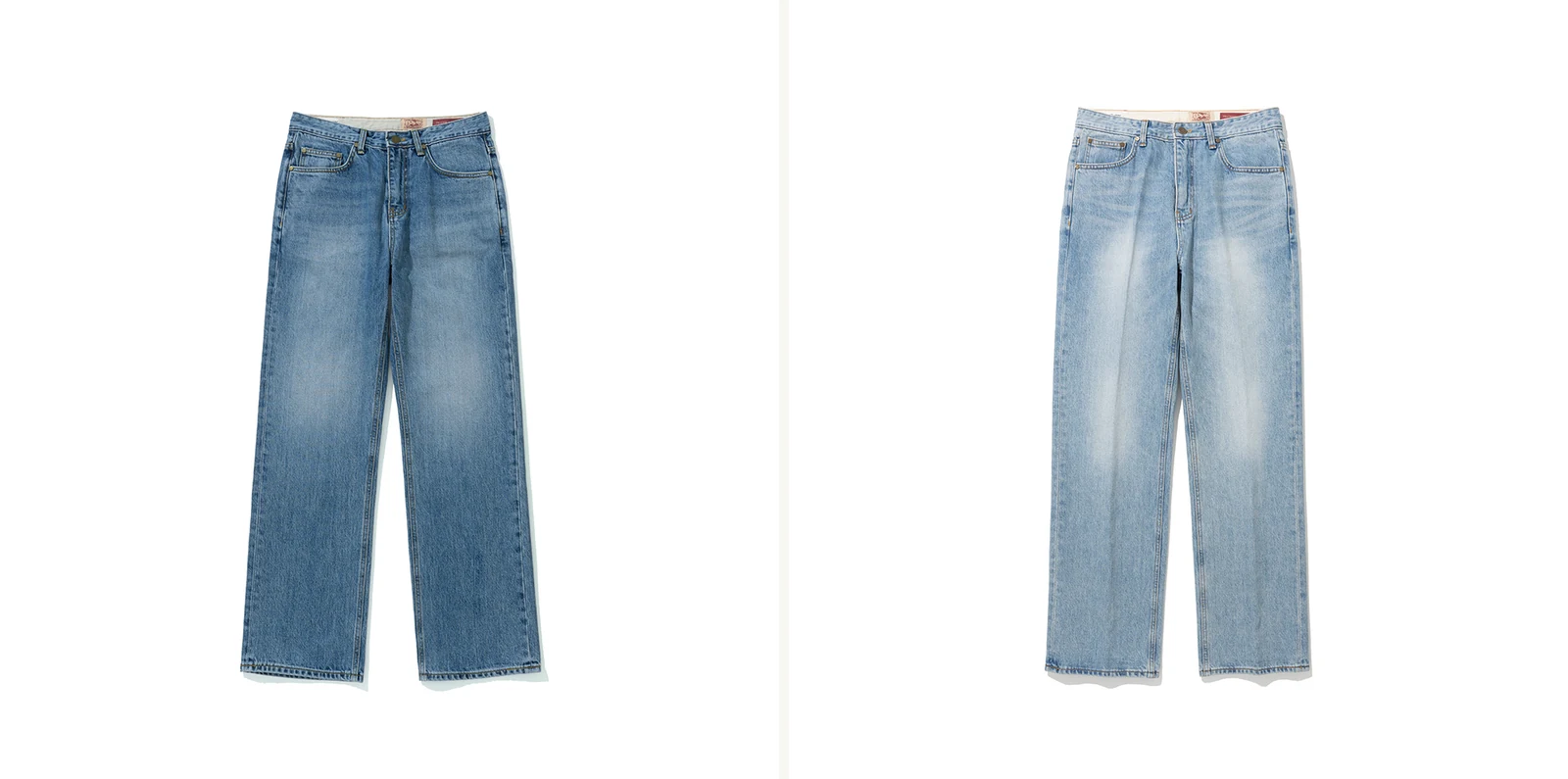
M.Blue Cat with navy blazer, two takes. Horn-button (left) for office; gold-button (right) for club. Same OCBD + knit tie + suede penny base. The blazer button is the only switch — and that switch is the entire difference between a Tuesday meeting and a Friday drink.

Madras with M.Blue Cat. Navy blazer over madras (left) tames the pattern enough for a restaurant; without the blazer (right) is the actual summer register — the look you wear walking to the bar in July, when adding a jacket is a heat decision rather than a register decision.
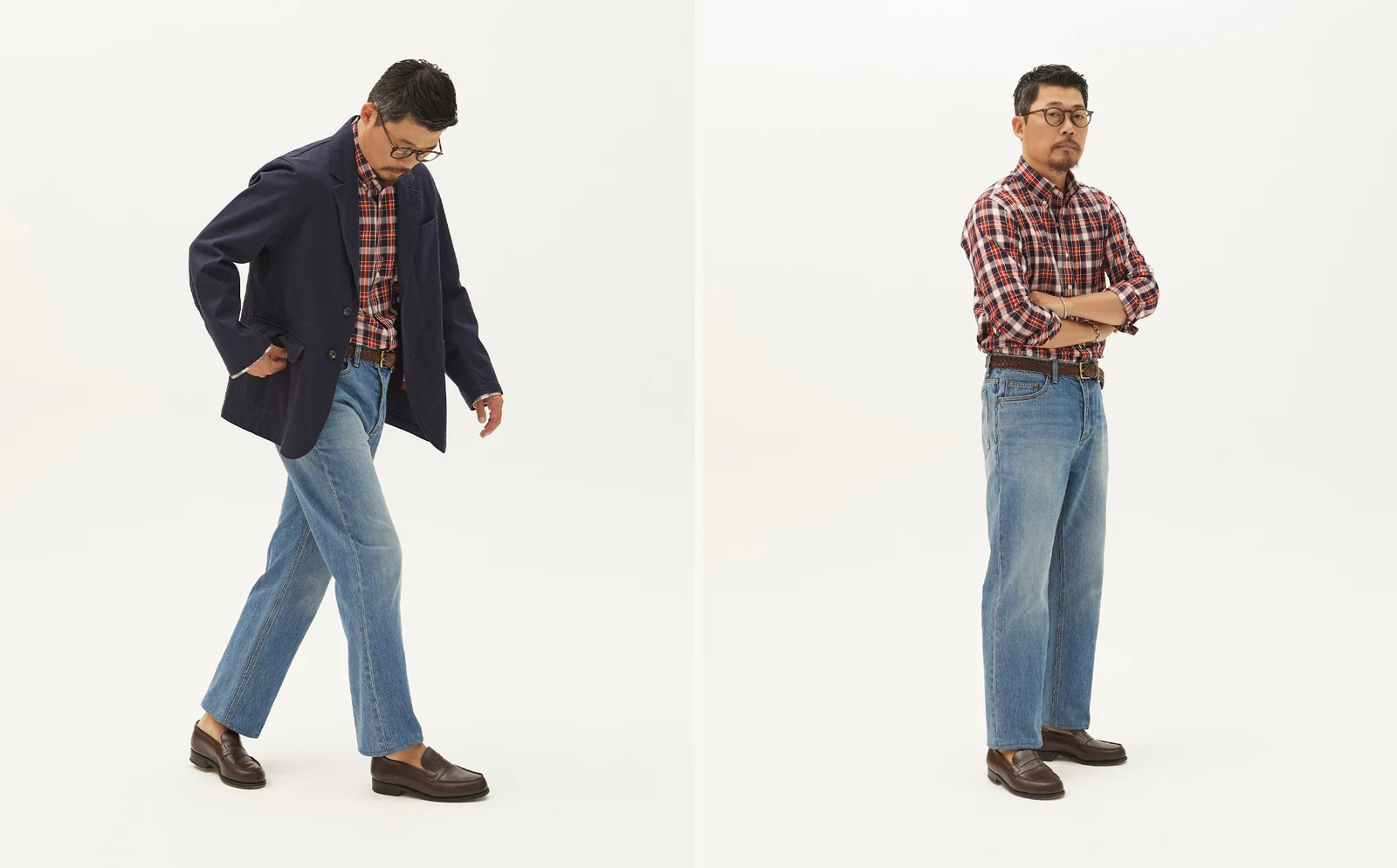
The cross-series move: M.Blue Cat with reverse-weave sweatshirt over OCBD + suede chukka. Reads as 1965 Princeton dorm room — except the chukka adds a register up. For the sweatshirt context, see the reverse weave construction guide.
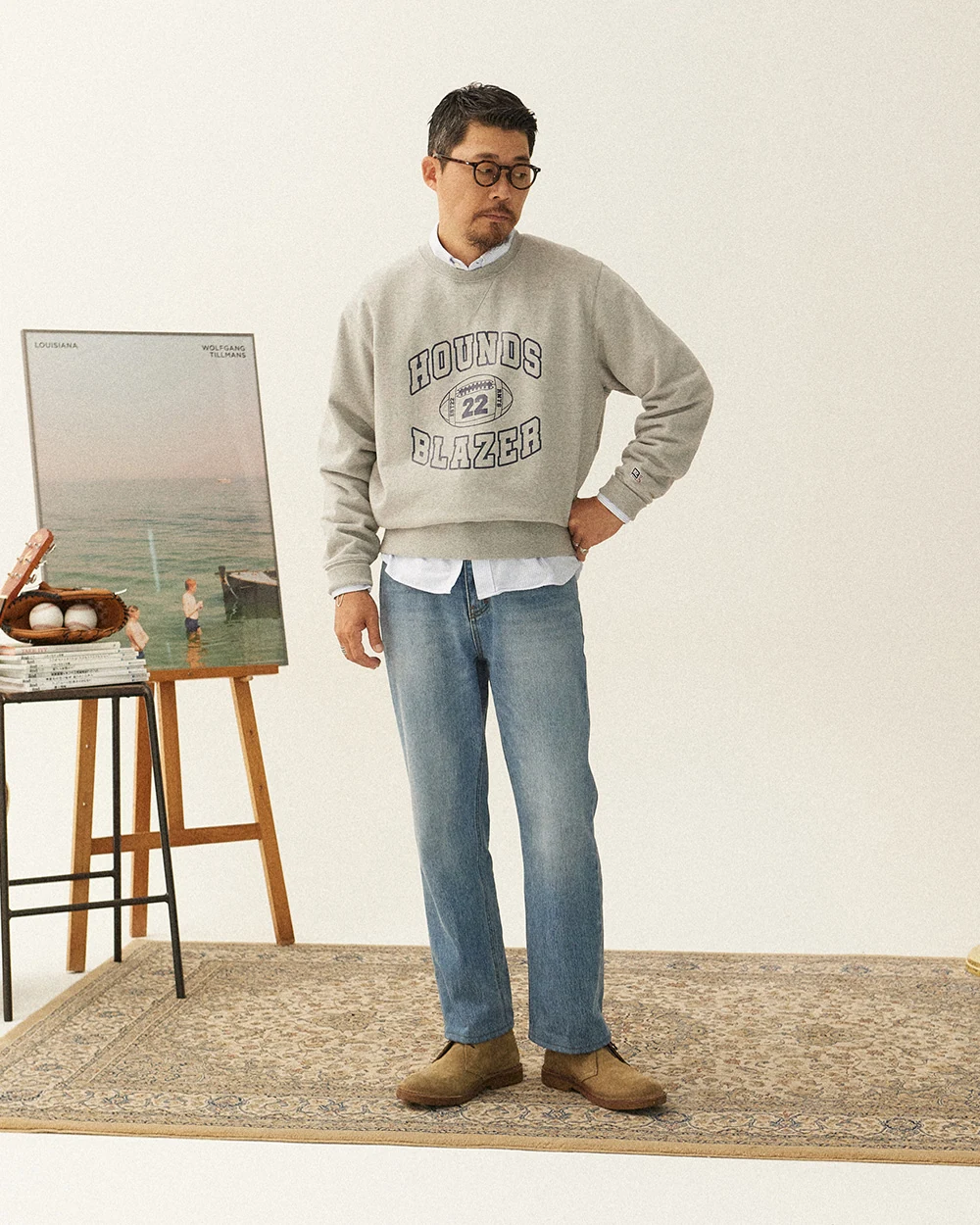
L.Blue Cat + sweatshirt + OCBD, two shoes. NB 990v1 + ball cap (left) reads weekend campus-rugged — the modern Trad answer to running errands. Suede penny (right) lifts the same outfit a register without changing anything else. Same pants, same knit, same shirt — different shoe, different afternoon.
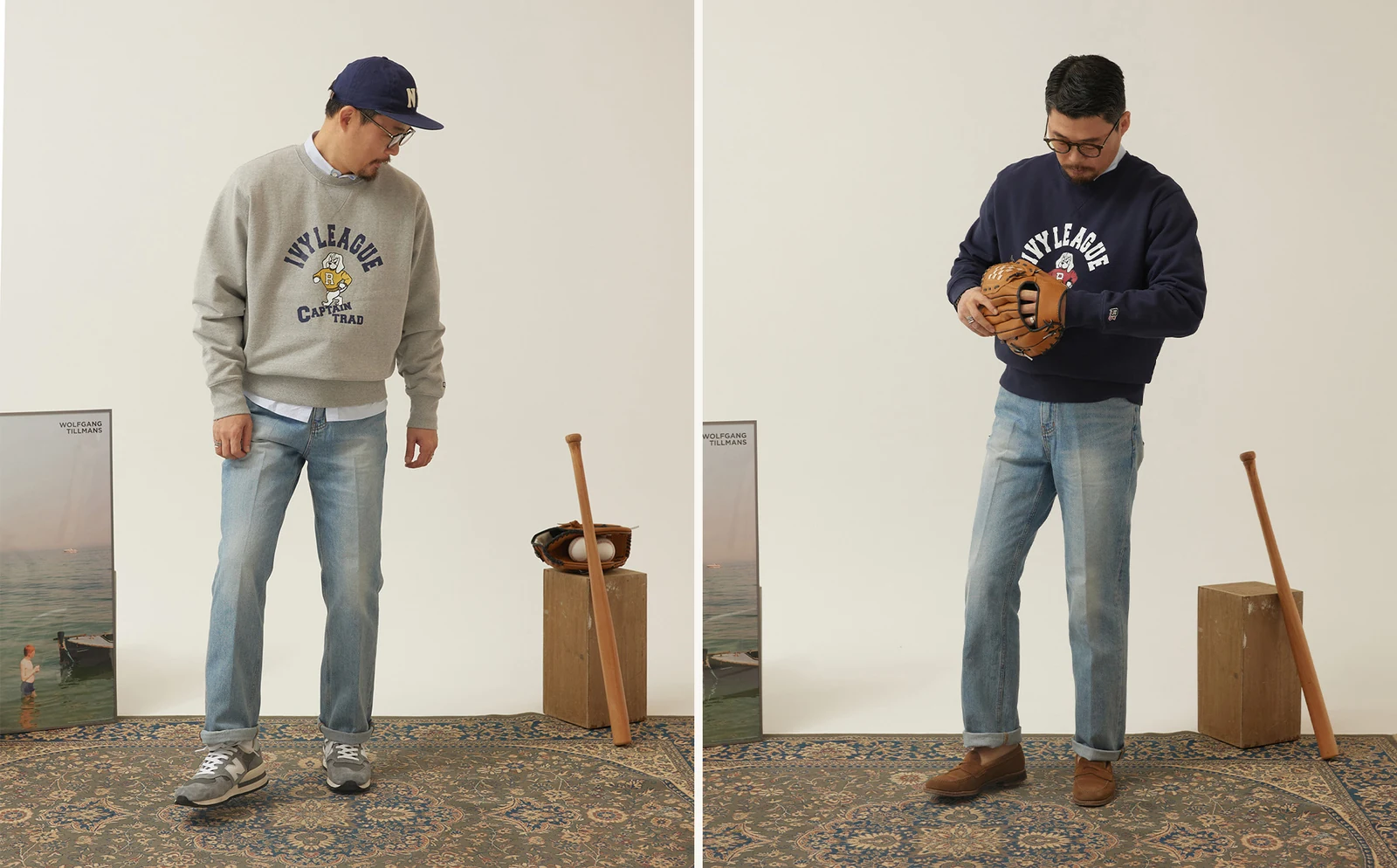
Two outerwear treatments on L.Blue Cat. Harrington over sweatshirt (left) is the rugged register — the weekend-tailgate register. Olive blazer (right) flips the same pants smart — the modern Seoul cocktail register. Suede penny carries both, which is the L.Blue Cat thesis: one shoe, full register.

L.Blue Cat with navy blazer + madras + suede penny — summer cocktail register. The light fade keeps the outfit from getting heavy in July humidity, and the madras signals the season without the blazer needing to be linen.
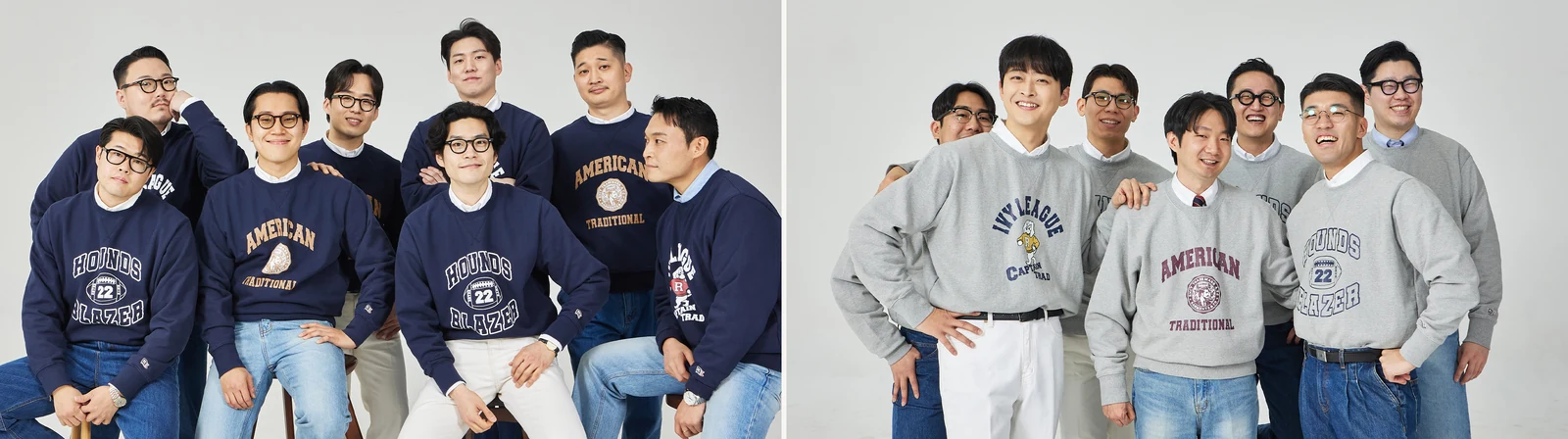
The two photographs below collapse all of the sweatshirt-plus-denim work above into a single team frame. Same Renacts collegiate graphics — Hounds Blazer, American Traditional, Ivy League Captain Trad — across navy and grey crewnecks, paired with whatever trad denim color each member happens to be wearing that week. The register is consistent enough that the whole group reads as one outfit, even though no two are identical.
Black & Cream — The Edges of the Register
Black and Cream sit at opposite ends of the trad denim spectrum and exist for opposite reasons. Black is the smart-casual register — the only non-indigo color that reads as deliberate rather than trend-cycle. Cream is the summer light register — the trad answer to why white jeans are too much.
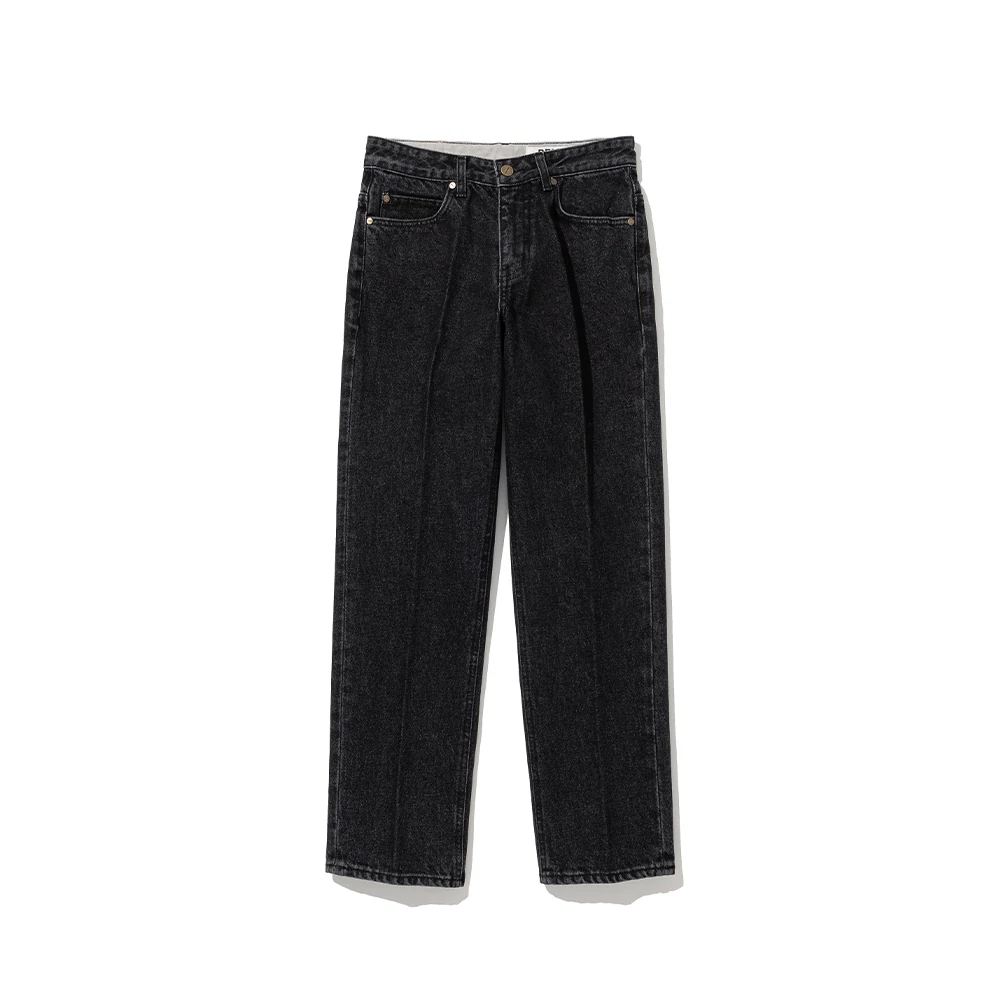
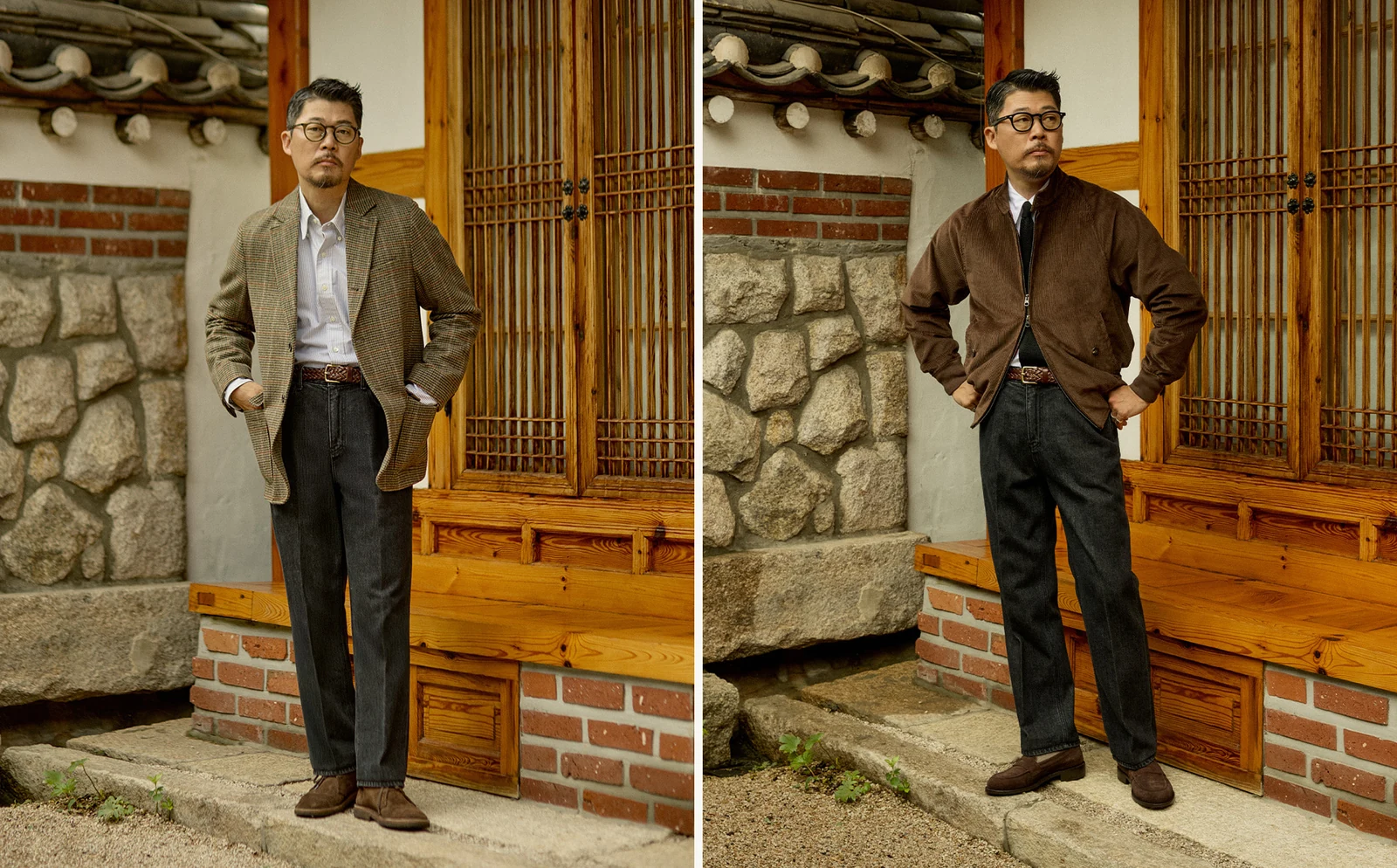
Black trad denim with two jackets. Gun club check + desert boot (left) reads autumn-academic; brown harrington + OCBD + black tie + suede penny (right) is the after-six version. Black denim with a black tie + brown leather is the move that sells the outfit — it doesn’t read as goth and it doesn’t read as menswear-blogger.
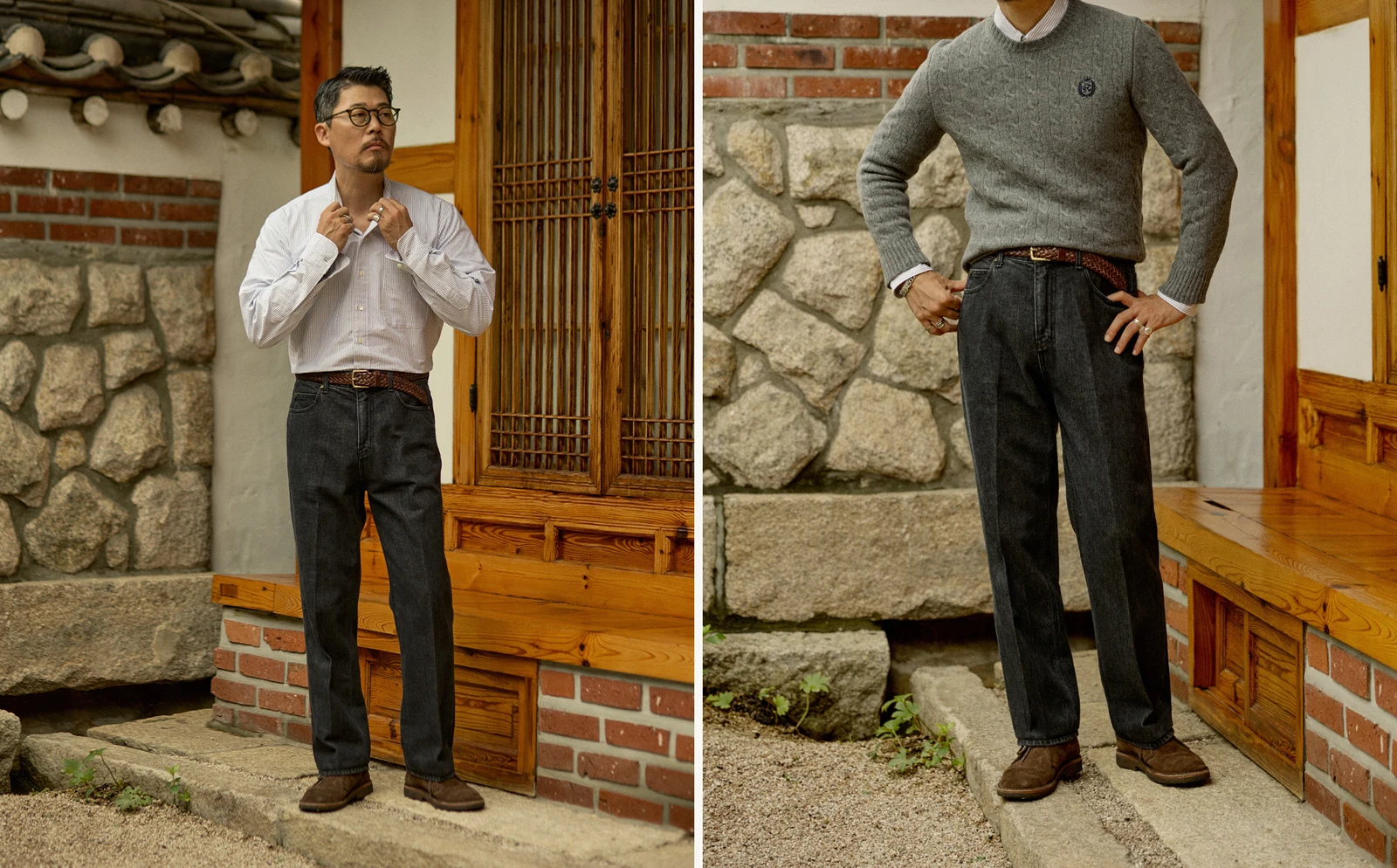
OCBD + desert boots base (left); crewneck cable added (right) — the only difference between the two looks. This is how a single knit layer changes the temperature of black trad denim from weekend-casual to coffee-meeting-considered.
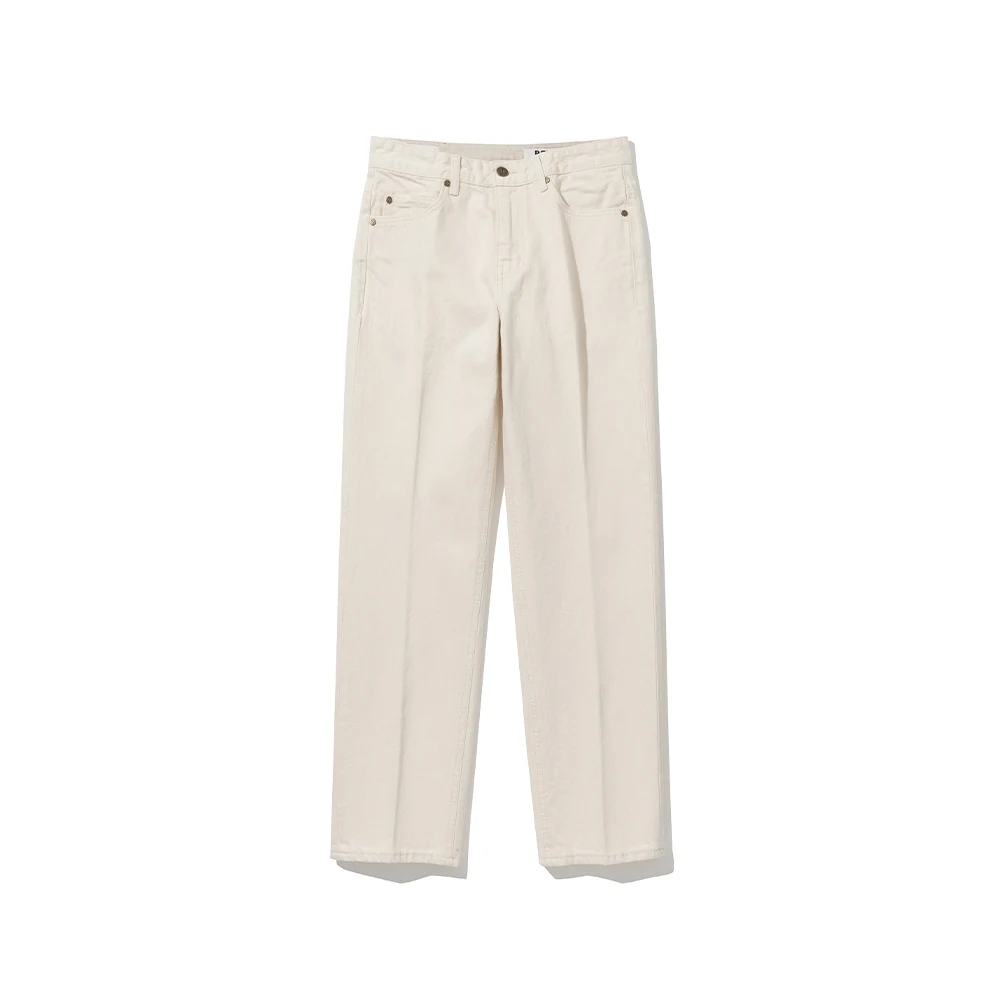
Cream’s range, two looks. Navy gold-button blazer + OCBD + knit tie + brown penny (left) is the summer-restaurant register — what you wear when the dinner is air-conditioned. Madras + suede penny (right) is the porch-weekend version — what you wear when it isn’t. Same pants, two summers.

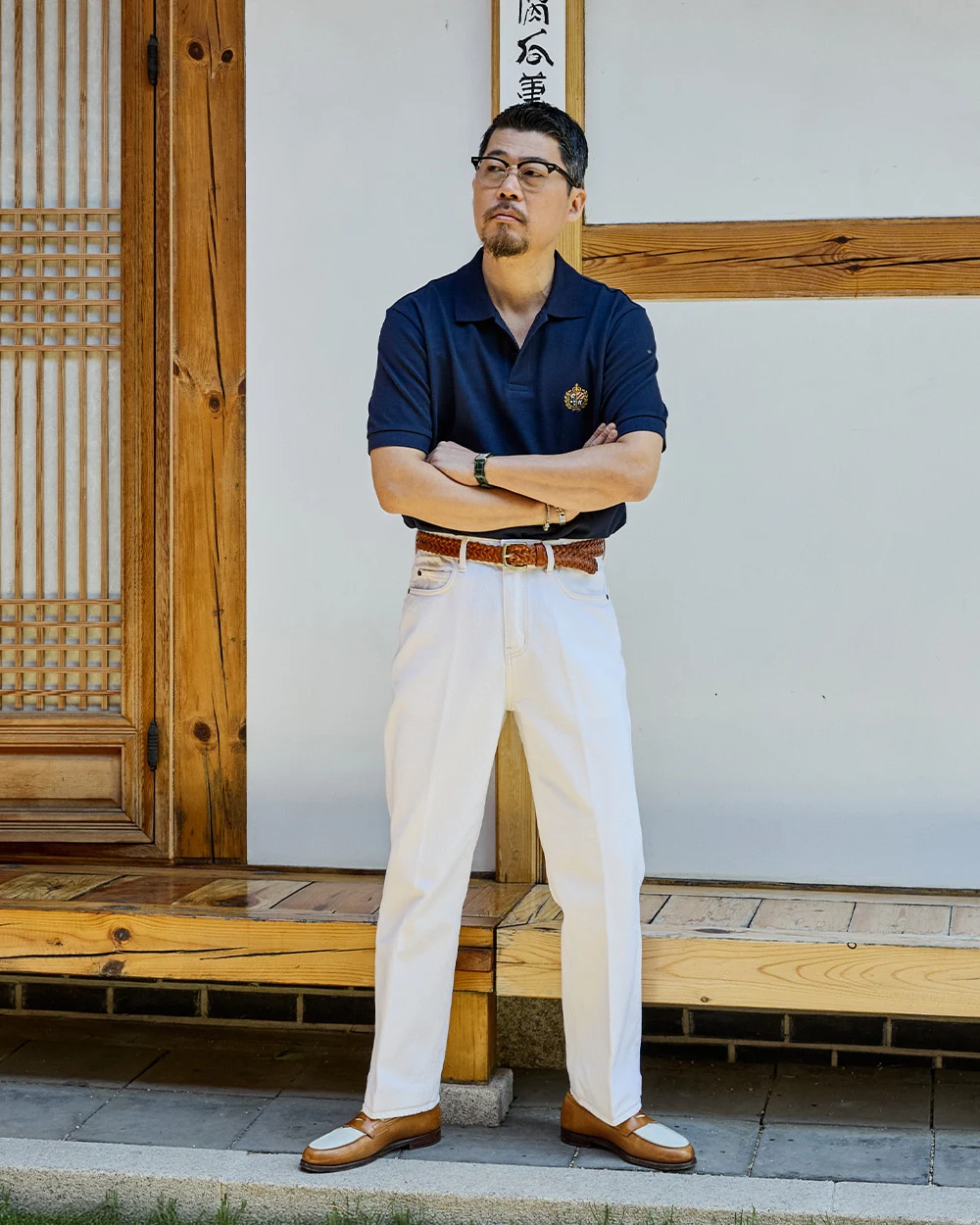
Cream + navy pique polo + spectator loafer. The summer country-club register, distilled to three pieces. The spectator loafer is the only piece that’s hard to find done well; the rest of the outfit is the cleanest trad denim summer move on this page.
Worn as a Set — The Renacts Team Register
Every photograph in the lookbook above shows one person in one color. The two below show what happens when an entire team commits to the same trad denim register — and what kind of visual consistency comes from holding eight colorways inside one cut philosophy.

Eight team members, eight different blazer-and-jacket combinations — red harrington, brown chore, navy hopsack, gold-button blazer, charcoal — over collegiate sweatshirts, over trad denim in indigo, D.Blue, M.Blue Cat, L.Blue Cat, Cream. Nothing matches; everything coheres. That is the trad denim register working at the group scale: the cut and the color vocabulary are constrained tightly enough that personal expression — what jacket, what knit, what shoe — never breaks the visual through-line.
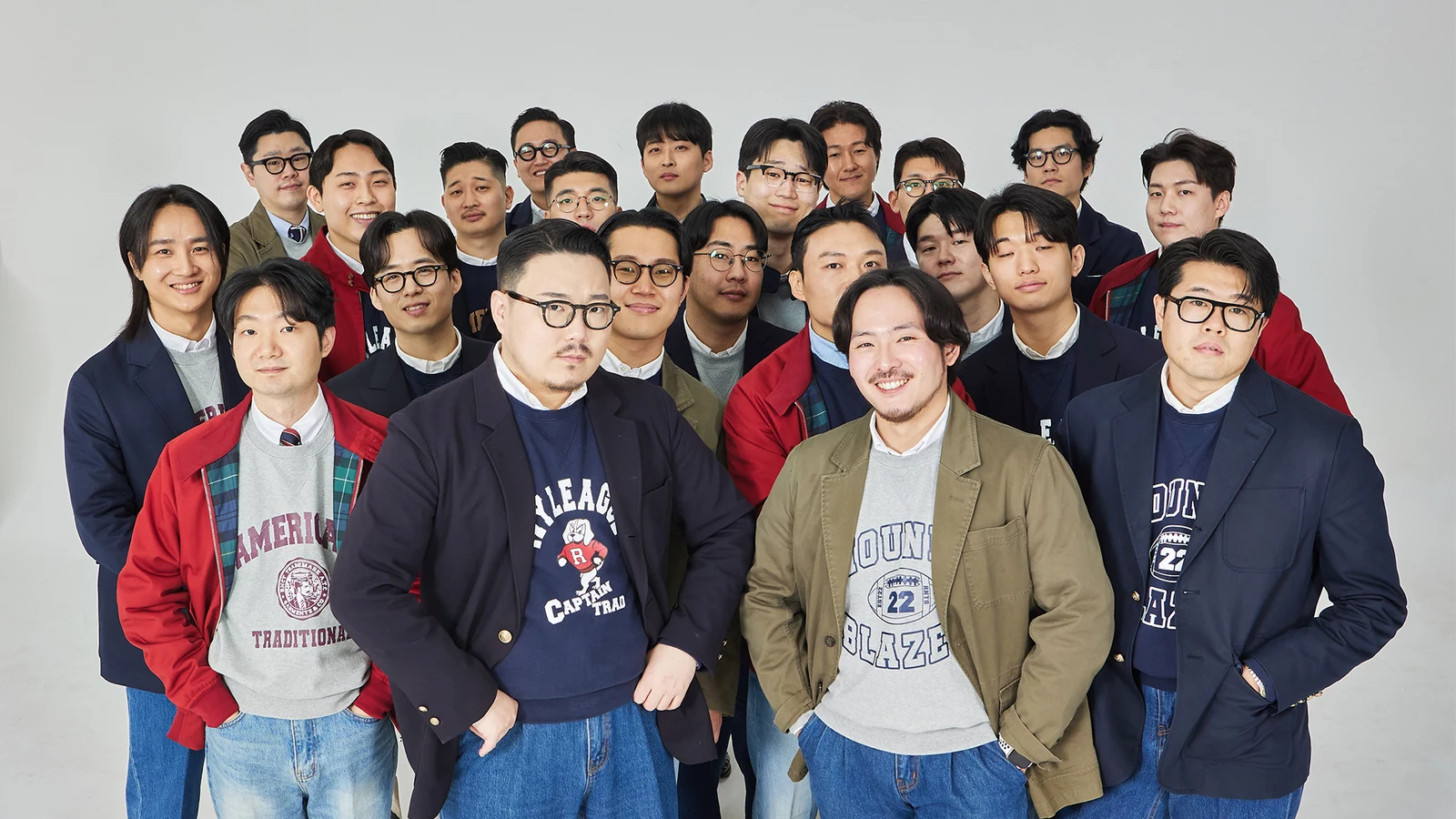
Twenty-plus team members in the same frame. Every jacket variant in this lookbook — gun club check, glen check, harrington, corduroy blazer, gold-button hopsack — and every sweatshirt graphic Renacts produces — Hounds Blazer, American Traditional, Ivy League Captain Trad — over trad denim ranging from raw indigo to ecru cream. The registers we walked through one color at a time live here as a single brand uniform. This is what the lookbook becomes when more than one person commits to it.
The takeaway is the L.Blue Cat lesson at scale: pick the color that fits your year, build the outfits the lookbook describes, and the register holds — even when ten people next to you are wearing different colors of the same register. Trad denim is one of the few menswear vocabularies where committing to the rules makes you look more like yourself, not less.
Why It Still Matters in Seoul
Trad denim translates to Seoul better than most American registers because the city’s weather mirrors New England’s: a long humid summer where Cream and L.Blue Cat earn their place, a transitional spring and fall where M.Blue Cat and the cat-brushed variants carry, a winter cold enough that Cone Mills 14 oz selvedge actually earns its weight under a tweed jacket. The fade you build walking Hongdae and Itaewon develops the same honeycombs and whiskers a 1960s Yale junior built walking from Battell Chapel to Mory’s. Geography changes the backdrop; the trad denim ages on the same physics.
What does change in Seoul is access. Cone Mills selvedge fabric is closed inventory since White Oak shut in 2017 — Renacts is one of the few brands sourcing the remaining yardage and finishing it with the chain-stitch hem and bronze rivet detail that lets the jeans fade like a vintage 501 rather than a fast-fashion replica. Eight colorways, one silhouette family, the same Cone Mills base, and a team committed enough to wear the lookbook as a uniform. The Seoul Trad position: pick the color that fits your year, wear it the next ten.
For the rest of the Ivy register — sack suit, OCBD, cinch-back chino, reverse weave — start at the Ivy Style guide. For the heritage context, Levi’s 501: The 1873 Patent. For brand-by-brand picks beyond Renacts (Levi’s 501 STF, LVC, RRL, Buzz Rickson, Sugar Cane, 3sixteen, Real McCoy’s), 17 American Vintage Brands Every Trad Collector Should Know.
The denim in the line: